I am at pains to stress I don’t work as a fortune-teller. I work as an adviser, working to a brief, and I offer forecasting within a specific context, because otherwise, who am I reading for exactly? And I aim to deal in relevant specifics wherever possible.
Context is key for meaning, relevance and precision.
However, I also like to challenge myself. General ‘scrying’ of ‘the’ future, Nostradamus style, is part of a very ancient tradition, and I sometimes work with a well known astrologer, Jessica Adams, writing as a guest contributor for a monthly feature, Tarot Tuesday at JessicaaAdams.com.
The challenge is to pick just one card, and share my intuitive impressions triggered by this card for the coming month. But without benefit of any other context than this loose time frame. One or two other Tarot card readers also write up their one card readings for the month to come, and Jessica then correlates these Tarot findings with current astrology.
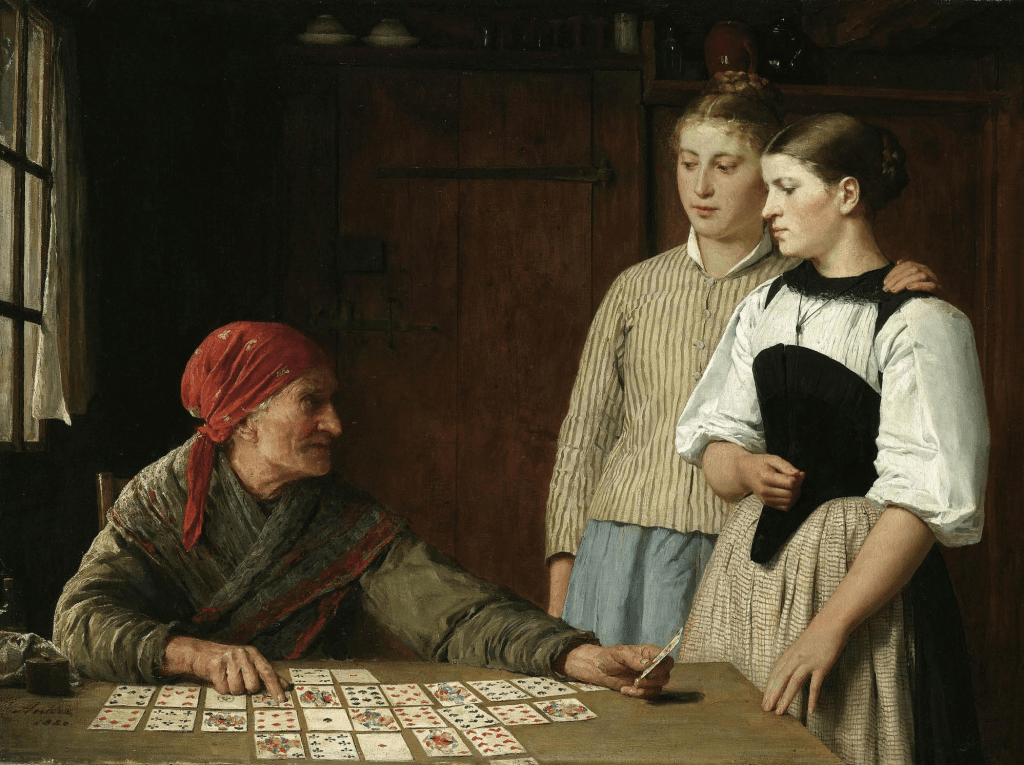
Artist Albert Anker 1880
My chosen card for this February 2020 was the Six of Swords.
Book meanings: relocation, progress, exploration, charting a new course, mourning, travel by water, self determination, east
From the Legacy of the Divine Tarot, Image by Ciro Marchetti.
Lick your finger, hold it up…what is the prevailing wind?
Winds are changeable of course, from day to day, even hour to hour, but still, it has been interesting for me as a reader, to correlate my previous one card ‘crystal ball’ readings with events of the ensuing month.
An earlier one card reading said ‘wild fire,’ (you can see previous readings via the link provided below) and it is still playing out, tragically; particularly the Australian wild fires, of which the first were actually in September, and now it is known that several of these were started deliberately.
These single card readings are actually drawn 2-3 weeks ahead of publication, so that I am drawing a card mid January for the first Tuesday in February, and mid February looking ahead to the first Tuesday in March and so on.
Logically, none of it ought to make any sense at all, unless by sheer coincidence. Except that isn’t how it works, when it works.
It works on animal sensing.
Click below to read February’s Tarot Tuesday feature, courtesy of Jessica Adams.
There are many depictions of animals and birds in the Tarot. They form a great part of the human landscape physically, intellectually, emotionally, spiritually, and symbolically. If there’s a heaven, what would it be without them? I wouldn’t mind, personally if mosquitoes, maggots, deadly snakes and komodo dragons didn’t make it. Spiders would be all right as long as they were non-venomous and less than two inches in diameter. However, it’s not me in charge.
The songbird traditionally most associated with Christmas, or to give the winter festival its older name, Yuletide – is the robin redbreast. The cheeky, dumpy little European robin, Erithacus rubecula is a member of the flycatcher family.
Its preferred habitats are woodlands, hedgerows, parks and garden. Its staple diet is worms, seeds, fruits and insects. It will fight over sunflower seeds and it adores…
Most of us know our zodiac or sun
sign, but what does it look like in the night sky, and what’s the story behind
it? This month it’s the turn of Sagittarius.
Common associations
Symbol:
Date of
Birth: Nov 22 to Dec 21
Ruling planet: Jupiter
Element:Fire
Key phrase: I seek
Body: Thighs
Birth Stone: Topaz, Citrine, Turquoise
Colour: Light Blue
Tarot card: Temperance
Public
Domain: Rider-Waite
The Astronomy
As with all of the Zodiac constellations, Sagittarius was recorded in the 2nd century by the Greek astronomer Ptolemy. The name is from the Latin for archer.
Sagittarius is a relatively large constellation which is mainly
visible in the southern hemisphere. In the Northern hemisphere the
constellation can be viewed low on the horizon from August to October. In the
Southern hemisphere Sagittarius can be viewed from June to November. Star maps
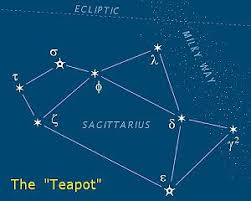
generally depict Sagittarius as a vaguely teapot-shaped star pattern or asterism.
Sagittarius is near the centre of our spiral galaxy, the Milky Way. There is a massive star-forming region known as the Omega Nebula situated within its boundaries and Sagittarius is also home to the Pistol Star, one of the brightest stars, the fifth brightest discovered in the Milky Way. First discovered by the Hubble Space telescope in 1930, the Pistol Star is largely hidden in the dust of its own Pistol nebula, but is 100 times as massive as our Sun, and 10,000,000 times as bright.
Sagittarius
is the ninth sign in the Zodiac and represents those born between Nov. 22 and
Dec. 21.
Greek
myth saw Sagittarius the Archer shooting Scorpio the Scorpion, which had been
sent to kill Orion the Hunter.
Sagittarius has long been mixed and confused with another centaur story, Chiron of the Centaurus constellation. Most interpretations conclude that Sagittarius refers to the the centaur, Chiron, who was accidentally shot by Hercules with a poison arrow.
This story
does indeed refer to a constellation myth, but it’s the myth behind Centaurus,
a non-zodiac constellation, and not Sagittarius.
The myth
behind Sagittarius probably refers instead to Krotos, a satyr who lived on Mount Helicon with the Muses. Krotos
or Crotus was the son
of Pan and Eupheme, and his mother
had nursed the Muses.
Krotos was renowned for
being both an excellent hunter, horse rider and a devoted adherent of the Muses
and their arts. He is credited with having invented archery and being the first
to use illumination for hunting animals. He is also said to have introduced
applause, and used to clap his hands at the singing of the Muses, for whom this
was a sign of acclaim preferable to any verbal ones. It was the Muses who asked
Zeus to place him among the stars, which he did, transforming Krotos into the
constellation Sagittarius.
Satyrs have human heads and torsos with two goat legs (and sometimes horns). Centaurs have four but the accounts and depictions of Krotos vary. But all the same, he was often depicted with four legs, as the excellent horseman he was.
The
Astrology
Sagittarius
is the ninth sign in the Zodiac and represents those born between Nov. 22 and
Dec. 21. The archer is seen as a bridge between elements and worlds. The life
lesson is seen as Temperance, as pictured in the Tarot card associated with
this sign. The message is all to do with the quiet but enormous power of
moderation, the art of expert timing, and also self-control, avoiding extremes
and addictive behaviours.
The
Astrological Personality
There is no such thing in reality as THE Sagittarius personality
and the same goes for all the zodiac sun signs. Your sun sign is an archetype,
a keynote but of course it is not and never could be the whole story.
The archetype of Sagittarius is brave, lively, warm, optimistic, rational and insightful. Sagittarius zodiac sign subjects need constant adventures and opportunities to grow to remain interested. Freedom is of the utmost importance to them, space and plenty of room for manoeuvre. Likewise they tend also to give lots of freedom to their partners.
They are generally very capable people but they need career flexibility, and they may refuse or fail to apply themselves if bored. Like Gemini, they are prone to restlessness. They may then fail to stick at a job or a succession of jobs, and may struggle financially in consequence.
They tend to have lots of friends, and family and friends can
feel neglected at times when Sagittarius goes go off and travels and shares
experiences with strangers, but Sagittarians will always come home.




 True Tarot Tales