“When will we see blanket lifting of lock down? (Esp UK) Prev readings posted here & on my blog indicated sharp rise to 7 April, initial peak easing post 23 April with partial lifting. Wider lifting by/b4 c 21 June (during Cancer) Today’s cards show little change 2 that story.”
So what are these cards telling me?
9 Clubs: a heavy burden. We’re taking this to town, staggering beneath the burden. Stamina required, and a strong sense of duty, a card of physical and moral fortitude.
6 Spades: a slow and solemn journey into previously uncharted territory, scientific research, illness and a road to recovery. I drew this card in my posting here 6 April when Boris Johnson went into hospital, ‘for further testing,’ when I wrote that this looked very serious but his recovery was indicated by this card, although it might well take him 3- 8 weeks to feel fully recovered.
A nurse from the ICU in St Thomas’s hospital has recently told a news programme that there had been one night when Boris Johnson was in the ICU when it could have gone ‘either way’, something no-one told the public at the time – but speculation was rife and many guessed it was worse than we were being told.
Jack of Hearts: good news, healing, a baby, early summer. This is the hinge card in the reading and suggests June. Pages indicate beginnings (and births) while, keeping to the original question – when do we sense the blanket lifting of lock-down…this will be happening in stages. That is clear, but the Hearts suit is the suit associated with summer, the equivalent of the Cups suit in a tarot deck.
6 Diamonds: medical diagnostics. The timing of the lifting of the lockdown will depend on the data. And the interpretation of that data
2 Hearts. The suits indicate different speeds or time-frames. Diamonds is the fastest suit, and Spades is the slowest. If I’m asking when or how long and I draw Hearts, the time-frame is read in terms of weeks at the fastest, and in terms of months at the slowest. This suggests further selective lifting of the lock-down may be phased in or tested within the next two weeks but for the broader picture, since we are now at the end of April, this brings us to late June before the UK as a whole, is declared out of lock-down, though it is evident it will not be business as before.
Tweeted 16 March
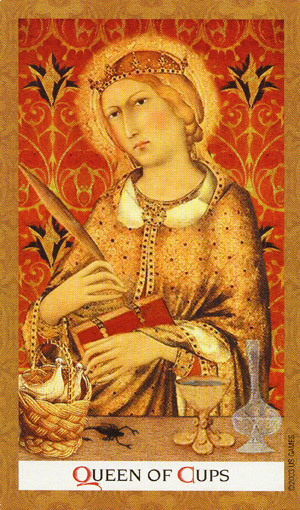
“Covid-19 UK via Tarot. Graph climbs- Full Moon 7/8 April- New Moon 23 April, peaked by late June-late July (the healing Queen Cups card = dates of Cancer) then post-peak phase till late Nov/early December 2020 (8 Wands Rx =Sagittarius) As ever naturally only Time will tell.”
The Queen of Cups from The Golden Tarot.
Seen on Twitter earlier today, a comment echoing that Full Moon date of around 8 April:
Professor Karol Sikora @ProfKarolSikora· The peak was around the 8th of April. Since then we have seen a gradual, but steady decline in fatalities. This isn’t blind positivity – the numbers tell the story. It’s been a horrific month, but we have got through the worst of it. Now we need to look to the future.
Professor Sikora directs us to a recent graph presented by David Paton tweeting as @cricketwyvern. He is Professor of Industrial Economics Nottingham University Business School
I may previously have muddled case incidence interchangeably with the lock-down, and right now I may feel less optimistic than Prof Sikora.
Yes, that heaviness, the feeling of dread is retreating even as the wailing rises. Yes, it looks set to improve in weeks rather than months, yes, the lock-down looks like it starts/continues in stages over the coming 2-8 weeks. Collectively we’ll be ‘out of jail June 21- July 21, some of us much sooner, but we’ll need to stay on guard for quite some time to come…I feel that could be next February/March 2021.
We can all see this is a particularly horrible virus, a Frankenstein creation, natural yet unnatural, born out of unimaginable suffering, whatever the chain of provenance between live animals in the Wuhan market, wild and domesticated, and an accident in a nearby lab.
As an instance of a genie let out of a bottle, or a demon, or bad karma, this could hardly be worse, though we’ve seen it before in other places, as with with the horrors of CJD for example after cattle were fed bone-meal…herbivores were fed BONE-MEAL from sheep infected with scrapie and farmers had not been told what was in that feed.
Covid19 has, some might feel, been rather too anthropomorphically characterized as malign and malevolent. It behaves with apparent cunning, determination and subterfuge. As to its sentience, we assume a virus has none, but it demonstrates a drive, it has particular modes, it seems likely that it can mutate, and it has an agenda, the same as we do arising at least in part from consumption of bats which like many rodents, have a truly ancient and for them, largely benign history with coronavirus, and the illegal hunting of endangered species such as tigers and pangolins for food or traditional Chinese ‘medicine.’.
Lords of the Atlas, but it is not ours to rule.
Back to the original question: it still looks as though the situation will be judged sufficiently manageable that the general present lock down is significantly lifting or lifted by or before late June-into July.
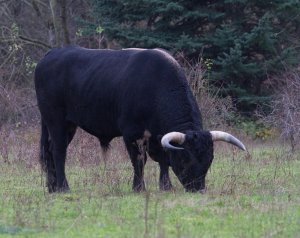
Taurus Symbol The Black Bull by George Bellows 1919
Common Associations
Dates: April 21-May 21 The cusp is April 19/20
Element: Fixed earth (mid spring)
Ruling planet: Venus
Body: neck, throat, tonsils
Birthstone: Emerald
Metal: copper
Flower: the Daisy; innocence, sanctity
Tree: the Apple Tree; youth, beauty, happiness, immortality. Avalon, resting place of King Arthur went was the ‘isle of apples’
Colours: pastel blue, green, pink
Famous for: strength, stamina, stubbornness, practicality, thoroughness, duty, honesty, sensuality, money sense, a pleasant speaking voice, artistic/singing ability, green fingers, good cooking, independence
Tarot card: The Hierophant- Tradition, Received wisdom, Books
Astronomy
Wiki
Taurus (Latin for Bull) is a large and prominent constellation between Aries to the west and Gemini to the east. It ranks 17th in size of the 48 Greek constellations recorded by Ptolemy in his introduction to the Mathematics of the Heavens, the Almagest, written AD 150.
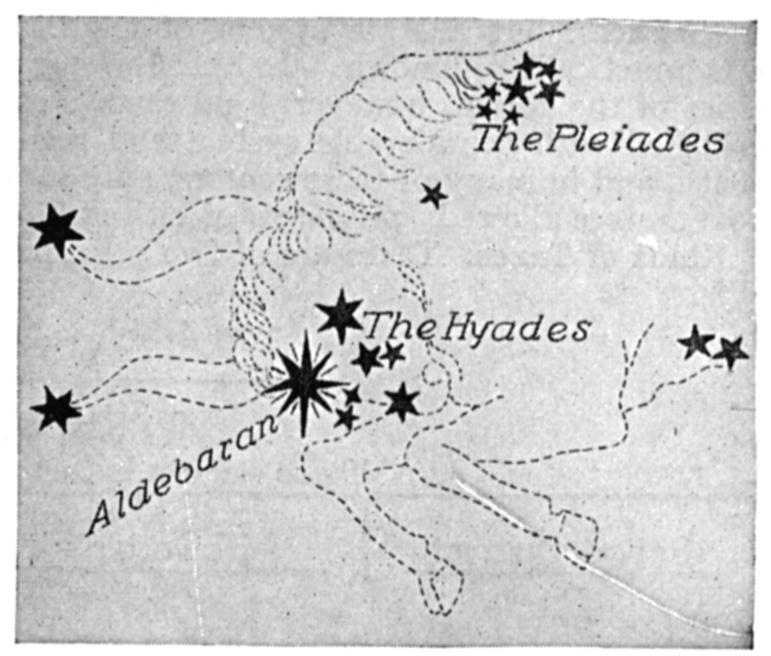
The stars of Taurus depict the face, horns and forepart of the bull’s body. His face is made up of a triangular cluster of stars called The Hyades. There are no legs. The bull is imagined half submerged. He is the mythical Bull from the Sea. A second cluster of stars, The Pleiades, known as The Seven Sisters, swarm like bees above his back.
The best time to observe Taurus in the night sky is during the months of December and January. By March and April, you might see it in the west in the twilight.
To find Taurus first the three stars of Orion’s belt. That’s usually easy on a clear winter’s night. Now look up to the right, looking north- east, See that bright orange-red star? That’s Aldebaran, ‘The Follower,’ a red giant, the biggest, brightest star in the constellation, the red eye of the Bull, glaring in the direction of Orion.
Should the Bull escape his heavenly pen, said an ancient Arabic legend, he would stampede the universe to pieces, and it would be the end of things for all time. Let’s hope nothing upsets him.
Wiki Commons: the horns, face and the giant red star, Aldebaran, the Eye of the Bull, glaring menacingly in the direction of Orion the Hunter
Taurus has been recognized as a sky bull since at least the Early Bronze Age. Historians think the figure of a bull was first discerned in the stars by the Sumerians around 3000 BC and was recorded in cuneiform by the Babylonians.
Ancient History
In modern astrology Aries is the first sign of the western zodiac, ushering in the spring (vernal) equinox along with the first lambs.
However, 4000 years ago it was Taurus, not Aries that coincided with the vernal equinox, and for Babylonian astronomers Taurus was the first sign of the Zodiac, ‘the Bull in front,’- leading from the front.
The Bull was also the first sign for the early Hebrews, who called it Aleph, as in A, the first letter of the alphabet.
Taurus coincided with the start of the calving season.
The bull, like its ancestors, the wild aurochs, is a potent symbol of strength and fertility, but where Leo the lion, represents wild strength, Taurus the bull is domesticated, controlled strength, as harnessed in oxen or a bull with a ring through his nose. One of the several archetypes associated with Taurus is ‘The Farmer,’ and many a bull has worn a ring through its nose for the sake of the farmer’s safety. The dairy bulls, breeds such as the Charolais for instance, are especially to be handled with care where the famous black bulls used in bullfighting are by comparison, more easygoing.
The bull has exerted a magical influence on human imagination even before the dawn of agriculture. Aurochs, the fiercer, wild ancestors of the modern bull, were painted in the Lascaux caves in France, in paintings thought to date from 15000 BC.
The most famous section of the Lascaux caves in the Dordogne in France is the Hall of the Bulls, featuring four black bulls, or aurochs. One of the bulls is 5.2 metres (17 ft) long, the largest animal discovered so far in cave art.
It is thought that the aurochs migrated at this time of year; a dangerous but potentially highly rewarding hunting opportunity. Not only did the aurochs provide the luxury of meat, but the horns and hide had many uses.
Lascaux
Hunting gave way to farming of animals, guaranteeing supplies with less risk attached. The first ever cattle, goats, sheep, and pig- farming began in the so-called ‘Fertile Crescent;’ a region covering eastern Turkey, Iraq, and south-western Iran about 12000 years ago.
These farming practices spread westwards, and in time had a genetic effect on the human population, with the sudden appearance of a gene mutation that enabled humans to digest raw cow’s milk. It’s not known when this first occurred, but it probably happened first in Northern Europe and today 35 % of the global human population can digest the milk sugar, lactose. Click on this link to find out more on this subject.
The Cult of the Bull and related Worship
Bull Leaping in Knossos
The bull was considered a divine animal throughout antiquity and was a symbol of the moon, fertility, rebirth, and royal power, while today, the Lithuanian word ‘taurus’ means ‘noble.’
There is evidence of bull cults throughout the Mediterranean starting in Anatolia, dating from at least 70000 BC. From the worship of the Apis bull in Egypt, to bull-leaping in Knossos and the sacrificial portrayal in Roman Mithraism, the bull has been an integral part of many diverse and important religious traditions.
Greek legend associated Taurus with the legend of Zeus and Europa, in which the god Zeus, up to his sneaky tricks yet again, disguised himself as a beautiful, gentle white bull, coaxed the princess Europa into climbing on his back, then abducted her, swam away with her to Crete, and made her one of his mistresses. The many gifts Zeus gave Europa included a pet dog that later became the constellation Canis Major. Their children supposedly included Minos, King of Crete, the builder of the Labyrinth and the famous palace at Knossos where the bull games were held.
Bull worship, or rather, the concept of the bull as divine concept gradually migrated ever westwards and northwards. The Celtic druids held Tauric festivals at least 2000 years ago, and there is archaeological evidence of bull worship near Newcastle and York in the UK.
The Buddha was born when the Full Moon was in Taurus (Vesak) and his birthday is celebrated at the Vesak Festival which occurs on the first Full Moon in Taurus.
Beware of the bull
Like the Bull himself, the classic Taurus subject, male or female, is generally peaceable, pleasant, even placid. But Taurus will not be disrespected, pushed or driven. Other people can get a shock when Taurus suddenly sees red …and they don’t give a lot of warning. The mistake of the other person was in underestimating them, taking their good nature for granted once too often.
Bulls cannot physically see red. It is the movement of the toreador’s cape that provokes them, and not the colour. But when the human bull ‘sees’ red, they either dig in hard, or may charge head on.
Taurus in a full-on rage is a ‘bull in a china shop’ – the Earth sign that will withstand or demolish the opposition of other more famous ‘fighting’ signs, Aries, Leo, and even lethal Scorpio, its opposite number in the zodiac.
Taurus doesn’t like to fight but doesn’t lose in a fair fight. The bull ring is not a fair fight; that’s the tragedy of Taurus. But if a Taurus is being unreasonable, misbehaving, or being a ‘bully’ quietly stand your ground. It should pass. Taurus is not at all vindictive as a rule.
But why upset the Bull? Look at him, quietly grazing. Taurus is not a saint, and can be difficult or grumpy sometimes, but he’s really not looking for trouble. Do as you would be done by, and everything should be buttercups and daisies in your everyday dealings with the Taurus subject, man or woman.
Last night we heard that the UK Prime Minister Boris Johnson went into hospital for ‘further testing.’
What does this signify?
Social media is a shocker. The sheer venom and schadenfreude of those sitting in judgement, ill-wishing another. There has been so much sad news already. We don’t need more, although more is surely coming.
For those declaring the PM caught it from flouting his own advice, speculation is rife, and it is possible Boris Johnson caught the coronavirus following a meeting with Michel Barnier, who subsequently tested positive and went into self isolation, and I would also wish M Barnier well.
I drew the following playing cards last night about 9.30, asking for the oracular ‘take’ on this unsettling development, and was struck at the way the cards mirrored the facts as reported, though also with an undertow not reported, but which could be inferred by any one of us in contemplating this situation.
Let me briefly explain again for any new visitors on this site: I ask myself a question, the cards are shuffled blind and drawn entirely at random, and I lay them out left to right in a schematic representation which can be read in a number of ways; eg, Past-present-possible future, or I may interpret my line of cards as representing: problem- crisis-resolution.
The first card supplies my baseline, and if it is obviously relevant to the matter in hand, this lets me know if I am on the right track.
I generally use 5 cards but here you will notice I have pulled extra cards, for no particular reason, except as prompted by my intuition, in seeking further clarity.
Cartomancy spread for Boris Johnson 05/04.2020
The Top Row, reading left to right…the outcome is indicated by a combination of the central card and also the final card in the row:
The Ten of Diamonds = Number 10 Downing Street
The Three of Swords = pain of separation, Carrie Symonds and Boris Johnson, perhaps also a reference to the PM’s recent divorce.
The Queen of Spades= Carrie Symonds. Experiencing considerable stress, as one might imagine, and we know she has also been ill. This also refers to other family, BJ’s mother, and to his former wife, Marina who has had some very serious health difficulties. BJ is mindful of all three.
The Ace of Spades Reversed: Crux of the matter. Spades is the suit of Air. An Ace is a breath. It suggests Boris became breathless, and it was this that necessitated the removal to hospital. Further testing may therefore suggests testing for a subsequent bacterial infection…possible secondary pneumonia and a possible need for antibiotics. I heard mention today of oxygen therapy for Boris, and if this is correct, it would seem to support that interpretation. The Ace of Spades is notorious as the card of endings. But reversed, it additionally suggests this is ‘not the end.’
The King of Spades is Boris himself; a Gemini subject, a king of the suit of Air. Mercurial, so intellectually agile, his speech cannot always keep up, and his capabilities may be mistrusted, misjudged or underestimated. He is buoyant, some might say, and indeed they do, unduly so, and his resilience in based in a native physical energy and a temperamentally innate optimism.
Two of Clubs: well it is serious, but it is not the Ten of Spades. That is an utter stinker of a card…it might only mean a migraine (only!) but it can be worse than the Death card – which when it denotes real, actual human mortality (and often it does not) refers to a natural, timely passing, in my experience
I am a sceptical psychic practitioner, and that is not mutually exclusive except in binary thinking. I am extremely conscious that young, strong people are succumbing to this horrible viral pneumonia, and if we hear the PM is on a ventilator, well, it’s bleak news indeed,but others have come back from that. This reading is mirroring what we already know, which serves to illustrate the synchronicity that happens in a reading….the common experience of an apparently random but oddly meaningful coincidence.
The Bottom Row
The Joker: This card is representing both the ‘wild card’ of the coronavirus, and also the Prime Minister himself. The Joker or the Fool as it is known in Tarot is not to be mistaken for a fool in the sense of stupidity. The Joker is the most powerful and most numinous card in the playing deck, just as the Fool is in a tarot deck. There is no predicting the Joker. It is the ultimate Fate card; the hand of destiny.
The Ace of Hearts Reversed: Loss of wellness, sadness and worry, concern for a child (or in this case existing children and a new baby on the way)
The Ace of Diamonds: This is a positive card when read in it’s own right, indicative of medical diagnostic expertise. Read in conjunction with the Seven of Diamonds, I read it as ‘fever/contagion’.
The King of Diamonds means a doctor, and probably refers to one or more medical advisers currently in attendance.
The King of Clubs refers to another doctor, and also a senior government figure being kept closely briefed (Clubs = the business of government)
The Three of Clubs There is a key team at work here; an inner team of 3 government figures keeping close counsel.
Let’s turn to my Tarot cards….better pictures. So read us a story, morning glory.
From The Legacy of The Divine Tarot, artist Ciro Marchetti
Card 1: The Ace of Pentacles Reversed = head of government absent, someone left home, the physical body is topsy-turvy, one cannot eat, business is not as usual. Money is lost. Sadly true for too many.
Card 2: The Fool. Aha, Here we have another face of The (totally serious) Joker. Boris Johnson, and look, he has his little dog Dylan right there with him. He has been a bit ‘out of it’ with this fever.
Card 3: The Six of Swords; a solemn undertaking, a journey into the unknown. Styxian, but I strongly relate to this card, and based on past experience of this card, more often than not it signifies the road to recovery. Time frame 6 days-6 weeks.
This morning I read an ominous prognostication via an esteemed colleague on Twitter, Kyra Oser; a psychic tarot reader in the US :
Fasting Fridays for Future@KyraOser· Today’s #Tarot: Tower, Devil R, 4 of Pentacles R This week brings the fall of more than one leader. The demise will come in threes. Mass unemployment of millions more will expose the greed of extreme wealth. The systems of past times will be overturned in an economic revolution.
Kyra does not name names, and she is quite right. Those cards are utter stinkers. I tend to be a sunny side up reader. I could be entirely wrong about that too, but if I have bad news to share with one of my clients, that is different. They have sought out the reading, I am trying to identify the answer to their question, and I am also working to identify their options in any given situation.
As with medicine, the aim in card reading is to do no harm. This looks as though it could be very tough.
All the very best to the PM, and to you too at this deeply unsettling time.
Update: 20: 30 and the PM has gone into special care.
The Norse runes in question: Elhaz/Elk, (protection) Uruz/Auroch (strength), Eihwaz/Yew (regeneration)
Astrology is about the search for meaning on earth as seen in the sky; seeking to understand human behaviour through the influence of planets and other celestial objects, Luna, our Moon being the .
Astrology began as humanity made conscious attempts to measure, record, and predict seasonal changes by paying attention to astronomical cycles.
Early evidence appears as markings on bones and cave walls 25,000 years ago; an early step towards recording the Moon’s influence upon tides and rivers, and towards creating the first calendars.
Symbolically, because it has no light of its own, The Moon represents our shadowy side, our dreams, hidden health, and the impulses that drive our behaviour whether or not we are consciously aware of them.
Why do astrologers study The Moon?
Humans have been studying the Moon since at least 25 000 years ago as the closest celestial body to Earth, exerting a physical gravitational effect on the tides, and on every living thing. Our bodies are largely water, subject to the pull of the tides, and we are no exception.
This affects men and women alike, but is more is readily noticeable in women, through their menstrual cycles.
The Moon in April: The Headlines
There is a lot of lunar drama going on this month, just as there is down here right now during this coronavirus pandemic.
This month’s Full Moon is a Super-moon, a Pink Moon, and it is also the Paschal (Easter) Moon
The Full Moon this month will be in the sign of Libra.
The New Moon this month will be in the sign of Taurus.
The New Moon is the first/last lunar phase when the Moon is located between the Earth and the Sun and the moon is largely invisible, hidden in the sun’s glare.
The Full Moon occurs when the Moon is on the opposite of the Earth from the Sun on the same celestial longitude and we can see the entire illuminated portion of the Moon.
Key Moon phases in April:
1 April First Quarter Moon (waxing moon)
7 April Full Moon (in Libra)
13 April Last Quarter (waning moon)
23 April New Moon (in Taurus)
29 April First Quarter Moon (waxing moon)
What is a Supermoon?
A supermoon is a full moon or a new moon that nearly coincides with perigee—the closest that the Moon comes to the Earth in its elliptic orbit—resulting in a slightly larger-than-usual apparent size as viewed from Earth.
What Is A Paschal Moon?
Easter is observed on the Sunday following the Paschal Full Moon, which is the first full Moon that occurs on or after the March equinox.
This year, the March equinox occurs on Thursday, March 19. The first full Moon to occur after that date is 7 April UK time.
So that Easter this year is the first Sunday after 7 April: Sunday, April 12.
What is a Pink Moon?
Historically, full Moon names were used to track the seasons and, for this reason, often relate closely to nature. The Moon names that we use today stem from Native American and Colonial-era sources and apply to the entire lunar month, not only the full Moon itself.
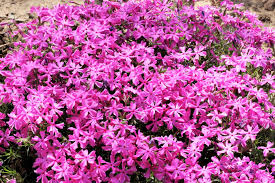
April’s full Moon coincides with the first appearance of the “moss pink,” or ground creeping phlox …early spring flowers.
Public Domain
What does this mean for you and me, personally?
In general terms the New Moon and waxing Moon phase building up to the next Full Moon is the optimum time to make a new plan, to initiate or apply for something, or to grow, make or get something.
A Full Moon is in general the optimum time to take stock and evaluate, or to gather, collect, harvest or cash in on something.
A Waning Moon is the optimum time for ending something, releasing something, or clearing out what’s no longer wanted or needed.
7 April: Full Moon in Libra
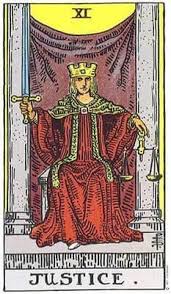
The Justice card: Rider- Waite Tarot
This full Moon shines a spotlight on the rule of reason, law and order, fair play, give and take, diplomacy
It can suggest romance in personal relationships, or repairing a disagreement. The sign of Libra, ruled by the planet Venus, is all about creating balance, harmony, and keeping the peace.
Libra is associated with The Justice Card in Tarot, which is about respect and fair play, following procedure, and applying logic and reason to problem-solving.
This is an unsettling time but The Justice card says, above all do not panic.
The Justice card suggests there will be added paperwork or other personal administration for most people one way or another in direct consequence of this situation. This paperwork may be legal in nature, or it may be financial, business or personal administration. It may be related to consumerism and provisioning, online shopping etc.
For small businesses and the self employed, the Justice card suggests special measures put in place in the next few weeks, according to each country’s own national decision-making processes.
The pendulum swings. A degree of disruption and anxiety is natural and inevitable. Uncertainty makes us anxious, but the only real illusion is certainty. Nothing is certain, as the old saying goes, but Death and taxes.
Let’s keep our cool, look out for one another, and pay attention to process, procedure and detail. Dot the i’s and cross the t’s to get the very best we can from this April Full Moon in Libra.
Professor Karol Sikora is Professor of Medicine at the Uni of Buckingham, an oncologist for 50 years, he tweets @ProfKarolSikora:
I can’t tell you how helpful the social distancing is. If we all keep it up, I think a feasible scenario is a return to some normality at the beginning of May. As long as we keep to the rules now, we’ll end up in a much better place after Easter than is feared.Social distancing works. The London School of Hygiene and Tropical Medicine estimate that before the lockdown one positive person would infect 2.6 other people. Now it is 0.62. This means the virus is cornered and will burn out.
23 April: The New Moon in Taurus
The Hierophant: Rider-Waite Tarot
The Hierophant card is associated with Taurus, a warm, earthy but creative, artistic and highly instinctive sign. It is about tradition, sticking with tried and trusted methods, creature comforts, and for many of us, these may have been in short supply, and there has been an unusual degree of extra stress and strain in recent weeks and months, with fire and flood wreaking havoc in 2019, all before Covid-19 showed its ugly face in December, and through its inexorable spread, reminding humanity that we are inextricably interconnected, and distance is no object.
Perhaps afterwards, when things have returned more to normal, as they will, it will be time to review a few of our global, national and personal practices, habits and expectations in respect of animal husbandry and global travel, and perhaps in time there will be some new normalities.
The Hierophant is the card of hospitals, publishers, universities and schools. Possibly things may enter a new phase, and in some cases, start to ease or start to return to normal in these sectors after this date.
In other news
A New Moon in Taurus suggests taking it easy. Don’t complain of boredom. Make an art out of staying home, making and doing new or quiet things, creating as the alternative to consuming.
For losing a little weight without a lot of effort, try working with the Moon, and limit your calorie intake for a 3-day diet once the New Moon begins.
This is also the card of formal studies, traditional crafts and universities and can signify a good time for starting a new study project or recreational group project, such as joining a choir for instance, or an art class.
Taurus is zodiac the sign of mid-spring, and everything alive and green. It is the ultimate zodiac sign of food and agriculture, matched only by the harvest time of Virgo. Why not discover your green fingers, or even experiment with growing a few of your own foodstuffs. You can always start small says the New Moon. A few seeds in a container, and see what happens.
People have been panicking. The supermarkets have been selling out of dried goods, but there will always other ways of doing things, or new recipes, or new ways of cooking or doing things to try out.
We can adapt. We can improvise. What did the Romans do before toilet paper had been invented? They worshipped Hygeia as the goddess of Health. And they had no loo paper, but still, they had ways….
And if that didn’t spoil your ‘bon appétit’, the April New Moon in Taurus says, ‘Eat your greens.’
I am running a few days late with this. Strange times for us all.
This is a revised and updated article, first published AskAstrology.com
Most of us know our sun sign, or sign of the zodiac, but what does it look like in the night sky, and what is the story behind it? The spring equinox was on March 20. Time to talk about Aries the Ram, the first sign of the new astrological year…
Common Associations
Symbol
Date of Birth: 19/21 March to 20 April
Ruling planet: Mars
Lucky Day: Tuesday
Energy: Yang (Masculine/Extrovert)
Element:Fire
Quality: Cardinal (the start of the season of spring)
Tarot Card: The Emperor (Masculinity, Fatherhood, Government, Law and Order, Courage, Stability)
Note the rams heads adorning his throne.
If I am asked ‘when?’ during a reading and I draw The Emperor, the time-frame suggested is Aries.
Public Domain: Rider-Waite Tarot
Astronomy
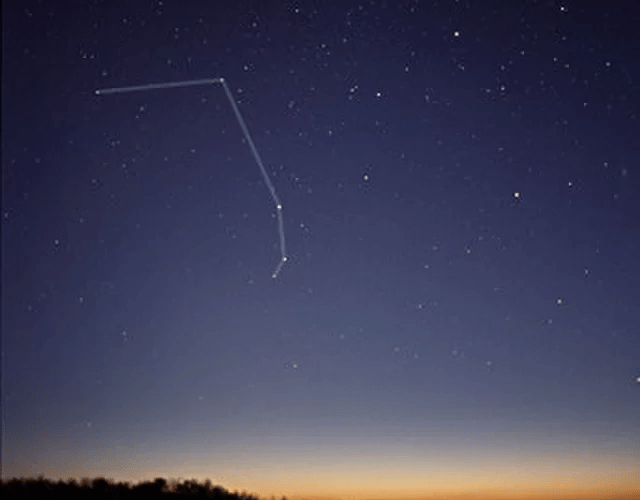
Aries, with the head of the Ram pointing downwards. The two bottom stars are the horns
Aries is located in the Northern Hemisphere between Pisces to its west and Taurus to its east.
It is not a specially bright or large constellation. The brightest star in Aries is Alpha Arietis, or Hamal, from the Arabic Al Ras al Hamal, meaning “the Head of the Sheep.” Hamal is a red giant with a magnitude of 2.0, visible to the naked eye, which is about as bright as Mars when the planet is at its farthest point from Earth. The other two brightest stars are the horns of the Ram, Sheratan and
Between 2000 BC and 100 BC the spring equinox used to be April 24 when Hamal was conjunct with the sun, but now the spring equinox is 20 March when the sun shines in front of the constellation Pisces on the border with Aries.
This is because the sun moves westward in front of the backdrop constellations by about one degree (two sun diameters) every 72 years. This drifting is due to a motion of Earth, a wobble on its axis, called the precession of the equinoxes.
But for historical reasons the spring/vernal equinox is still referred as the First Point of Aries.
The Aries constellation contains a galaxy about 100 million light-years from our own galaxy, the Milky Way, and it also a planetary system called 30 Ari, which consists of a gas giant and four stars.
A supernova in Aries was recorded in May, in the year 1012 AD.
The best time to see Aries.
Look for it in December around 9 p.m. local time, rising in the east. A Northern Hemisphere spring or Southern Hemisphere autumn is the worst time of year for viewing Aries, when it is lost in the sun’s glare. December is an especially good month for viewing Aries, when the Earth is on the other side of the sun. In late October, Aries rises in the east at sunset, reaches its highest point in the sky at midnight and sets in the west at sunrise.
Aries reaches its highest point in the sky about 10 p.m. local time (the time in all time zones) in late November, 8 p.m. local time in late December and 6 p.m. local time in late January.
History and Mythology
The spring equinox was a time of renewal throughout the northern half of Earth, an event of great significance to people who were much more aware than we are nowadays, of human dependence on the land and sky.
Once upon a time Aries marked the end of the wild sheep main lambing season in Europe, 21 March – 20 April.
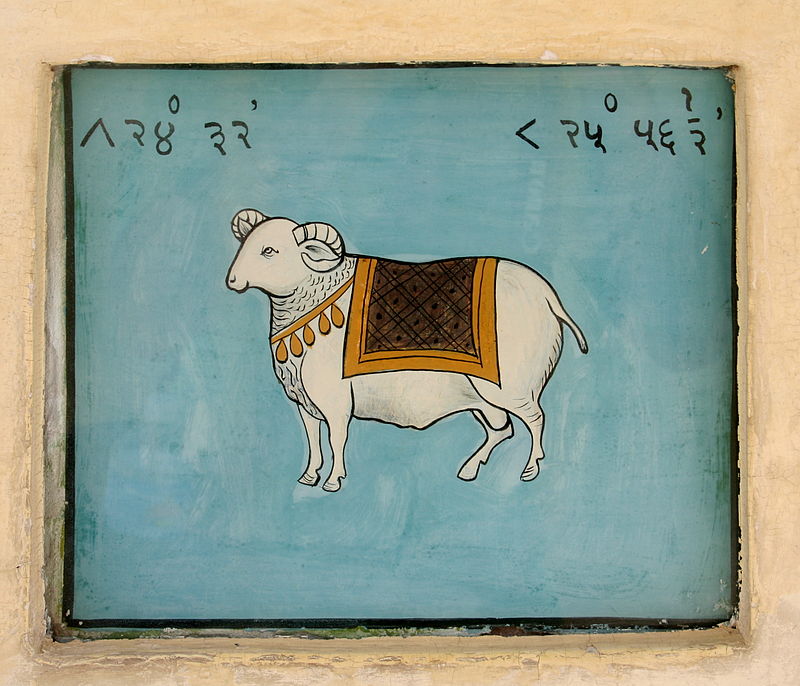
Below, in this rather humorous and charming illustration from India, is surely the least ever fiery ram of a wild sheep.
Humanity made connections, looking up and making patterns out of the skies overhead at that time, matching these to such significant natural events on the ground.
The Sumerians are one of the oldest known urban civilisations in what is now called Southern Iraq, during the Neolithic-Bronze Age, 4500 BC to 1500 years BC. The ancient Sumerians called the sun, Subat, meaning the Ancient Sheep or Ram and the planets were the Celestial Herd.
The brother and sister Phrixus and Helle were the children of the Boeotian king Athamas and the cloud fairy, Nephele. She died, the king remarried, and his new wife, Ino, feared and hated them and planned to kill them as a perceived threat to her own two children by the king.
They fled, rescued by a flying golden ram sent by Hermes at the plea of the dead Nephele, watching in anguish from the other world, but Helle fell into the sea below and was lost in the Dardanelles, named the Hellespont in her honour. Later, safely in Colchis, Phrixus (rather ungratefully) sacrificed the Golden Ram, returning it to the gods, and presented its fleece as a gift to King Aeetes, who placed it on a tree in a grove under the guard of a dragon, the hideous Hydra, whom Jason later killed in order to steal the magical healing fleece.
In ancient Egyptian astronomy, Aries was called Lord of the Head, and was associated with the god Amon-Ra, depicted as a man with a ram’s head and representing fertility and creativity. And because it was the location of the spring (vernal) equinox, it was also called the “Indicator of the Reborn Sun.” The position of Aries at the zenith coincided with the rising of Sirius in the east and the flooding of the Nile.
The Temple of Amon-Ra at Karnak bore the likeness of the supreme sun-god with the horns of a ram. The road to Karnak was formed from the wings of two granite sphinxes bearing the head of Aries.
However, Aries was not fully recognized as a constellation until classical times when the ancient Greeks from about 1580 B.C. to 360 B.C. oriented the construction of many of their sacred temples in relationship to Hamal.
In Hellenistic astrology, the constellation of Aries is associated with the golden ram of Greek mythology that rescued Phrixus and Helle on orders from Hermes, taking them to the land of Colchis.
The brother and sister, Phrixus and Helle, were the children of the Boeotian king Athamas and the cloud fairy, Nephele. Athamas was unfaithful and Nepehele left. Drought followed but Athamas remarried, and his new wife, Ino, planned to kill Phrixus and Helle as a perceived threat to her own two children by the king.
They fled, rescued by a flying golden ram sent by Hermes at the plea of Nephele, watching in anguish from the other world, but Helle fell into the sea below and was lost in the Dardanelles, named the Hellespont in her honour.
Public Domain: 1902
The magical ram, Krios, spoke to Phrixus to calm and comfort him as they continued on their way. Later, safely in Colchis, Phrixus (perhaps rather ungratefully) sacrificed the Golden Ram, returning it to the gods, and presented its fleece as a gift to King Aeetes, who placed it on a tree in a grove under the guard of a dragon, the hideous Hydra, whom Jason later killed in order to steal the magical healing fleece.
The name Phrixus means ‘curly.’
Astrological Personality
There is no such thing in reality as THE Aries personality and the same goes for all the zodiac sun signs. Your sun sign is an archetype, a keynote, but of course it is not your full astrological portrait. We are all unique and it could never be the whole story.
Aries is ultra-virile, with a warrior spirit, just as a ram will charge headlong, at an intruder, and may even kill a person who enters his field, threatening his ewes and his territory at the wrong moment.
Aries is known for its determination and zest for life, and in the same spirit, Aries can be reckless and with it, accident prone in its general haste to get on and do whatever is the next thing. Aries are at a statistically increased risk of accidents, especially with head and neck injuries in comparison with other signs, largely due to impatience and risk-taking behaviours.
Aries is ready to experiment or pioneer but may not finish what it starts. They are determined but can be diverted by their own impatience if they don’t get quick results.
In their personal relationships Aries are lively, pleasant, frank, direct and generous. Full of wit and bravery and bounce and joie de vivre, there is much to love and admire about the early springtime subjects of fiery Aries, the Mighty Ram.
This concludes my series exploring the science and history of the Zodiac. Browse the archives for the astronomy and ancient stories behind the other signs of the Zodiac.
“Covid-19 UK via Tarot. Graph climbs- Full Moon 7/8 April- New Moon 23 April, peaked by late June-late July (the healing Queen Cups card = dates of Cancer) then post-peak phase till late Nov/early December 2020 (8 Wands Rx =Sagittarius) As ever naturally only Time will tell.”
The Queen of Cups from The Golden Tarot.
I understand this is roughly in line with the current scientific modelling, in which case, the congruence is an interesting coincidence.
The timing associated with this card is the zodiac sign of Cancer. This means late June- 23 July, and suggests the imminent acute medical emergency seems likely to pass its peak and start to resolve by midsummer, though the economic ramifications continue throughout 2020, and almost certainly, well beyond.
The Eight of Wands, planes above the clouds, The Tarot of the Divine Legacy
The Eight of Wands reversed is associated with Sagittarius, the bright and breezy, free and easy cosmic traveller, and indicates we are still having this conversation late November/early December 2020, and this card specifically references a continued downturn in global travel. Worst case risk detected here is a second phase, starting late Nov/Early Dec as has happened before with other pandemics.
Astrologers have been commenting since 2017 in some instances, speculating in respect of an ominous outlook for 2020; a challenging conjunction of Saturn in Capricorn coming up at intervals during 2020. They are seeing parallels between the astrology of 2020 and prognostications made by UK astrologer William Lilley from 1648 onwards.
Excerpt via astrologer Jessica Adams.
“Astrologers are here to serve. It’s part of our professional code. When William Lilly predicted back in 1648, that in 1665, “so grand a catastrophe and great mutation unto this monarchy and government as never yet appeared” would come – it did.
Lilly wrote“it will be ominous to London, unto her merchants at sea, to her traffique on land, to her poor”. He actually wrote “by reason of sundry fires and consuming plague.”
The Company of Astrologers still holds a church memorial service in his honour on Lilly Day, every year.
What is really interesting in 2020 is is his prediction in a 1648 London pamphlet. This was the astrologer’s equivalent of a website today.
He saw, in the year 1665, “so grand a catastrophe and great mutation unto this monarchy and government as never yet appeared.” Note his use of mutation. Viruses can mutate.
Lilly went on, “it will be ominous to London, unto her merchants at sea, to her traffique on land, to her poor.” He actually wrote “by reason of sundry fires and consuming plague.” In 1665 the woodcut of bodies in shrouds came to pass and in 1666 The Great Fire of London began.
The Bubonic Plague of 1665 has thus passed into the history books as a date-stamped, illustrated, astrological prediction.”
Another more recent prediction has been receiving a lot of public attention recently.
‘In around 2020 a severe pneumonia-like illness will spread throughout the globe, attacking the lungs and the bronchial tubes… Almost more baffling…it will.. vanish as quickly as it arrived, attack again ten years later, and then disappear completely.’ – wrote Psychic Sylvia Browne in her book, End of Days, 2008.
Astrologer of The Lady magazine, Victor Olliver, made a reference to this on social media recently. A lucky guess, commented someone. Indeed, and anyone can guess. We do it all the time, or we could not function from day to day. I guess it’s going to rain. Better wear my raincoat.
But as guesswork goes, date-stamped and published in 2008, this is pretty specific, I think many reasonable people would be ready to agree.
Sylvia Browne was a controversial, possibly really rather unpleasant figure who famously got many things wrong, telling parents of missing children their children were dead when they weren’t, and vice versa. But I bought and read the book to see for myself, and she did indeed publish this clear demonstration of clairvoyance, however hit and miss she may have been in respect of so many other things.
Covid19
This new coronavirus sub-type arose in a ‘seafood’ market, according to the poor young doctor Li who identified it, shared his findings in a restricted online conversation with colleagues, and was either spied on or reported, rebuked by his manager and threatened by the police for expressing his concerns.
The same young doctor returned quietly to work and kept his mouth shut, only to die, infected by a patient who had been a storefront seller in this self same ‘seafood’ market, leaving a pregnant wife and small children. A man of his age could have been expected to survive, but this particular patient is thought to have carried an unusually high viral load, by reason of his market stall.
Such has been the anger in China, the Chinese Government exonerated Dr Li yesterday, 10 March, and scapegoated those who rebuked and threatened him, much good does that do him and his family.
HONG KONG—Weeks after Chinese social media erupted in grief and rage over the death of a doctor reprimanded by police for raising early alarms about the new coronavirus, Beijing is seeking to assuage public anger by rescinding his penalty and punishing those who rebuked him.
The Huanan market was closed 1 January. On 24 February 2020, the Chinese government announced that the trade and consumption of wild animals would be banned throughout China, but made no announcement in respect of a ban on the use of animals in Chinese medicine, and the closure of the market has not been announced as permanent. The Chinse government says it has been closed for ‘renovation.’
Let’s watch that space.
Back to Sylvia Browne for a moment. Did she suggest this ‘severe pneumonia like illness’ marked the beginning of ‘The End of Days’?
No, she did not. Or not exactly. But she did see it as a kind of a canary in the mine, a signpost of a coming decline in the global human population during the coming century, and I am inclined to think, based on the assumption that we carry on exactly as we are doing, she was on to something there.
This thing has leapt from animals to humans and ultimately kills by thickening and hardening the mucus in the throat, chest and lungs. There is a cytokine storm and suffocation. And yet again, as with SARS and Swine Flu and Ebola, and the Spanish Flu which was carried far and wide on returning troopships after the war, a pandemic of two phases, it begs the same kinds of questions.
From the Huanan market to the globe. Modern work and leisure travel habits have carried this new virus, which is basically a new form of pneumonia, pretty much right around the populated world.
Deaths from coronavirus worldwide are today estimated at 10 000. And this is extremely serious but it’s not the Spanish Flu of 2018 which accounted for 50 million and possibly as many as 100 million.
It is not the Black Death, or as it was called at the time, The Pest (Yersinia Pestis – bubonic plague) which came out of Central or East Asia in 1347, travelling the trade route along the Silk Road into the Crimea and delivered into Sicily by 12 ships from the Black Sea reaching England in 1348. This great plague killed more than 30 % of the entire population of Europe. Some estimates suggest it was as many as 60 %.
This is not that. I do not see that it will become that.
But I won’t be remotely alone or unusual in reading this as another warning. The global human population at the time of the Spanish flu in 1918 was 1.7 billion and today it is 7.8 billion.
Freedoms we have come to take for granted, or have come to regard as our inalienable rights, including cheap travel in massive numbers wherever we like, whenever we like, how we like and for as long as we like, are overdue a fundamental re-think. We want to do what we like when we like, at least with our free time. But we are over-extended.
The Queen of Cups says Home is where the Heart is.
But where is the heart?
A citizen of everywhere is a citizen of nowhere, a consumer first and last, carried aloft in the capacious claws of a doubtful new freedom, as contrails track and line the sky, the real and honest price tag not yet known.
To see a World in a Grain of Sand
And a Heaven in a Wild Flower,
Hold Infinity in the palm of your hand
And Eternity in an hour.


William Blake: Extracts from Songs of Innocence
Meanwhile spring is here and that may help resources in the northern hemisphere, by seeing the easing off the annual caseload of seasonal flu.
The spring equinox was yesterday.
Back soon with more on that, and the story of the Fiery Sky Ram Aries…..
Most of us know our zodiac or sun sign, but what does it look like in the night sky, and what’s the story behind it? This month it’s the turn of Pisces the Heavenly Fishes…
Birth Stone: Aquamarine but also amethyst, ruby, bloodstone and jasper. Aquamarine is the blue variety of beryl. Emerald is a green beryl. The aquamarine is believed to enhance foresight and clairvoyance, and a sense of happiness.
Colour: Purple, violet, sea-green
Herbs/Flowers: the water lily (associated with Neptune)
Tarot card: The Moon: ebb and flow, cyclical shifts, intuition, dreams, visionary capabilities, fertility, difficulties with travel, uncertainties, shadow boxing, wild creatures, instinct v civilisation, genius, delusion
From The Gilded Royale Tarot, Ciro Marchetti
Public Domain: Rider-Waite
The Astronomy
In the sky, Pisces is represented as two fish swimming at right angles to each other, one to the north and one to the west and attached by a cord. The fish are most usually depicted as koi.
Pisces, named for the Latin plural of fish is the 14th largest constellation overall. Pisces is in the first quadrant of the Northern Hemisphere and covers a large V-shaped region. While it is a fairly large constellation, its stars are faint — none are brighter than fourth magnitude — making it challenging to see in the sky with the naked eye.
Even so, its brightest star, Eta Piscium, also known as Alpherg or Kullat Nunu, is a bright giant star (G class) 294 light-years from Earth and has a luminosity 316 times greater that of the sun. Kullat Nunu is its Babylonian name. ‘Nunu’ means ‘fish’ and ‘kullat’ is a bucket.
Pisces second brightest star is Gamma Piscium, a yellow giant about 130 light-years from Earth.
Alpha Piscium is the third brightest star in Pisces, and is made up of a pair of white dwarf stars in close proximity. Its other name is Alrescha (“the cord.”) It lights the spot where it appears that the tails of the two fish are joined or tied together.
The best time to see Pisces in the Northern Hemisphere is between 6-9 November at 9 PM below the Square of Pegasus.
Pisces is notable for containing the point at which the sun crosses the celestial equator into the Northern Hemisphere around March 20 each year.
Image from the Atlas Coelestis, posthumously published by astronomer John Flamsteed, 1729, illustrator John Thornhill.
Astronomer and author Ian Ridpath explains: A cord joins the tails of Pisces. The horizontal dashed line passing through the southerly fish is the celestial equator, and the diagonal dashed line is the Sun’s annual path, the ecliptic.
The point where they cross is known as the vernal (spring) equinox.
History and Mythology
The fish of Pisces are attached by a cord of stars, just as life and death, and winter and spring are conjoined and cannot be separated.
Salmon spawn from October- December onwards. The last of the Atlantic salmon spawning happens late February, after which the salmon die. Perhaps there is a connection here.
Pisces is a mutable sign. These are the signs that mark the end of a season; the other mutable signs are Gemini and Sagittarius. Pisces marks the end of winter, leading up to the vernal equinox. Of all the zodiac signs, mutable signs are traditionally the most flexible and adaptable, the ones most at ease with endings and transitions and change.
Pisces is not only the last sign of winter, moving into spring; it is the last sign of the whole zodiac year, the culmination of all the signs that came before it. Symbolically therefore, Pisces has one foot, or fish in the death of the old year, meaning the last of the winter, pre-spring equinox, and one foot or fish in the quickening of spring, post-spring equinox.
Winter often brings mourning, as it carries away the frail and the old.
Psychic Pisces straddles the season of that winter’s grief and the new green shoots of spring.
The sign of Pisces is Babylonian in origin. Enki, the Sumerian god of wisdom, and the alleged true father of mankind, is associated with the planet Neptune, which astrologically rules the sign of Pisces.
To the ancient Greeks, the fish themselves were the goddess Aphrodite and her son, Eros. They were walking by the Euphrates one day when a terrible monster, Typhon, suddenly rose up out of the water to destroy them.
The gods of Olympus were no match for this particular very ancient monster, a son of Gaia, or Earth herself. He was as tall as the heavens and his eyes shot flames. Instead of fingers, he had 100 dragon’s heads sprouting from his hands.
None of the Olympians had the power to destroy the ghastly Typhon, or confront him, not alone, and he tried to kill them every chance he got. For a time, all they could do was flee, often by transforming themselves into animals, and Aphrodite and Eros, in this case, transformed themselves into fish and swam away.
Another version of the story says they dived into the river, and were rescued by two friendly fish that carried them to safety, and were later placed in the sky, their tails intertwined, to commemorate the day when Eros (Love) and Aphrodite (Beauty) were saved from a hideous fate.
Ultimately, Zeus managed to imprison the terrible Typhon beneath Mount Etna…and he is still very much alive down there to this day.
The Astrological Personality
There is no such thing in reality as THE Pisces personality and the same goes for all the zodiac sun signs. Your sun sign is an archetype, a keynote but of course it is not and never could be the whole story.
Pisces combines imagination with determination, charm with depth, and at times there is a certain passivity, even inertia, which may actually serve them very well at times, but may in some cases degenerate into a trap or a kind of darkness involving depression, alcohol or other substance misuse.
These individuals are talented, natural artists or musicians. They are famously loyal once committed, compassionate and sensitive.
Pisces has steel. This doesn’t get mentioned much, hardly ever, if at all, but Pisces has a quiet steel. They may tire, but they endure, and try taking them on, they may not say much, but watch their face harden, and, should you cross the line once too often, again, they may not say much, but you are gone.
Their instincts are kindly, and they have a soft spot for the underdog. Where they demonstrate a lack of proper consideration for others, or undue stubbornness, it is not due to any lack of goodwill, but because they are not paying attention, too focused on their inner preoccupations.
Pisces needs variety, and structure must allow them room for a degree of autonomy. Many police officers, arbitrators and judges are born under Pisces, as well as artists and musicians. Administrative work, although Pisces can do it, is really not their sort of thing by and large.
Pisces can make excellent and approachable leaders of small teams, loyal to their staff. They will take on injustice, take on those superior in status, but Pisces, unlike, say Aquarius, confines their remit to action on an individual basis. Pisces are not temperamentally disposed to mount group actions, campaigns or crusades unless perhaps, they are early Pisces, born on the Aquarius cusp, but the later subjects of this sign, born close to the Aries cusp, are very much the ‘doers’ of Pisces.
Pisces is brave but their physical energy must be guarded. It can be erratic, and once depleted, is not always easily restored. If they are prone to headaches at the back of the head, there may be related bladder infections or other hidden issues. Pisces needs longer to recuperate from illnesses than some other signs. It needs plenty of rest, music and relaxation time near to rivers, ponds and sea.
Weaknesses – Depending on their other planetary placements, Pisces may be prone to falling prey to either wishful thinking, or gloom or unhealthy lifestyle habits, especially when struggling to recover and regroup from setbacks. Lacking a clear sense of purpose or direction, Pisces can drift loose from their cord, becoming detached and living too much in their own imaginary world.
Have you ever had a Tarot reading with someone else, or pulled cards for yourself, and been surprised, mystified or even spooked because the cards were so relevant it was downright uncanny? How does that happen? After all, there are 78 cards in a Tarot deck. For those few cards you chose entirely at random, the others all had to stay in the deck.
The Basics
Tarot is only one of many systems of divination. Others are far older in origin, including astrology, palmistry, the I-Ching, runes and reading bones/entrails etc as in Rome, where Spurinna, the haruspex predicted the assassination of Julius Caesar. The popularity of card games took off after Mamluk game cards were brought to Western Europe from Turkey, and the earliest known set of tarot cards was created in the 14th century. The Tarot, also known as the Tarocchi or Tarock, began as a game of chance in the courts of northern Italy but did not become seriously associated with fortune telling or other psychic divination until much later, by the mid 18th century.
Physically speaking, a Tarot deck is little more than 78 pieces of illustrated, numbered card-stock.
The meanings in the cards need a reader to make them come alive. Study is required. No faith is required, however. No religion, no need to commune with any ‘spirits’ than the spirit of Mankind. I have read for Christian, Muslim, Hindu, Chinese and Jewish clients, as well as for atheists, agnostics and downright skeptics. No problem at all. The imagery in the Tarot crosses cultural boundaries.
But in communing with some ancient, but ‘higher’ part of ourselves, superego, not id, perhaps we are communing with the Divine, depending on however one wishes to define it. Or else tapping into our ancient animal knowing. That we muted or traded in exchange for the great advancement to language.
I see it as a transcendence or suspension of the everyday self. When I am doing a reading for another person, I need to free myself, try and take myself out of the equation, me and my worry about getting it ‘right’ or ‘wrong’; me and my ego.
I sometimes joke as I shuffle the cards, ‘OK, now my ancient inner animal is going to have a little talk with your ancient inner animal.’
We are going to converse on at (at least) two levels, consciously, and via telepathy, enabled by the imagery of the cards.
Marcus the psychic pig, accurately predicted the result of the EU Referendum, and The US Elections
Suspension of self and ego notwithstanding, delivery of a professional level of service means I, or any other reader need to do as well or better than the pig.
The reader draws cards blindly and at random, and lays them out in a pattern or spread, using the placement of the cards, the imagery and associated meanings of that card. Why choose this card and not that one? Well, there is the mystery. The central nervous system has a mind of its own, and dictates my movement, in determining the instant at which I stop shuffling. I can think of no better explanation. The choice to stop shuffling is not remotely deliberate.
The reader then interprets the cards, sharing what they sense about a given person, situation or question, past, present and possible future.
This stuff is not omniscience. I don’t KNOW anything. I just say what I see and feel. The thing that amazes, and can even startle the person being read for, and the readers too at times, is the total, immediate and undeniable relevance of cards drawn blindly and at random, and then organised into a pattern or spread for interpretation.
The cards were drawn at random, but the results do not seem random at all.
They fit.
OK, but shaddap! How exactly does this stuff WORK?
Well, OK, OK. But there is no one single, neat and tidy answer.
The reader has ‘uploaded’ a ‘programme’ by learning the meanings and associations of the cards. With much repetition and practice, just as with learning to play an instrument or indeed any kind of rote learning, this programming becomes almost second nature, and the cards may act now, not only as technical support but as a springboard for insights prompted by lateral or associative thinking, backed up by instinct.
This provides them with their starting point, and then their own ideas, empathy or intuition supplies further comment. The cards provide a spring board for the reader’s intuition, but the associations of the cards supply the details enabling greater precision of interpretation. Associative thinking, or lateral thinking helps me a lot in arriving at ‘psychic’ insights or ‘hits.’
I look at the card and there is a kind of a ‘ping’
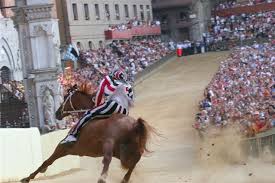
For instance: I drew the Six of Wands, and this card generally means progress, promotion, a trip but on this occasion, something about the artwork made me say something I had never said on previous occasions, drawing the self same card, and I asked the client, ‘are you thinking of going to Siena?’
And she was, or rather, a place just outside Siena, but how did I arrive at that guess? Firstly, I had already established that we were looking at a travel destination. Secondly, something about it suddenly made me think of the Palio.
The Six Wands from The Legacy of The Divine Tarot, Ciro Marchetti
At other times the six of Wands has told me about motorbikes. Once it ‘showed’ me an upcoming sporting event, a big one and I asked the client, was this correct, and learned he was going to the Paralympics as a reserve member of the wheelchair rugby team. Most recently I drew this card, and said to the lady that it looked as though she may be meeting a man who was into speeding vehicles, but his job involved teamwork. She recognized this description and said he was a firefighter. In this instance then, the six of Wands denoted a fire engine.
Same card, three entirely concrete, different yet related interpretations, talking about the real, modern world.
Synchronicity
The psychologist Carl Jung never learned to read the Tarot himself but was fascinated by its ability to reflect what was going on. Jung theorized that Tarot works by means of a phenomenon he called “synchronicity”, or meaningful coincidence.
Jung was also fascinated by what Tarot could tell us about real people we know as pictured through classic story archetypes, e.g.; The King, The High Priestess, the Wise Man (Magician) the Hermit, and for its insights into the conscious mind working in tandem with the unconscious mind.
The ‘coincidences’ of the Tarot’s commentary, relating the enquirer/clients own story back to them are so frequent and particular that the enquirer/client strongly feels that they have been heard by some mysterious invisible presence. The reader feels it too.
The reader has ‘uploaded’ a ‘programme’ by learning the meanings and associations of the cards. With much repetition and practice, just as with learning a language or to to play an instrument or indeed any kind of rote learning, this programming becomes second nature, and the cards may act now, not only as technical support, but as a springboard for insights prompted by lateral or associative thinking, and we may go up into the realms of the psychic stratosphere.
The clues in the cards
Each card has many keywords attached. These are the basic building bricks of the reading.
The Chariot card, for instance, has these meanings attached; a vehicle, a driving test, a garage, a road trip, travel, ambition, project, a partnership, teamwork, discipline, and also the zodiac sign of Cancer and the dates associated with this sign (June 21-July 22)
So, let’s imagine I draw this card. Which meaning is the right one here and now?
Circe by Waterhouse
John William Waterhouse – Sketch of Circe, 1911-1914 (public domain)
How does the reader
1: choose cards which so appropriately describe things you have not yet told the reader?
2: choose which of the many possible card interpretations to go with?
Well, the context of the card is a clue. What are the surrounding cards? The reader studies these with care. Beyond this, the short answer is, the reader doesn’t know. They make a judgement call and go with their first impressions, trusting the unconscious process, then making it conscious again, putting it back into words.
This is presumably working on empathy.
Intuition is one’s inner tuition – one’s instinctive understanding. It’s necessary for survival, and we all possess it to some degree.
Using a learned system such as Tarot helps us give it words.
Sometimes these words are so specific, many call it ‘psychic’ and psychic ability and intuition are often seen as “supernatural.”
But anyone can learn to read Tarot cards, while the degree of proficiency attained depends on a certain natural talent, but also depends to a very great extent on study and practise. Lots of people start learning, but give it up again without ever finding out all they might be able to do with it.
In Summary
Tarot is an art not a science. It is a form of language. You clearly see there’s a process at work. The mechanisms are both apparent and inscrutable. One sees the physical actions of shuffling, drawing and arranging the cards, and then upon card knowledge, feeling and sensing and finally, the right, apposite and meaningful word choice.
Becoming proficient at reading the Tarot, such that one can read to a service level feels like a big responsibility. Well, it is, and it demands a heck of a lot of practice, and the more you work with the Tarot or whatever system of divination you might want to work with, the more confidently you will be able to tap into your intuition, but you do not need to think of yourself as psychic in order to learn to read the Tarot, or to become fluent and proficient.
There is a native understanding beyond your conscious awareness and control. Whether you think that proceeds from your subconscious, the collective unconscious, God, your guides, or your higher self doesn’t matter.
The results are the proof. Sometimes these can be put to the test, observed and validated immediately, as when a reader says something that they could not possibly have known, but the client knows to be correct. But when a reader comments in respect of events many months ahead, it might be turn out to be pie in the sky, or it might prove accurate, but only time will tell.
Is the information potentially usable, actionable or workable here and now?
That is a pragmatic reading. It is my experience that most people welcome an element of pragmatism when they are at a crossroads. The Tarot is no less ‘spiritual’ when it psychically detects a problem with the drains.
Fortune Teller, Albert Anker, 1880
We can, and do know more than we know. All of us, and without necessarily knowing HOW we know it. Perhaps there are biological algorithms at work here, and why should this be surprising?
We don’t even know how old we are as a species. Not really. Until 2015 we were told, based on the available evidence, that humanity had been practicing organised agriculture for 12000 years, but subsequent discoveries by the sea of Galilee suggest humanity has been experimenting with crop eugenics for at least 23000 years.
We don’t know everything there is to know about Time.
Six million years of Mankind. 200 000 years of ‘modern’ us. We’ve got nothing on the scorpions, with their 350 million years. Still, we are more ancient and mysterious, it seems, with every new archaeological discovery.
















 True Tarot Tales