The Saturnian Strangeness of the Winter Solstice

Saturn rules Capricorn, the zodiac sign which became associated with the dates of Christmas. Bright lights, good cheer, a nosh- up, a knees-up; the Romans celebrated Saturn as the god of agriculture, and also because, according to their theology, Saturn was the god who ruled the world during the long lost Golden Age, and they wanted it back, please.

The Saturnalia was celebrated 17 December, with festivities usually culminating round 23 December.

Public Domain

Outside of this context, Saturn is not usually so jovial in aspect. It is the planet of great virtues, but stern and serious. Life is a serious business, and requires effort, is the message of Saturn.

Caesar must be rendered to. The bottom line safeguarded. Nothing came from nowhere, nothing is for nothing. Even the birds don’t sing for fun. The birds especially do not sing for fun. They sing to win and stake a territory, and keep it. They sing to win a mate, they sing to ward off threats to their nests, but is their song less beautiful for that?

Saturn is all about the bottom line. Food is the bottom line, and the solstice meant the return of the sun for the new year’s crops. It wouldn’t do to take Saturn for granted.

The face of Janus, past and future, could be seen as another face of Saturn himself. Janus, the primordial god of beginnings, gates, transitions, time, duality, doorways, passages, is the god of endings. An ancient legend said the souls of the dead returned to their origin, rising through the gates of the constellation of Capricornus, where the souls of newborn descended to arrive on Earth through the gates of Cancer, zodiac sign of the summer solstice in a never-ending wheel of souls.

Public Domain

For all of us there comes a point where every year, a familiar face or name will leave the orbit of our lives, and we revisit the memories. Maybe it is a person, or maybe it is a place. Perhaps it is something we used to do, or used to wish for. The ghosts have their own pictures, particular songs, sounds and smells.

They are many, bittersweet, the ever-more crowding ghosts of Christmas past.

WHO WALKS THIS EARTH UNSEEN

The ghosts of the Displaced

Those who could have been

Those who never knew

What else where else

To whom they could belong

Not here or now where else

They could have been

What else around us all

The ghosts of Might Have Been

Behind the lives behind the claims

Their space not yet but come their time

Make way

Margaret Whyte, December 2019

Christmas 1972

The Why of Winter

Photo by Pixabay on Pexels.com

My mother turned 81 just before Christmas; wise, shrewd, beautiful, a mother of five; a gifted teacher, naturalist, poet, and for many years, a champion protector of women’s statutory right to give birth in their own home if they wished, not to become mandatory patients in a more or less public setting, rendered subordinates in their own care during what is a personal and family event.

An independent thinker possessed of moral and physical courage, self-discipline and fortitude; and with a keen sense of the absurd -without which there is no sense of humour, she could be described as a classical Capricorn Queen of Pentacles, born 23 December.

Both her parents were naturalists, and she in turn took her children to the wild places, beach combing and. hill- climbing. We climbed in the Lakes, in Glen Coe, on Mull. As teenagers, we were not always in the mood, but she would not leave us at home.

Nor could we always keep up with her, a smallish woman, 5′ 5…same height as me, and with the stamina of…well, a mountain a goat, trotting on ahead with her backpack, my stepfather, Pa, six foot five, toiling moodily at the rear with the biggest backpack.

Capricorn marks the winter solstice, so it marks the beginning of winter, but it also marks the returning sun.

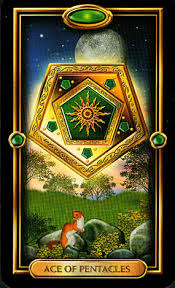
Capricorn is the cardinal sign of Earth in the western zodiac, and also in the storybook of the Tarot, and its associated cards are The Devil (Pan) the Ace of Pentacles (Earth) and the Queen of Pentacles.

Image from The Gilded Tarot, Ciro Marchetti


The Why of Winter

by Katie-Ellen

Sirius hard on the

Hunter’s heels

Stoats in ermine

Gain the field

Resting time

For sap-sunk trees

And earthed in dens

Some sleep

the hungry time

In deathly ease

Blackthorn points

The ancient tracks

Of chasing men

And panting beasts

Sweated salts

And bone-crack feasts

Oaks and sacred

Moons of mistletoe

Call down Life

Or conjure woe

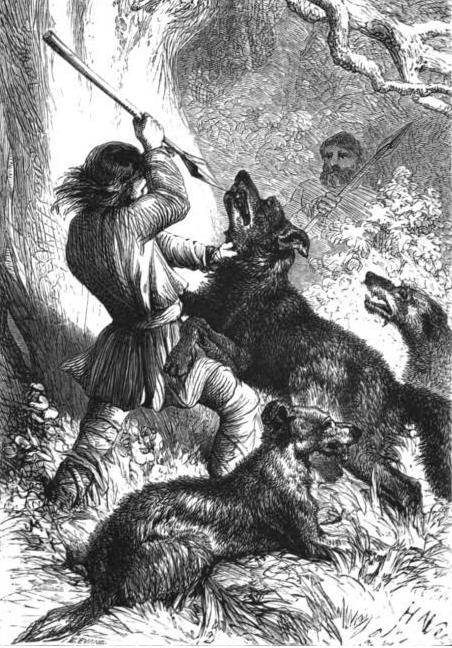
When wolves at doors

Shall seek for more

As Gaia tilts

And wheeling skies

Spin winter stars

There is no other why.

Capricorn, the Cosmic Sea-Goat

An introduction to the astronomy, history and, mythology of the zodiac sign of Capricorn…

 Most of us know our zodiac or sun sign, but what does it look like in the night sky, and what’s the story behind it? This month it’s the turn of Capricorn…

Common associations

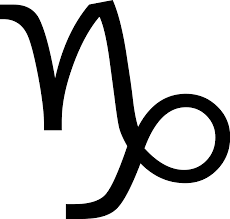
Symbol:

Date of Birth: 21 Dec to 20 January

Ruling planet: Saturn

Lucky Day: Saturday    Lucky Numbers 2 and 8

Energy: Yin

Element: Earth

Quality: Cardinal (the start of the season of winter)

Key phrase:  I build, I use

Body:  Skin, knees, skeletal system

Birth Stone:  Red Garnet, Black Onyx

Herbs/Flowers: Wintergreen, Ivy, Carnation

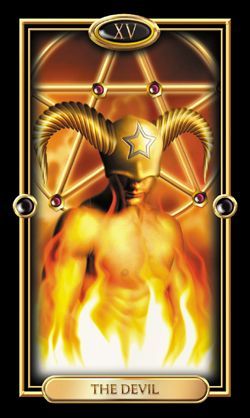
Tarot card:  The Devil (Pan/Nature, Mystery, Fascination, Obsession, Entrapment)

The Devil card wiki.jpg
From The Gilded Tarot by kind permission of Ciro Marchetti

The Astronomy

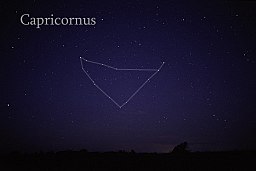
Capricorn stars wiki 256px-CapricornusCC.jpg
Public Domain

The constellation of Capricornus is located in an area of sky known as The Sea or The Water, containing other water-related constellations including Aquarius, Pisces and Eridanus.

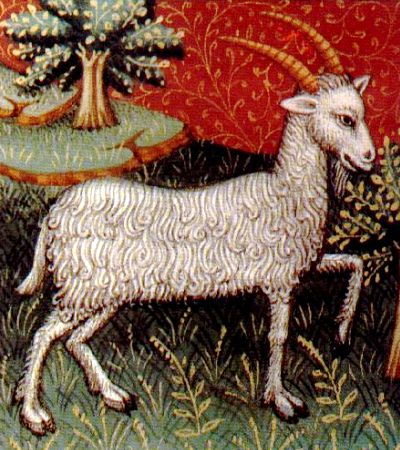
Its name is Latin for “horned goat” or “having horns like a goat’s”, and it is commonly represented in the form of a sea-goat: a mythical creature that is half goat, half-fish, like Pricus, the son of Chronos (Time) king of the mer-goats of Greek myth. This seems to have been an evolution legend.  The children of Pricus left the sea to dwell on mountains, leaving him alone in the oceans with no-one to teach any more, and Pricus was a great teacher. Zeus placed him in the Sea of the Stars so that he could see his children again, and they could look up and see him.

Capricornus is the smallest constellation in the zodiac, with no first magnitude stars. Even so, the brightest star, Delta Capricorni A, is a white giant with a luminosity 8.5 times that of the Sun.

Capricornus has three stars with known planets and contains a Messier object, Messier 30, a globular cluster 28,000 light years distant,about 90 light years across in size.

The cluster is approaching us at the speed of 181.9 km/s. It was one of the first deep sky objects discovered by Charles Messier in 1764.

There are five meteor showers associated with Capricornus: the Alpha Capricornids, the Chi Capricornids, the Sigma Capricornids, the Tau Capricornids, and the Capricorniden-Sagittarids.

Like other constellations of the astrological zodiac, Capricorn was first catalogued by the Greek astronomer Ptolemy in the 2nd century.

The planet Neptune was discovered in the constellation Capricornus, near Deneb Algedi, the brightest star in the tail of the goat, on September 23, 1846.

This perhaps explains or illustrates a strong astral and psychic mythic connection between Capricorn and Pisces the Fishes.

History and Mythology

Though Capricornus is the second faintest constellation in the sky after Cancer, its imagery is very ancient indeed, associated with myths that go back to the 21st century BC and several of which centre on various sun gods nursed by a she-goat.

All myths of astrology have their roots in Earth’s seasons. Goats, and their relatives, ibex, were depicted in Ice Age paintings, and later immortalized in myth as Capricorn.

Male ibex started fighting and mating during early winter, December and January, coinciding with the later days ascribed to Capricorn.  In the early Bronze Age, Capricornus marked the winter solstice and, in modern astrology, as distinct from astronomy, Capricorn’s rule still begins on the first day of winter. The constellation itself is actually overhead nowadays during Aquarius, due to the wobble of the Earth, an effect known as precession, but the sun sign named after Capricornus retains the dates accorded to it by Ptolemy.

Before 1000 BC the Sumerians knew Capricorn as the goat-fish, or SUHUR-MASH-HA, but the constellation is nowadays more widely associated with two mythical creatures from Greek legends: the deity Pan, and the she-goat Amalthea who suckled baby Zeus, although these legends were based on far more ancient stories involving kindly she-goats and baby sun deities.

The forest deity Pan has the legs and horns of a goat, like Krotos, his son, who was a great archer and devotee of the Muses, and is identified with the neighbouring constellation Sagittarius.

Pan, so the legend said, was placed in the sky by Zeus in gratitude after he came to the rescue of other gods during a time the Olympian gods sought refuge in Egypt following their epic battle with the Titans, when the monster Typhon, son of the Titan Tartarus and Earth, sought revenge.

Typhon was a fearsome fire-breathing creature, higher than mountains and with dragons’ heads instead of fingers. The Olympian gods sought to escape his vengeance by adopting various disguises: Zeus, a ram – Hera, a white cow, Bacchus (another version of the myth suggests Pan) a goat.

Zeus was dismembered by Typhon, but was saved when Bacchus/Pan played a sound on his pipes, ‘panikos,’  from which we get the word ‘panic’ – and he panicked  the monster long enough for an agile Hermes to collect the supreme god’s limbs and carefully restore him. In gratitude, Zeus transferred Bacchus/Pan to the heavens as Capricornus.

Another legend says that while the souls of those about to be born descend to Earth through the constellation of Cancer, via the Beehive Cluster, the souls of the dead return to the cosmic sea, ascending through the gate of Capricorn.

Capricornus.jpg

Public Domain: Celestial Atlas 1822

The Astrology

Capricorn is the tenth sign in the Zodiac.

There is no such thing in reality as THE Capricorn personality and the same goes for all the zodiac sun signs. Your sun sign is an archetype, a keynote but of course it is not and never could be the whole story.

The archetype of Capricorn is shrewd, wise, and even Gnostic. They are profound thinkers, often deeply enquiring, and with a wry sense of humour, self-reliant, stoic in the face of adversity, hard-working, determined and resilient.

They have high standards, and expect much of themselves but also others which, depending on other aspects of their astrological portrait, can make them demanding or even overbearing task-masters,

They are known for a dry rather than a joyful wit, and if Saturn gets too prominent, they can be downbeat, cynical and suspicious, seeing traps and problems everywhere, viewing the enthusiasm of others as premature or naïve.

Capricorn is no-one’s fool, but Capricorn carries its own weight, and the weight of others too from time to time, and Capricorn climbs the mountain to see the world, not so that the world will see Capricorn.  

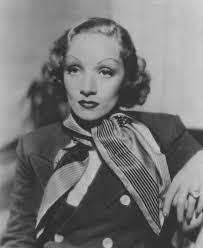
Marlene.jpg
Public Domain

“Duties are what make life most worth the living. Lacking them, you are not necessary to anyone. And this would be like living in an empty space. Or not being alive at all.”- Marlene Dietrich, born Dec 27, 1901

Season’s Greetings!

A Robin’s Tarot Tale

A Christmas robin reading…..

Katie-Ellen's avatarTrue Tarot Tales

A real reading done for a robin, befitting the season.


Image: Public Domain

There are many depictions of animals and birds in the Tarot.  They form a great part of the human landscape physically, intellectually, emotionally, spiritually, and symbolically. If there’s a heaven, what would it be without them? I wouldn’t mind, personally if mosquitoes, maggots, deadly snakes and komodo dragons didn’t make it. Spiders would be all right as long as they were non-venomous and less than two inches in diameter. However, it’s not me in charge.

The  songbird traditionally most associated with Christmas, or to give the winter festival its older name,   Yuletide – is the robin redbreast. The cheeky, dumpy little European robin, Erithacus rubecula is a member of the flycatcher family.

Its preferred habitats are woodlands, hedgerows, parks and garden. Its staple diet is worms, seeds, fruits and insects. It will fight over sunflower seeds and it adores…

View original post 977 more words

This Tarot reading stuff. Divination or Counselling?

The cosmic archer Sagittarius.

Most of us know our zodiac or sun sign, but what does it look like in the night sky, and what’s the story behind it? This month it’s the turn of Sagittarius.

Common associations

Symbol:

Date of Birth: Nov 22 to Dec 21

Ruling planet: Jupiter

Element: Fire

Key phrase:  I seek

Body: Thighs

Birth Stone: Topaz, Citrine, Turquoise 

Colour:  Light Blue

Tarot card:  Temperance

Temperance wiki rider waite.jpg

Public Domain:  Rider-Waite

The Astronomy

As with all of the Zodiac constellations, Sagittarius was recorded in the 2nd century by the Greek astronomer Ptolemy. The name is from the Latin for archer.

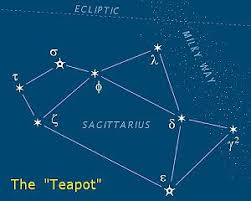
Sagittarius is a relatively large constellation which is mainly visible in the southern hemisphere. In the Northern hemisphere the constellation can be viewed low on the horizon from August to October. In the Southern hemisphere Sagittarius can be viewed from June to November. Star maps generally depict Sagittarius as a vaguely teapot-shaped star pattern or asterism.

Map sagittarius wiki.jpg

Sagittarius is near the centre of our spiral galaxy, the Milky Way. There is a massive star-forming region known as the Omega Nebula situated within its boundaries and Sagittarius is also home to the Pistol Star, one of the brightest stars, the fifth brightest discovered in the Milky Way. First discovered by the Hubble Space telescope in 1930, the Pistol Star is largely hidden in the dust of its own Pistol nebula, but is 100 times as massive as our Sun, and 10,000,000 times as bright.

Watch here for a mind-boggling representation of where the Pistol Star sits in the scale of size of stars in the Milky Way: https://www.youtube.com/watch?v=GoW8Tf7hTGA

The Myth

Sagittarius Celestial Atlas 1822.jpg

Public Domain: Celestial Atlas 1822

Sagittarius is the ninth sign in the Zodiac and represents those born between Nov. 22 and Dec. 21.

Greek myth saw Sagittarius the Archer shooting Scorpio the Scorpion, which had been sent to kill Orion the Hunter.

Sagittarius has long been mixed and confused with another centaur story, Chiron of the Centaurus constellation. Most interpretations conclude that Sagittarius refers to the the centaur, Chiron, who was accidentally shot by Hercules with a poison arrow.  

This story does indeed refer to a constellation myth, but it’s the myth behind Centaurus, a non-zodiac constellation, and not Sagittarius.

The myth behind Sagittarius probably refers instead to Krotos, a satyr who lived on Mount Helicon with the Muses. Krotos or Crotus was the son of Pan and Eupheme, and his mother had nursed the Muses.

Krotos was renowned for being both an excellent hunter, horse rider and a devoted adherent of the Muses and their arts. He is credited with having invented archery and being the first to use illumination for hunting animals. He is also said to have introduced applause, and used to clap his hands at the singing of the Muses, for whom this was a sign of acclaim preferable to any verbal ones. It was the Muses who asked Zeus to place him among the stars, which he did, transforming Krotos into the constellation Sagittarius.

Satyrs have human heads and torsos with two goat legs (and sometimes horns). Centaurs have four but the accounts and depictions of Krotos vary. But all the same, he was often depicted with four legs, as the excellent horseman he was.

The Astrology

Sagittarius is the ninth sign in the Zodiac and represents those born between Nov. 22 and Dec. 21. The archer is seen as a bridge between elements and worlds. The life lesson is seen as Temperance, as pictured in the Tarot card associated with this sign. The message is all to do with the quiet but enormous power of moderation, the art of expert timing, and also self-control, avoiding extremes and addictive behaviours.

The Astrological Personality

There is no such thing in reality as THE Sagittarius personality and the same goes for all the zodiac sun signs. Your sun sign is an archetype, a keynote but of course it is not and never could be the whole story.

The archetype of Sagittarius is brave, lively, warm, optimistic, rational and insightful. Sagittarius zodiac sign subjects need constant adventures and opportunities to grow to remain interested. Freedom is of the utmost importance to them, space and plenty of room for manoeuvre. Likewise they tend also to give lots of freedom to their partners.

They are generally very capable people but they need career flexibility, and they may refuse or fail to apply themselves if bored.  Like Gemini, they are prone to restlessness. They may then fail to stick at a job or a succession of jobs, and may struggle financially in consequence.

They tend to have lots of friends, and family and friends can feel neglected at times when Sagittarius goes go off and travels and shares experiences with strangers, but Sagittarians will always come home.

Next time, the cosmic goat Capricorn…

Halloween and ‘Alfablot’-‘Sacrifice to the Elves’

Did the Norse celebrate Halloween? Plus a message from the runes for you…

Public Domain

What we know of Norse Mythology comes largely from the Eddas, two collections of writings from assorted anonymous writers, dating around 1250 CE.

All Hallows Eve, Halloween or Samhain is a Gaelic custom, not Norse.  The Norse peoples did mark this time of year, although in a different way, with Álfablót – the Elf Ritual.  

Elves were associated with burial mounds (also known as barrows) as it was believed that they lived in or around them, and more than this, elves were associated with the souls of the dead, rather than fairies in the other sense of the word, as a supernatural entity that was never human.

Rakni’s burial mound, Noway, Public Domain

It is the largest burial mound in Scandinavia, 77 metres in diameter and over 15 metres in height. There are a number of stories associated with it, one associated with a roving sea-King Raki or Ragnar. Skull fragments were found inside it, of a man aged between 20 and 25 but there were no grave goods. The mound has been dated to the sixth century to the time of the great migration after the collapse of the Roman Empire.

It is possible that this chieftain was an ancestor of Rollo, the Norse ancestor of William the Conqueror.

Like the modern Halloween, Álfablót originally marked the general end of autumn, although it may technically be celebrated on any day around this time. However in recent years, it has been predominantly practiced on or close to 31st October (Halloween/Samhain). 

Traditionally, Álfablót almost certainly involved an animal sacrifice, (blood) Records suggest this may even have been a (highly valuable) bull. It was intended as a sacrifice to the elves, asking for protection from the ancestors. Connected with this, the elves were also associated with fertility. 

A chief difference here is, unlike Halloween/Samhain, Álfablót was not a community celebration. It was a private ritual performed at the homesteads. Strangers were not permitted to take part or even watch.

Old Norse Runes

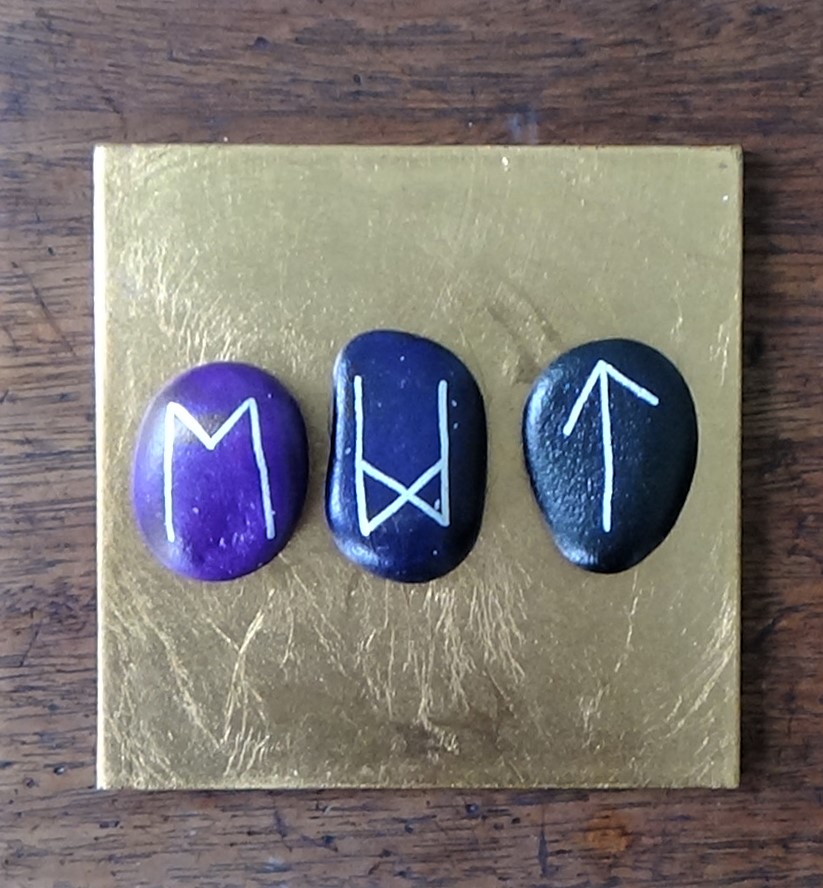
What runes do we drawn this Halloween Álfablót 2022?

Ehwaz The Horse transport, journey progress

Mannaz Merkstave Communication difficulties, trouble with fellow man

Tiwaz Justice, Law and War (spear)

The message is not a cheerful one, I am sorry to say, but it will easily be understood why not in the context of the war in Ukraine and a lot more besides.

One might reasonably say, but the dead do us no harm? It is the living we need to watch for. Well, that depends upon their legacy, and the memories they leave behind. Jewish graves read ‘may their memory be a blessing.’

The rune of mankind has been drawn merkstave. This advice is a downer. In these days of travelling far afield almost at the drop of a hat, don’t be too quick at this time to get on your ‘horse’ and ride off to the lands of ‘strangers’.

Don’t be too quick to share your opinions with your neighbour, or all and sundry.

You do not know what they may be struggling with when you enter their space. Beware of the horses coming to your door carrying strangers. Some will come as friends, and honour us with their arrival. But not every stranger comes as a friend. The history books warn, it is a friendly fool that can’t tell friend from foe.

Why do you travel? What do you bring to the places you visit, for the sustenance of the people who live there?

Who is this that is coming now? Why do they come? What do they seek? What do they offer? Is it a fair just and lawful exchange? Or is this a hunting trip? What is the prey? What is the prize?

This grim counsel goes against our powerful instinct of hospitality and kindness to strangers. But that bottom line was always there, and the runes are reminding us.

The Viking raid on Lindisfarne in 793 sent a shock wave through Europe. But this was just the start of something bigger. What was driving it? In part, changes to the laws of inheritance in Scandinavia, younger sons, now dispossessed of family farms, had to go in search of their own fortunes.

So they did.

The Viking Raid on Lindisfarne

Another way of looking at these runes in terms of comment or advice about the cosmic weather right now, which is, beware of joining the crowd.

Beware of crowds. This, following the tragedy in Seoul where 150 or more people have died in a crush at a Halloween celebration. And the death toll is still rising, following the collapse of a bridge in India killing over 141 people who were celebrating Diwali, the festival of lights.

This also refers to getting into arguments on social media, and avoid gossip at this time. Stay clear of group-think.

The runes here are reflecting the fact that fiery Mars, planet of war, has just moved into the zodiac domain of Gemini, the sign of communications and siblings, and it will stay there, appparently moving backwards or retrograde, until 12 January 2023. There will be spectacular events. One can see how this combination may represent aeroplanes, missiles or indeed any kind of projectile. The threat of a nuclear attack is real, though I haven’t been shown that it will happen.

Contagion travels by the same token, suggesting an inevitable rise of flu and covid cases starting now, at least in the northern hemisphere.

There are many kinds of ghosts. There are the whirling leaves that used to be buds. There are the echoes of the distant past. There are the ghosts of our hopes, not all of which can ever be realized, the grief, the fears and memories of the living.

But Jupiter is returning to Pisces and this brings a promise of good cheer. Even in desperate times we see a Ukrainian soldier rescuing a hamster in a cage, the hamster obliviously running in its wheel. The soldier places it in the back of the truck, returns for two rabbits.

In such moments rests the hope for humanity.

Death is the theme for the season- and this is an unusually tricky Halloween season, caught between the partial solar in Scorpio on 25 October, and the upcoming Lunar eclipse in Taurus on 8 November.

Photo by Josh Hild on Pexels.com

HALLOWEEN

The grey ghosts are shifting.

Mists are lifting on the grey graves

where sandpipers call.

Mountains or clouds,

grey whales or waves

all one under the treacherous sun.

Fishbones are heaped

on the floors of the forest

where the Red Beast crouches

squinting aslant.

Waterbones lie fractal on stones

and frozen meniscus squeaks and groans.

Giant scaffolds loom in carlights 

where Death has swept up

to throttle the Titans,

shaking stiff in their ropes.

Ogres rear in the speeding corner.

White in the phantom night

respectful retainers line the lanes;

skulls and jaws, knuckles, thighbones.

stand to attention.

And the moon is ringed in a saturnine glow.

Dry bones stand tall by hedge and wall,

incorruptible, crack and creak

as the Old Year enters

The Big Sleep

Margaret Whyte 21.11.04

The Zodiac’s Celestial Scorpion

Scorpio…The celestial scorpion

Most of us know our sign of the zodiac, but what does its constellation look like in the night sky, and what’s the story behind the sign? Around October 23 this month we entered the sign of the Scorpion.

Common Associations

Dates:  October 23 –November 22

Ruling planets:  Co-ruled by Mars, and after its discovery in 1930, Pluto

Symbol:  Scorpion, Eagle (Because of the nearby constellation, Aquila, the Eagle)

Zodiac element: Water

Zodiac quality: Fixed

Keyword:  I desire. I transform

Colour:  Dark red

Birthstone:  Yellow Topaz, Opal, Aquamarine, Tourmaline.

Tree:  Walnut,Hawthorn, Blackthorn

Tarot Card:  Death

Death card.jpg

Image from the Rider –Waite

Astronomy

Scorpius from which the zodiac sign of Scorpio gets its name, is a massive and spectacular j- shaped constellation located in the southern hemisphere near the centre of the Milky Way. In the Northern hemisphere it can be seen in July and August, most visible in July at 9.00 PM. In the Southern hemisphere it is visible from March to October, looking like a faint band in the Milky Way overhead.

https://upload.wikimedia.org/wikipedia/commons/thumb/4/4e/ScorpiusCC.jpg/256px-ScorpiusCC.jpg

Its name is Latin for scorpion and it is one of the 48 constellations identified by the Greek astronomer Ptolemy in the second century. Like Aries, Taurus and Leo, it is an ancient constellation, recognised as such pre-dating the Greeks.

Scorpius is the southernmost of all the constellations in the zodiac, and lies between Libra to the west and Sagittarius to the east. It used to be bigger, but its claws later became part of the constellation the Romans named Libra in the first century.

Its brightest star, one of the brightest of all in the night sky, is the ‘heart’ of the scorpion, Antares, meaning ‘rival of Ares’ (the Greek name for the Roman god of war, Mars) It is so-named because it is bright reddish in colour, like Mars, and also because Scorpio’s ruling planet was Mars until Pluto was discovered in 1930. Now it is considered co-ruled by both Mars (The Warrior) and Pluto (The Transformer)

Scorpius contains many bright stars, and interesting exo-planets.

The planet PSR B1620-26 b is sometimes nicknamed “Methuselah” being estimated at 12.7 billion years old.  (The universe is about 13.7 billion years old.)  Methuselah is vast, with a mass about twice that of Jupiter and it orbits around not one, but two stars.

Gliese 667Cc is a “super-Earth” about four times as massive as Earth. It orbits a red dwarf star, Gliese 667C; part of a three-star system only 22 light-years away from Earth. It’s considered potentially habitable and the same system contains two other potentially habitable planets: Gliese 667Ce and Gliese 667Cf – both  are about 2.7 times the mass of Earth.

“Habitability” is defined as a rocky world that is close enough to its parent star for liquid water to exist on the surface, though other factors may later rule it out, such as the variability of its star, or the composition of the planet’s atmosphere.

Mythology & History

Nature, religion and astrology were intertwined in the ancient world, and the scorpion has been here hundreds of millions of years, more than 450 million, compared with our six million or so.

Sometime around four thousand years ago the Babylonians looked up, discerned the brightly leaning J- shape in the summer stars and called this constellation MUL.GIR.TAB – the ‘Scorpion’, literally read as ‘the (creature with) a burning sting’.

The movements and relative positions of Scorpius were mapped by Babylonian magicians and astrologers, who left written records.

“When a halo surrounds the Moon and Scorpio stands in it, it will cause men to marry princesses, (or) lions will die, and the traffic of the land will be hindered.”

A comet appearing in Scorpius was read as a warning of a plague, but when the Sun rose in Scorpius, alchemists saw their one chance for the transmutation of lead into gold.

Sidney_Hall_-_Urania's_Mirror_-_Scorpio.jpg

Public Domain

In Greek mythology the scorpion refers to a story about Orion. According to one of these myths Orion boasted to his friend the goddess Artemis and her mother, Leto, that he would hunt and kill every animal on Earth. Demeter, the goddess of Earth decided this was completely unacceptable behaviour.

Artemis was a great hunter herself, but she did not kill for the sake of killing and was ultimately a protector of all creatures. Demeter sent a scorpion to deal with Orion. He fought back, and according to some accounts he killed the scorpion, but whether or not Orion killed the scorpion, the scorpion definitely killed Orion.

Zeus was much impressed by the scorpion’s battle spirit, and raised the scorpion to heaven, and at the request of Artemis; he did the same for Orion.

In other cultures it is not seen as a scorpion. In Indonesia it is the Banyakangrem – “the brooded swan,” or the Kalapa Doyong, meaning “the leaning coconut tree.” In Hawaii, it is “The Fishhook” of the demi-god Maui.

In Chinese mythology, the constellation is part of the Azure Dragon.

And yet, there is consensus across not only continents but hemispheres. Thousands of years before the Greeks and Romans established their societies, the Australian Aboriginal people also saw the stars of Scorpius as a cosmic scorpion, as did the Aztecs of Central Mexico. The Lowland Mayans  had scorpion constellations. These may have matched up with the Scorpion of the zodiac, but there no clear proof. It is thought that the Mayans viewed the celestial scorpion as an eclipse-causing agent.

The arrival of Scorpio’s sign in the northern hemisphere coincides with the advent of mystery, the fast fading autumn light, and the ghosts, myths and superstitions of Halloween, or All Hallows Eve, hence its association with the Tarot’s Death Card.

Facts about scorpions

  • They are an ancient creature, the earliest evidence dates from the Silurian period 450 million years ago, when the first scorpion ancestors left the seas for the land. Fossils from the Carboniferous 300 million years ago indicate little change since then. Early scorpions may have had compound eyes. 
  • They are arachnids: arachnida scorpiones, with a body in two sections, 2 pincers or pedi-palps, 8 legs like a spider, and an exo-skeleton made of chitin. They are more closely related to Harvestmen than spiders.
  • They dance before mating, a stately promenade. They give birth to live young and carry them on their backs until the babies have their first moult when they disperse. The mothers may eat the young if resources are desperately scarce.
  • They have a long life span compared with other arachnids, 2-3 years in the wild but they have lived up to 25 years in captivity. They can live a year without food and eat insects, spiders, other scorpions and lizards. They also eat small mammals, such as mice.
  • They glow in the dark except when newly moulted. Scorpion fossils still fluoresce, despite spending hundreds of millions of years embedded in rock.
  • They are famously venomous. However of the nearly 2,000 known species of scorpions, only 25 have venom powerful enough to be dangerous to an adult human. In the U.S., the Arizona bark scorpion, Centruroides sculpturatus, produces venom strong enough to kill a small child, but anti-venom means deaths are rare.

The Scorpio Zodiac Personality

Like the other water signs, Cancer and Pisces, Scorpio is considered clairvoyant, or at least, keenly intuitive. But Scorpio has far greater intensity. This is water behaving as steam, while not overlooking the venom of its sting.

Scorpio rules the eighth sign of the zodiac, to do with Birth, Sex and Death.  No wonder the subjects can be intense, and they are often possessed of great personal charisma. They are watchful but keep their feelings hidden. Born investigators, spies or secret agents, they are shrewd judges of human nature, while less conscientious Scorpio subjects may make use of this to their advantage, and drop friends whom they no longer see as useful.  But combined with their intense determination and loyalty where they decide to accord it, Scorpios can make great leaders, scientist, and devoted doctors. They are quick learners, very adaptable, often changing careers, going down new paths.

Scorpio can be vengeful…and patient, but also devoted, and they never forget a kindness either.

Next time…the story of Sagittarius.

IF BACON GREW ON TREES

The Nutrient Report and other essays on food, eating, diet, health and the state of our planet

Rex Factor

Reviewing all the Kings and Queens of England & Scotland

The World's Passenger Ships

Ship History site, a compendium of passenger ships 1858- today's new builds

Capricorn Astrology Research

Research into Astrology

WAR STORIES

WWII & its Aftermath - Jennie Mack Gray

Quintus Curtius

Fortress Of The Mind

Jessica Davidson

Astrologer ~ Mystic ~ Writer

Mythology Matters

Matters of Myth, and Why Myth Matters

The Sanctuary of Vindos

Brythonic Polytheism and Shamanism