Friday 23 September marks the the first day of astronomical autumn/fall in the Northern Hemisphere. and spring in the southern hemisphere, when day and night are nearly equal. In the United Kingdom the equinox will be 02:03 AM
This is the day when we enter the zodiac air sign of Libra, and the Tarot cards specifically associated with 23 September are Justice and the Two of Swords, belonging to the first decan of Libra.
You will notice a striking similarity between this card and the Tarot’s Justice card, its major arcana counterpart.
The Gilded Tarot Royale, Ciro Marchetti
The Two of Swords is blind like Justice. Wilfully blind, and for a purpose, either for tactical reasons, or because this decision simply cannot be rushed. Here, the wings serving as a blindfold denote the element of air, and impartiality, the use of cool, calm intellect brought to bear on a tricky situation.
If the card comes out upside down, then someone is being a refusenik. A decision must be taken but they are procrastinating.
The Two of Swords can describe a see-saw, and is reflecting what we all know, that internationally and domestically October looks like another tense month of watching, waiting, diplomatic stand-offs and tensions.
Mercury goes direct again 2 October, possibly smoothing certain communications, but October 2022 is going to be anything but a mild news month, and we don’t need the Tarot to see that.
I’ll be watching the first ten days or so of October when we are in Three of Swords territory. Meaning? Severance. Putin is a second decan Libra, which has all manner of wonderful qualities. But his personal chart features a difficult fixed star; born with his natal sun conjunct the ‘rapacious and fiendish’ Algorab, the right wing of the Crow in the constellation of Corvus the Crow.
The Two of Swords is difficult at times. It may suggest indecision, a delay, or a truce, a stand-off, a stalemate. Libra will see-saw in seeking to achieve an equilibrium. It may see-saw rather a lot.
On a personal level, more than once the Two of Swords has alerted me to the fact that a client has been experiencing headaches, possibly migraines. These have often been attributed to stress. Or they have been to see the optician, or have just scheduled a visit to see the optician. The Two of Swords may mean eyes-or teeth. This card may be talking, entirely literally, about needing to see the dentist.
Tarot can be literal like that. Rightly so. The reader is working in the real world. No, it isn’t always fun.
But the world keeps turning, and with it, the wonders of the wheel of the seasons.
How soon will we see the UK (and global) economy recover from the recession created by the global effort to minimize deaths due to covid19? I am basing the question on a dateline starting this 1 September.
I shuffle and draw the Nine of Pentacles, also called the Nine of Coins.
The Legacy of the Divine Tarot, Ciro Marchetti
This Minor Arcana card is in my mind, the Tarot’s personification of Britannia and it:-
talks first and foremost about financial independence and self-sufficiency attained through employment or self-employment.
correlates with the zodiac sign of Virgo, which runs 23 August-22 September and together with the other earth signs, Taurus and Capricorn, is a key zodiac sign associated with banking and financial services. Also schools and universities.
Is ruled by Venus, planet of beauty. Not only does it rule banking and all financial services, it rules the beauty industry, hospitality, architecture, the arts, design, fashion and horticulture, viticulture and food production.
Therefore, drawing the Nine of Pentacles, I have a benchmark for interpretation, sufficient to confirm that the Tarot has ‘logged’ the question. OK. So how long for the UK to come out of recession, counting ahead in financial quarters of a year.
How many financial quarters will it take?
I switch to my ordinary playing cards asking to see how many financial quarters it will take the UK to enter recovery, using one card to represent one quarter and asking to be shown the Ace of Diamonds in token of a definitive answer to this question.
Divination involves a lot of this kind of self-programming. It’s all in the framing of the question.
I shuffle the cards blind, pull a card, pull another, pull another…how many cards will it take before we get a good money card….and the third card out is The Ace of Diamonds.
The Ace of Diamonds is suggesting that the UK will start to see some good news, small signs of recovery in the third quarter counting forward from September 2020, which would bring us to June 2021.
I’m surprised that the Ace Diamonds has made an appearance so soon, but this is a volatile card compared with say, The Ace of Clubs which is also a money card, but more solid, and I carry on pulling cards.
The fifth card, representing the fifth quarter is the Six of Diamonds.
Six is the number of community, and diamonds is the suit of money. This card can suggest loss, and of course there have been losses, and there will be more. But on balance it is a positive omen for the state of UK employment.
In summary the UK seems to show small signs of economic recovery with ups and downs but possibly as early as the next 3-5 financial quarters bringing us to June-December 2021.
So now I go online to find out what the Bank of England has been saying.
“The Bank expects the UK economy to shrink by 9.5% this year. While this would be the biggest annual decline in 100 years, it is not as steep as its initial estimate of a 14% contraction.”
So, we drew the Nine of Pentacles and here they are, forecasting a shrinkage of 9.5 % this year. But wait….hang on – here comes another nine.
“More than nine million jobs have been furloughed under the government’s job retention scheme, but the Bank expects most people to go back to work as the economy recovers.”
One of these people has been my son- in- law, a chef. And now he’s back to work. But hang on a sec…. ding- a- ling, here comes a third nine.
“The Bank expects the UK economy to grow by 9% in 2021, and 3.5% in 2022, with the economy forecast to get back to its pre-Covid size at the end of 2021.”
For the UK economy to return to its precovid size by the end of 2021 would accord with the 5 quarters intimated by the Six of Diamonds.
In a further comment Andrew Bailey, the Governor of The Bank of England said,
… “the UK still faced its sharpest recession on record, with the outlook for growth now “unusually uncertain.” Mr Bailey said it was the “largest quantum of uncertainty in a forecast” that policymakers had ever published.”
Last quarter 2021 seems rather optimistic. But if it’s 2023, perhaps that’s not bad, considering the aftermath of the Great Depression. As ever, only time will tell.
Orion The Hunter returns, and in the northern hemisphere can once again be seen bestriding the east at sunrise. So when we say return, where has he been, then? The answer is, he has been invisible, hidden in the glare of the sun since May.
But now he is back and will rise earlier each day until he is visible all evening during the winter months. As a girl I used to like to go out on cold frosty evenings to fill the coal scuttle from the coal bunker in the back garden. Looking up at him. I knew his name. I knew he was The Hunter but wondered about him, and what he was hunting up there.
Those winter evenings still have that same kind of magic.
Orion is only the 26th largest constellation, sitting on the celestial equator, facing the constellation next door, the oncoming, charging, Taurus the Bull. So it’s far from being the biggest, and it’s smaller than another Greek hero, Perseus but Orion’s got more brilliant stars, commanding the impression of its vastness.
(The biggest constellation of all is Hydra, and the biggest constellation of the twelve included in the Zodiac is Virgo.)
Orion’s two brightest stars are the blue-white star Rigel, representing the Hunter’s left foot, and the red supergiant Betelgeuse, Orion’s right shoulder. They’re both thought to be to be about ten million years old, which makes Betelgeuse quite young to be a red supergiant, but it’s evolved faster due to its enormous mass. It is expected to go supernova in the next million years and when it does will be brighter than the Moon and the brightest supernova ever to have been visible from Earth.
Orion’s third brightest star is Bellatrix, his left shoulder, and Orions’s Belt is one of the most easily recognized asterisms with its three stars.
You can read them east to west or left to right; Alnitak (girdle), Alnilam (string of pearls) and Mintaka (area) They have many other names across the world; The Magi, the Three Mary’s, and the Mayans called them The Fire Drill, invoking them in an annual fire ceremony to delay the onset of the end of the world.
‘No other constellation more accurately represents the figure of a man,’ said Germanicus Caesar
Orion is identified as a human figure in every culture at every latitude, with countless variations of different names and legends.
Orion, also called Nimrod, was the son of Poseidon and was the most handsome man ever to walk the earth. He was a great hunting buddy and friend of Artemis. Her twin brother, Apollo glowered, seeing that Artemis fancied Orion something rotten, although she had taken a vow of perpetual chastity.
Orion could be a bit of a sex pest, chasing the Pleiades, so that Zeus confiscated them to the sky for their own peace and quiet. And a fat lot of good it did them, because when Orion was killed by a scorpion (THE scorpion) Artemis in her grief, asked Zeus to post Orion upstairs to the heavens, which he did, right next door to the Pleiades, who also represent the celestial bull pen of Taurus. Thanks Zeus. You didn’t think that one through, did you?
Should Taurus ever break free of his pen, said an ancient Arabic legend, it will be the end of all things. Let’s hope he’s happy up there, and that Orion doesn’t chase the Pleiades away.
Orion bravely strides towards the Bull but although he killed the scorpion that also killed him, he still fears it, and dreads its appearance fleeing west as the autumn wears on and Scorpius rises (Scorpio)
Orion in his eternal battle with Scorpius
The stand off between Orion and Taurus the Bull, its red eye, Aldebaran glaring at him, daring him to come nearer, does not fit the Greek legend of Orion, and a question has been raised in some quarters over the identity of Orion, and whether he has become confused with Herakles/Hercules at any time in his identification with this constellation.
The reasons are likely historical. The constellation as recognized by the Greeks originated with the Sumerians, who saw in it their great hero Gilgamesh fighting the Bull of Heaven. The Sumerian name for Orion was URU AN-NA, meaning light of heaven and Taurus was GUD AN-NA, bull of heaven.
Gilgamesh was the Sumerian equivalent of Heracles, the greatest hero of Greek mythology, and one of the labours of Heracles was to catch the Cretan bull, but Orion was never in a fight with a bull. Heracles, it has been suggested, deserves a magnificent constellation such as this one, but has been consigned to a much more obscure area of sky. So has there been a mix-up, or perhaps we could see it as a mash-up, Orion and Heracles in mutual diguise?
Orion and The Tarot
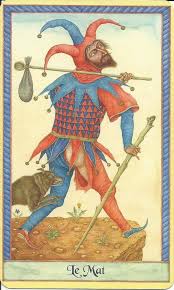
The Golden Tarot by Kat Black
The Tarot card most commonly associated with Orion is The Fool. The most numinous card in the deck, its element is Air and it is ruled by the planet of revolution, Uranus.
It is the portal of the number Zero.
The Fool or as some called him, The Jester, is both beginnings and ending.
In a real life reading it may detect or forecast a birth of a child, or a new offer or a launch or opportunity of some kind. And change happens all the time but this is always major or significant in scope. But although is not associated with Death, unlike the famous Death card, it can mean a death too, representing infinity, the ouroboros.
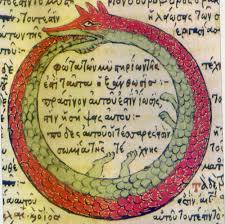
An ouroboros
The Fool lives in the moment. He may be fun, he may be joy, or he may be frightening. There’s every reason a lot of people are scared of clowns as the living embodiment of The Fool. He represents the wisdom of innocence, or mistakes made through impulsiveness or ignorance rather than stupidity. But he may represent a threat, whether direct or existential, clearly sensed but not as yet clearly identifiable. The fear is visceral, not lightly to be dismissed.
He may be a shamanic, gnostic figure; the stranger, the outcast, the wise Fool or the Fool on the Hill. He dances to his own tune. He takes chances, risks, and sometimes these pay off, but sometimes he steps over the edge of the cliff, heedless of his dog’s most urgent warning.
The dog in the card is not biting the Fool, but desperately trying to get his attention. If someone asks the Tarot’s advice and then I draw this card reversed….someone needs to draw back from the precipice and look again before they leap.
I may bark like the Fool’s dog but will they act on this advice? CAN they? Will they even really hear it, let alone find a way to use it? We are who we are, and we do what we do, based on who we are. It is a rare person who can step back and see things anew once they are committed to Opinion A or B or they are emotionally invested in outcome A or B.
Advice, to be heard, must be sufficiently timely, before the paint dries.
Everywhere the Fool goes, his dog follows, just as Orion is followed in the skies by his two hunting dogs, Canis major and Canis minor. Sirius, the Dog Star is in the constellation of Canis Major and is THE brightest star in Earth’s night sky.
The only objects that outshine Sirius in our skies are the sun, moon, Venus, Jupiter, Mars and Mercury – and Sirius will usually outshine Mercury too.
All Mankind is Orion.
We were hunters at the dawn of man (The Fool) And gatherers too, but we were never gorillas, and never herbivores on our ancestral line.
“We were risen not of fallen angels but risen apes, and they were killer apes besides” – Robert Ardrey, in African Genesis.
Hunting was what brought us together in teams, then communities. Co operation meant compassion.
Fatboy Slim tells a version of that story here (except that we were apes but not on the gorilla branch). See Orion in the final frame of the video.
Leo is such a glamour-puss. So what’s this about the perm?
The sun has entered the second decan of fiery Leo, August 2-August 12 and tonight’s full moon, 3 August, is in Leo’s opposite zodiac sign; Aquarius, the water-bearer, the cloud bearer.
This is a strange, dreamy, quirky, quixotic and steamy combination. Maybe in a good way but not necessarily.
It might mean a few nights of oppressive humidity over the next two weeks.
It might mean getting frazzled.
It might mean steam coming out of your ears. Like this little lioness with a rather enviable perm.
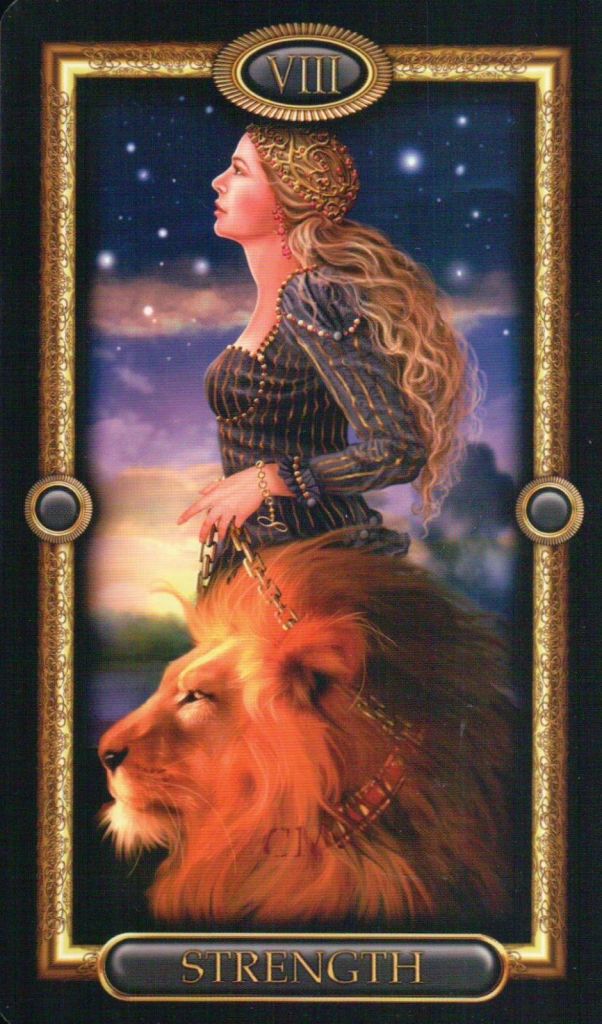
The Major Arcana card associated with Leo is Strength: physical, mental, moral, emotional. Fortitude which demands patience. Nothing much can be achieved without the ability or willingness to stand and endure.
Centuries apart:
“Here I stand. I can do no other,” Martin Luther at the Diet of Worms.
“The ultimate measure of a man is not where he stands in moments of comfort and convenience, but where he stands at times of challenge and controversy.”-Martin Luther King.
He was a Capricorn native. But we are more than just our keynote sun sign. We encompass the whole zodiac
Strength from The Gilded Tarot Royale: Ciro Marchetti
The second decan of Leo is associated with the Tarot’s Six of Wands, the 6 Wands; a card of action, vision, passion ,courage and superb self-discipline. This is what it takes to enter the arena – any arena. Riding high on the accomplishment of a great effort. But there are no short-cuts. No escaping the Herculean labour to be done. This is dedication to excellence; the attribute of the zenith of the sign of Leo.
The Six of Wands From The Legacy of the Divine Tarot, Ciro Marchetti
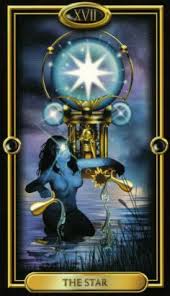
Tonight this energy is tempered by the quirky, remote, cerebral Moon in Aquarius. The corresponding Major Arcana card here is The Star: inspiration, a vision, recovery, the application of reason, but this can also be the card of social revolution.
The Gilded Tarot, Ciro Marchetti
The Star
Bridging water, land and sky
Cloudy, cool Aquarian eye
Reasons, gauges Rain assuages
Pours, refills an empty jar
Learning, thirsty, takes us far
But Hope outshines all other stars
Katie-Ellen
A very different mood. May steam be expected, and will it be steam coming out of someone’s ears? It may be best to keep your head down and just get on with your own thing, always assuming it’s not against the law, of course.
The Minor Arcana card corresponding with the degree of tonight’s Full Moon in Aquarius is the solemn yet benevolent Six of Swords; a road to recovery, new learning and discovery, charting new waters, leaving behind the past and with it any vain regrets.
The Legacy of The Divine Tarot, Ciro Marchetti
The next two weeks look unsettled and a lot of us are likely to be feeling more jumpy than usual, even given all the anxiety of recent months . This is a time for staying extra cool, calm and flexible and avoiding risk and conflict. This is a time for focusing hard on work and personal projects, but not for making sudden moves or big changes.
There’s plenty to push our buttons right now. Leo says we can put our energies to plenty of good uses, doing our own thing, and Aquarius says we can keep our cool, even if others are losing theirs.
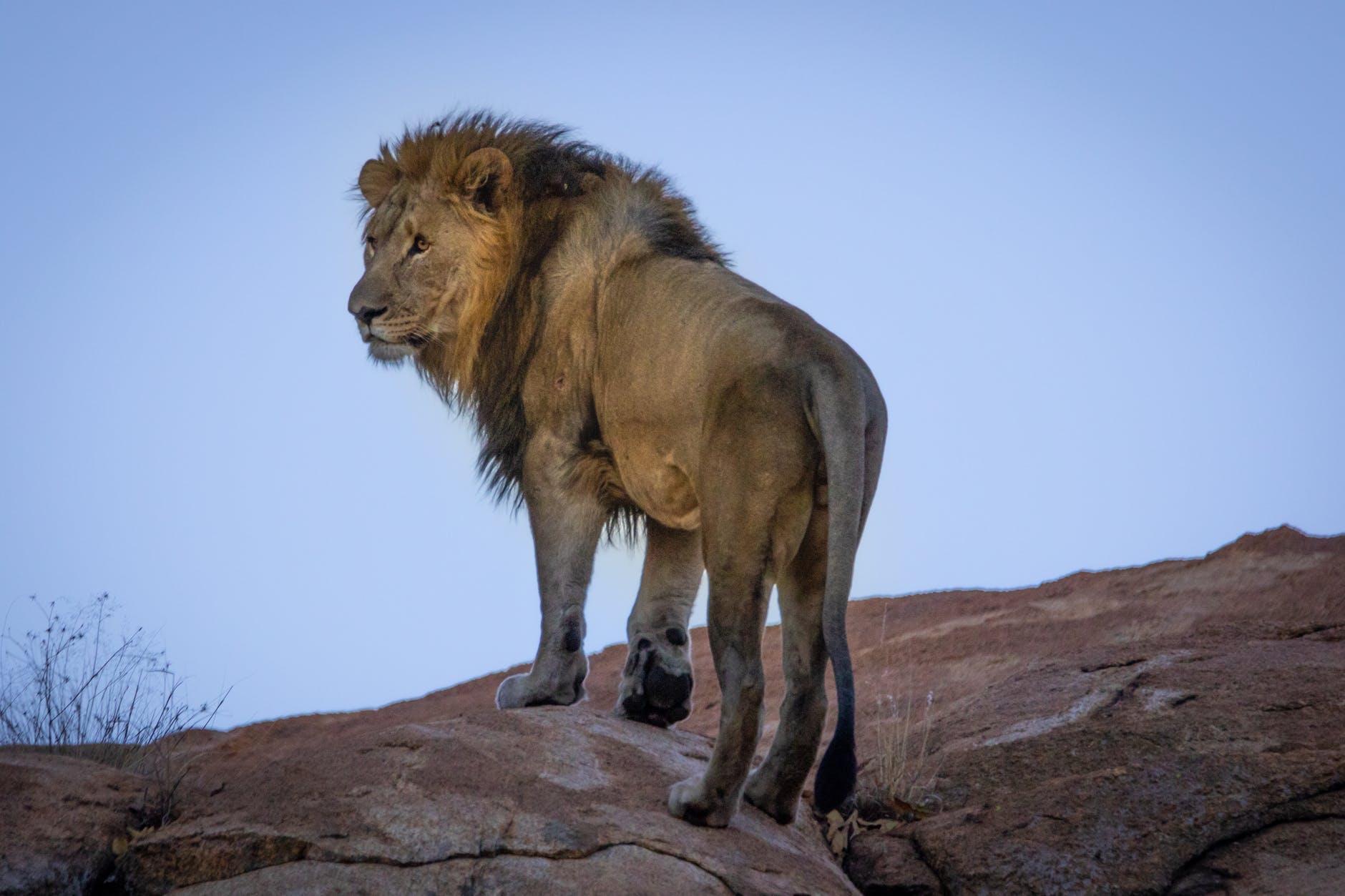
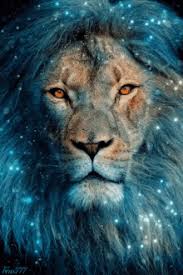
Today 22 July, we leave the zodiac sign of Cancer, the mysterious and elusive Crab in the Starry zodiac sea, the sign of the zenith of the summer, and we move into the astrological sign of Leo the celestial lion. Most of us know our zodiac or sun sign, but what does it actually look like in the night sky, and what’s the story behind it? It’s time to roll out the red carpet for the star-lion, Leo…
The Lady and the Lion. Perhaps it is Una. Or perhaps her name is Leona or Leonora, for the lion is also the lioness. Her hold on the leash could not be lighter. She is controlling the lion, but only because it is allowing it, not fighting her restraint, signifying that the lion is also a part of herself. This is just as one would imagine, a very welcome card of better health, signifying recovery if someone has been ill.
Astronomy
Leo is one of the 48 constellations described by the 2nd-century astronomer Ptolemy, and one of the 88 modern constellations recognised by NASA today, between the neighbouring constellations of Cancer to the west and Virgo to the east.
Leo is the 12th largest constellations, and one of the most easily recognizable due to its many bright stars, and a distinctive shape suggesting a crouching lion, apparently facing right.
The bright light in the sky beneath Leo as seen in the photo below is Jupiter.
Wiki
The best time to see the Lion is Spring in the northern hemisphere, from around the March equinox. In early April, the constellation Leo reaches its high point for the night around 10 p.m. By around May 1, Leo reaches his high point for the night around 8 p.m. local time In early May, the Lion begins to set in the west around 2 a.m. local time and by June, Leo is descending in the west in the evening, drifting progressively westward.
By late July and into early August, the Lion is beginning to fade into the sunset, returning to the eastern sky and visible before dawn around late September or October.
Look out for the Big Dipper, Leo is below it. You are looking for a backwards question mark pattern called the Sickle; and you can see its curve outlines the Lion’s mane.
Leo’s brightest star, Regulus, or Alpha Leonis, ‘The King Star,’ is the heart of the celestial lion, a sparkling blue-white star at the bottom of the backwards question mark pattern. Regulus, means “little king” or “prince” in Latin. The star’s Greek name, Basiliscos, has the same meaning, while the Arabic name is Qalb al-Asad, meaning literally “the heart of the lion.”
Mind Boggler -Leo’s fifth largest star, Epsilon Leonis, 247 light years from Earth, is 288 times more luminous than the Sun, four times as massive and has 21 times the solar radius.
A triangle of stars in eastern Leo represents the Lion’s hindquarters and tail. The brightest star of the triangle is named Denebola, Arabic, meaning the Lion’s Tail.
There are 15 stars in Leo with 18 known planets between them, but none of the planets is in a habitable zone.
The Leonids are meteor showers associated with the constellation of Leo. They peak around November 17-18 every year, and there is another minor shower, the January Leonids, peaking January 1 – 7.
Leo the Lion has since ancient times been associated with the sun and royalty, ruled by the sun in astrology and is one of the oldest constellations collectively recognized with many ancient civilizations agreeing on perceiving it as a lion.
Archaeological evidence suggests that Mesopotamians recognized a constellation similar to Leo as early as 4000 BC. The Persians knew the constellation as Shir or Ser, Babylonians called it UR.GU.LA (“the great lion”), Syrians knew it as Aryo, and the Turks as Artan.
The story goes that the ancient Egyptians venerated Leo because the appearance overhead of this constellation used to coincide with the annual flooding of the Nile River, the lifeblood of their agriculture and indeed, the nation entire. Marking the end of drought, desert lions would arrive at the river, driven by desperation, and their appearance was welcomed as a certain sign that the floods were shortly on their way. The Egyptians accordingly honoured the lion with festivals, and even today many statues of lions can be found along the course of the Nile River, proof of their reverence.
It’s thought that the lion-headed fountains commonly designed by Greek and Roman architects equally symbolized the life-giving waters released by the sun’s presence in Leo.
Herakles’ first labour was the killing of the Nemean Lion. This terrifying lion lived in a cave in Nemea, a town located to the south-west of Corinth. It was a man-eater, dining on the local folk, not OK, and a few had tried to kill it, only to find to their (terminal) horror, nothing could pierce the lion’s hide, it was so preternaturally tough.But someone must have survived to tell this tale, for Herakles, being forewarned of this additional teensy problem, managed somehow to sneak up on the lion asleep in its cave, and strangled to death the uber-kitty; poor puddy-tat.
Herakles then rather disrespectfully, I can’t help feeling, if undeniably pragmatically, skinned the lion with its own claws, and wore its skin as a cloak, making himself even more ferocious in appearance, as well as presumably, and even more importantly, arrow-proof.
This fixed fire sign is known for its pride, ambition and determination, warmth and generosity of spirit, not to mention, charisma, but above all, Leo is known for bravery; the lionhearted one, the divine expression of physical, mental, and emotional fortitude, which is a very great virtue. Leo parents are typically devoted, but they rule their households, no question about it.
Courage takes many forms. There is the courage of initiative, the will to advance, engage and attack. There is moral courage, proceeding in the face of fear, “feeling the fear and doing it anyway.”
And there is the courage to endure, to withstand, and the fortitude that quietly says to itself, “I will keep smiling, and tomorrow I will try again”. No banners and no accolades.
Leo can be its own worst enemy; hasty, arrogant, reckless, self-centred, headstrong and careless, and for these reasons, unless these subjects learn patience, consideration and self-control, they are not necessarily always as lucky in life as they could be, or as they, and the great, shining Leo truly deserve, proud and thirsty children of the sun.
30 April is known as May Eve, marking May Day and the beginning of the ancient Celt festival of Beltane.
Beltane begins at dusk on 30 April and is matched by its European counterpart, Walpurgis Nacht, or St Walpurga’s Night in Germanic tradition.
St Walpurga or Walburge was born in Crediton in Devon, but travelled widely as a missionary in the service of her uncle St Boniface, and eventually became abbess of a monastery in Heidenheim in modern Bavaria where she died 25 February 777 or 779. She was canonized 1 May 870.
Walpurga is reputed to protect sailors in storms at sea, reputedly thanks to a miracle when she was sailing to Germany and a terrible storm broke out, and she knelt on deck and prayed and the storm cleared as if by magic…
And yet, interestingly, Walpurga is also a protector against witchcraft. Curious, isn’t it. That someone’s holy prayer is someone else’s satanic spell or witch’s invocation.
Origins
Two great festivals in northern Europe long pre-dating Christianity were Samhain (Halloween) marking the start of winter, and Beltane (April 30/May 1) marking the start of summer.
Beltane ‘the fires of Bel’ began as an ancient fire festival celebrated since at least the Dark Ages if not long before. The celebrations began at dusk on April 30th when great bonfires were lit to welcome the height of spring now associated with the zodiac sign of Taurus the Bull, representing the fertility of spring in full bloom.”
Traditionally,” writes Glennie Kindred (in Sacred Celebrations), “all fires in the community were put out and a special fire was kindled for Beltane. This was the ‘balefire’ or the Teineigen, the ‘need fire.’
Bel or Belenus (Celtic: possibly, Bright One) was a deity associated with pastures, meadows and animal husbandry and other agriculture. He was a fire god rather than a sun god as such, though the sun was used as a common motif in religious imagery.
The cattle were walked between two bonfires in a symbolical purification ritual, to be protected by the smoke from Bel’s fire before being put out to the open pastures for the summer. Bonfires were lit on sacred hills too, and the smoke was considered a magical blessing on the fields, animals, and community, and was also supposed to maintain a fragile balance, keeping up a smokescreen, literally, between the human and faery realms.
The month of May got its name from Maia, also called Flora, the Greek goddess of spring and new abundance. Maia was the oldest of the seven sisters known as the Pleiades, and she was the mother of Hermes (Mercury.) The last zodiac sign of Spring, Gemini, is ruled by airy Mercury, as the air fills with butterflies and pollen.
Flora, or Maia by Botticelli
The name ‘May’ has been used in English since about 1430. Before this time the name of this month was spelled Maius or Mai. The Anglo- Saxons called it Tri-Milchus because all that lush new grass meant cows could now be milked three times a day.
The celebration of May Day has its roots in astronomy, celebrating the halfway point between the spring equinox and the summer solstice. It has been celebrated in the British Isles and through much of Europe as a fertility festival since the Dark Ages, and probably before that, with many stories and superstitions attached.
Superstitions
Like Halloween, May Eve and May Day is a magical time of year, liminal, when the veil between different worlds and realities is thinner than at other times of year.
Beltane or Walpurgisnacht is the mirror image, the spring season’s equivalent of Halloween when witches are said to dance at the Devil’s Sabbath.
This is a time for ghosts, but this is also the time of year when folklore suggests you are most likely to meet a supernatural being from the realm of ‘faery.’
The Fae are an ancient race, and they do not like humans whom they view as destructive, and who is to say they do not have a fair point there. The Fae are afraid of iron. To keep them at bay-
Touch wood no good
Touch iron, this you can rely on…
In this sense the Fae could be said to represent the spirit of humanity before the Iron Age.
They are not the cute creatures of fairy tale. Encounters are dangerous and are best avoided – or you may never be seen again. Do not, whatever you do, go to sleep on a fairy hill at any time, but especially not on May Eve or May Day and especially beware of going to sleep under flowering hawthorn bushes ….
Sex and Scandal
The Christian church made attempts to ban May Day festivities outright because of their overtly pagan nature and “lewd” context as an open celebration of male and female sexuality and fertility – ‘a heathenish vanity generally abused to superstition and wickedness.’
May Day meant drinking and fighting, another reason for the church’s disapproval, but this in itself harks back to the ancient traditions of the sacrifice of ‘The Green Man’ – a mythical figure representing the eternal battle waged between summer and winter, feast and famine. Many pubs in England are still named The Green Man.
In Padstow, Minehead and some other places in the UK, mischievous hobby-horses (‘osses) roamed the streets in search of unsuspecting young ladies to ‘carry away’ for undisclosed purposes.
Morris dancers up to no good riding with hobbyhorses, Richmond embankment,1620
Men who had been disappointed in love would make straw men representing their rivals and stick them on bushes. These depictions were needless to say, often deeply unflattering, and fighting might well follow once they were discovered and identified and the maker was known.
May Day harks back to the ancient traditions of the sacrifice of ‘The Green Man’ – a mythical figure representing the eternal battle waged between summer and winter, feast and famine. Many pubs in England are still named The Green Man.
This splendid depiction is on a boss in Rochester Cathedral, thanks to Wikimedia Commons.
The Puritans banned May Day under Oliver Cromwell but Charles 11 brought it back into custom after the Restoration.
Maypole Dancing goes back at least to the 14th century, but it seems the custom was very old even then, though the dance as we know it today, so pretty and decorative(and tame) -children dancing in village squares, is probably a Victorian invention . The maypole is generally assumed to be a phallic symbol, but the Norse peoples connected it with tree worship, and this connects British and Germanic tradition going back to a shared proto-germanic culture which is part of the common root culture in British life even today.
The Maypole dancing which so upset the Church and the Puritans comes down to us from the rites of spring dedicated to Freya.
The maypole originally represented a living tree, in particular the giant ash tree Yggdrasil, the great “world tree” of Norse myth, linking the nine worlds of the Norse cosmology including Asgard, land of the gods, Midgard, or Earth and Hel, the underworld.
“Ygg” means terrible. It was on this tree that Odin chose to hang nine days and nights, thirsty and fasting in exchange for the knowledge of the runes. The Norns sit beneath it and when every new person is born, carves their names into its bark…and with it, their destiny, although this can change. The Norns will allow us to rewrite it, unlike the destinies woven by the three Fates of Greek mythology.
Walpurgis Night
Also In the Germanic tradition, Walpurgis Night, on April 30th is a moon festival sacred to the goddess Freya.
“Walpurga” is another one of Freya’s names. The re-dedication of the holiday to “St. Walpurga” was a later Christian addition.
Freya (Old Norse, Freyja meaning “Lady”) is one of the pre-eminent goddesses in Norse mythology. She was the goddess of love and beauty in Norse mythology, the goddess of marriage and family and a great prophetess – a seeress. She taught her husband Odin how to read the runes, and like Odin, she had a fiercer aspect as a patron deity of war and death in battle.
Freya wears a cloak of falcon feathers and has a magical gold necklace called Brísingamen. She rides in a chariot pulled by two cats and a sacred boar called Hildisvíni runs alongside, though he is not shown in this picture.
The cats, it has been speculated, were two male kittens found by Thor. They had been abandoned by their mother and he took them to Freya. What kind of cats? I’d have thought Norwegian Forest cats, but legend suggests the kittens were grey-blue and on that basis it’s speculated they were Russian Blues.
Bringing in the May
I washed my face in water
That had neither rained nor run
And then I dried it on a towel
That was never woven or spun
The rhyme suggests we go out barefoot very early on May morning and wash our faces in all that magical dew (or late snow) Your complexion will instantly improve. Let the wind and sunshine dry our faces and we’ll have good luck all year.
Bringing in ‘the may’ means gathering cuttings of flowering trees for magical protection of the home. Bring in branches of forsythia, magnolia, lilac, or other flowering branches. Decorate the doorway to keep away unfriendly fae and other spirits
Make garlands or decorate a basket or a ‘May bush’ with flowers and coloured ribbons. This would often be a hawthorn bush but it doesn’t have to be.
If you need to move a bee hive, May 1 is a traditional day for doing it, hopefully clement for the bees.
Turnips are traditionally planted on May 1. Plant now for lovely mashed turnip later. What are you waiting for?
Fishermen expect to get lucky with catch on May Day.
It’s a powerful day for spell-casting…any spells to do with bringing in health, wealth, and abundance. Light a red or pink candle for love or passion…but be careful what you wish for, and it is unlucky to try and take what is not rightfully available to you.
Traditionally it is unlucky to get married in May. ‘Marry in May, regret it for aye.’ But not to panic if you’ve got the date already booked. The writer of this article was born on May Eve and got married in May – 30 years ago this year- and like all of us, has had mixed luck in life. But so far at least is still married.
This Beltane, Venus has moved into her astrological home turf of Taurus. Good for money, the Stock Exchange. Good for all things green and growing. Good for glamour…an old term for magic. Venus will stay here for almost a month. And Mars moves into its home sign of Aries on 30 April. Pow. Action time. Vim and vigour.
This Walpurgis baby turns 61 on 30 April. Vim and vigour, not feeling it so much, but we shall see…..I may report back.
I am running a few days late with this. Strange times for us all.
This is a revised and updated article, first published AskAstrology.com
Most of us know our sun sign, or sign of the zodiac, but what does it look like in the night sky, and what is the story behind it? The spring equinox was on March 20. Time to talk about Aries the Ram, the first sign of the new astrological year…
Common Associations
Symbol
Date of Birth: 19/21 March to 20 April
Ruling planet: Mars
Lucky Day: Tuesday
Energy: Yang (Masculine/Extrovert)
Element:Fire
Quality: Cardinal (the start of the season of spring)
Tarot Card: The Emperor (Masculinity, Fatherhood, Government, Law and Order, Courage, Stability)
Note the rams heads adorning his throne.
If I am asked ‘when?’ during a reading and I draw The Emperor, the time-frame suggested is Aries.
Public Domain: Rider-Waite Tarot
Astronomy
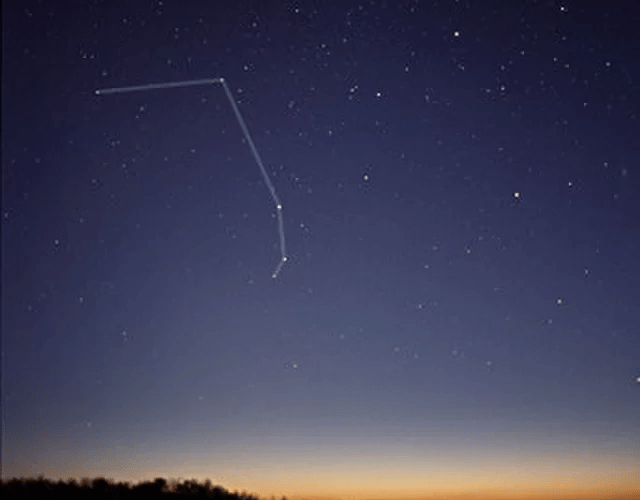
Aries, with the head of the Ram pointing downwards. The two bottom stars are the horns
Aries is located in the Northern Hemisphere between Pisces to its west and Taurus to its east.
It is not a specially bright or large constellation. The brightest star in Aries is Alpha Arietis, or Hamal, from the Arabic Al Ras al Hamal, meaning “the Head of the Sheep.” Hamal is a red giant with a magnitude of 2.0, visible to the naked eye, which is about as bright as Mars when the planet is at its farthest point from Earth. The other two brightest stars are the horns of the Ram, Sheratan and
Between 2000 BC and 100 BC the spring equinox used to be April 24 when Hamal was conjunct with the sun, but now the spring equinox is 20 March when the sun shines in front of the constellation Pisces on the border with Aries.
This is because the sun moves westward in front of the backdrop constellations by about one degree (two sun diameters) every 72 years. This drifting is due to a motion of Earth, a wobble on its axis, called the precession of the equinoxes.
But for historical reasons the spring/vernal equinox is still referred as the First Point of Aries.
The Aries constellation contains a galaxy about 100 million light-years from our own galaxy, the Milky Way, and it also a planetary system called 30 Ari, which consists of a gas giant and four stars.
A supernova in Aries was recorded in May, in the year 1012 AD.
The best time to see Aries.
Look for it in December around 9 p.m. local time, rising in the east. A Northern Hemisphere spring or Southern Hemisphere autumn is the worst time of year for viewing Aries, when it is lost in the sun’s glare. December is an especially good month for viewing Aries, when the Earth is on the other side of the sun. In late October, Aries rises in the east at sunset, reaches its highest point in the sky at midnight and sets in the west at sunrise.
Aries reaches its highest point in the sky about 10 p.m. local time (the time in all time zones) in late November, 8 p.m. local time in late December and 6 p.m. local time in late January.
History and Mythology
The spring equinox was a time of renewal throughout the northern half of Earth, an event of great significance to people who were much more aware than we are nowadays, of human dependence on the land and sky.
Once upon a time Aries marked the end of the wild sheep main lambing season in Europe, 21 March – 20 April.
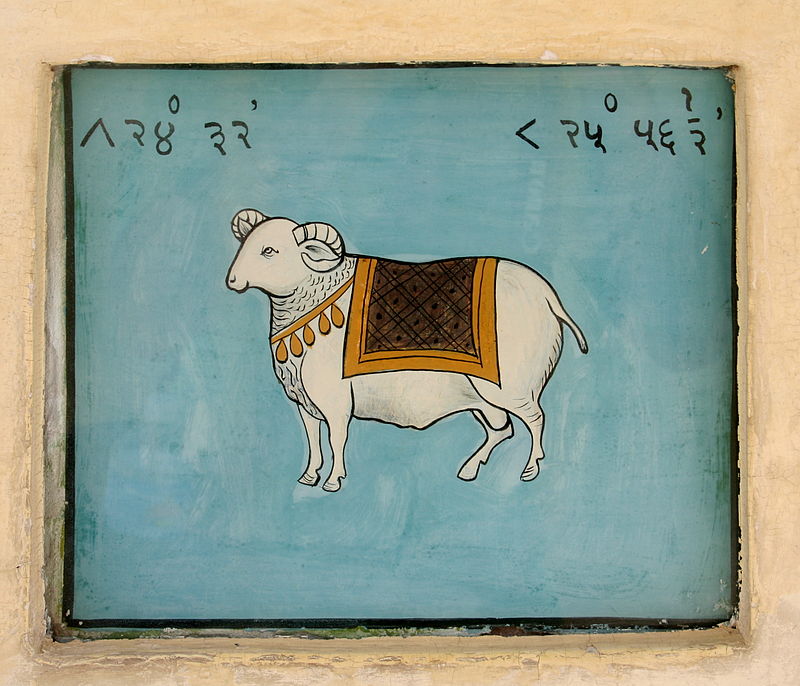
Below, in this rather humorous and charming illustration from India, is surely the least ever fiery ram of a wild sheep.
Humanity made connections, looking up and making patterns out of the skies overhead at that time, matching these to such significant natural events on the ground.
The Sumerians are one of the oldest known urban civilisations in what is now called Southern Iraq, during the Neolithic-Bronze Age, 4500 BC to 1500 years BC. The ancient Sumerians called the sun, Subat, meaning the Ancient Sheep or Ram and the planets were the Celestial Herd.
The brother and sister Phrixus and Helle were the children of the Boeotian king Athamas and the cloud fairy, Nephele. She died, the king remarried, and his new wife, Ino, feared and hated them and planned to kill them as a perceived threat to her own two children by the king.
They fled, rescued by a flying golden ram sent by Hermes at the plea of the dead Nephele, watching in anguish from the other world, but Helle fell into the sea below and was lost in the Dardanelles, named the Hellespont in her honour. Later, safely in Colchis, Phrixus (rather ungratefully) sacrificed the Golden Ram, returning it to the gods, and presented its fleece as a gift to King Aeetes, who placed it on a tree in a grove under the guard of a dragon, the hideous Hydra, whom Jason later killed in order to steal the magical healing fleece.
In ancient Egyptian astronomy, Aries was called Lord of the Head, and was associated with the god Amon-Ra, depicted as a man with a ram’s head and representing fertility and creativity. And because it was the location of the spring (vernal) equinox, it was also called the “Indicator of the Reborn Sun.” The position of Aries at the zenith coincided with the rising of Sirius in the east and the flooding of the Nile.
The Temple of Amon-Ra at Karnak bore the likeness of the supreme sun-god with the horns of a ram. The road to Karnak was formed from the wings of two granite sphinxes bearing the head of Aries.
However, Aries was not fully recognized as a constellation until classical times when the ancient Greeks from about 1580 B.C. to 360 B.C. oriented the construction of many of their sacred temples in relationship to Hamal.
In Hellenistic astrology, the constellation of Aries is associated with the golden ram of Greek mythology that rescued Phrixus and Helle on orders from Hermes, taking them to the land of Colchis.
The brother and sister, Phrixus and Helle, were the children of the Boeotian king Athamas and the cloud fairy, Nephele. Athamas was unfaithful and Nepehele left. Drought followed but Athamas remarried, and his new wife, Ino, planned to kill Phrixus and Helle as a perceived threat to her own two children by the king.
They fled, rescued by a flying golden ram sent by Hermes at the plea of Nephele, watching in anguish from the other world, but Helle fell into the sea below and was lost in the Dardanelles, named the Hellespont in her honour.
Public Domain: 1902
The magical ram, Krios, spoke to Phrixus to calm and comfort him as they continued on their way. Later, safely in Colchis, Phrixus (perhaps rather ungratefully) sacrificed the Golden Ram, returning it to the gods, and presented its fleece as a gift to King Aeetes, who placed it on a tree in a grove under the guard of a dragon, the hideous Hydra, whom Jason later killed in order to steal the magical healing fleece.
The name Phrixus means ‘curly.’
Astrological Personality
There is no such thing in reality as THE Aries personality and the same goes for all the zodiac sun signs. Your sun sign is an archetype, a keynote, but of course it is not your full astrological portrait. We are all unique and it could never be the whole story.
Aries is ultra-virile, with a warrior spirit, just as a ram will charge headlong, at an intruder, and may even kill a person who enters his field, threatening his ewes and his territory at the wrong moment.
Aries is known for its determination and zest for life, and in the same spirit, Aries can be reckless and with it, accident prone in its general haste to get on and do whatever is the next thing. Aries are at a statistically increased risk of accidents, especially with head and neck injuries in comparison with other signs, largely due to impatience and risk-taking behaviours.
Aries is ready to experiment or pioneer but may not finish what it starts. They are determined but can be diverted by their own impatience if they don’t get quick results.
In their personal relationships Aries are lively, pleasant, frank, direct and generous. Full of wit and bravery and bounce and joie de vivre, there is much to love and admire about the early springtime subjects of fiery Aries, the Mighty Ram.
This concludes my series exploring the science and history of the Zodiac. Browse the archives for the astronomy and ancient stories behind the other signs of the Zodiac.