The joke is not remotely funny, but could this be the wild card, The Joker in real life action? In the living person of former Ukraine President Poroshenko.
Has Ukraine set a trap for itself of its own devising? That the Ukraine judiciary chose in January, with Russia growling ever louder, to summon to court former President of Ukraine, Petro Poroshenko who had fled to exile in Russia but flew in from Warsaw for this court case January 2022?
“On 25 February 2022, amid the 2022 Russian invasion of Ukraine, Poroshenko appeared on TV with a Kalashnikov rifle together with the civil defense forces on the streets of Kyiv. He also stated that he believed that “Putin will never conquer Ukraine, no matter how many soldiers he has, how many missiles he has, how many nuclear weapons he has… We Ukrainians are a free people, with a great European future. This is definitely so”- Wikipedia
Ukraine ordered in its own Trojan horse? Extraordinary timing of this court case. Mr Poroshenko has flown in from Warsaw (not exile in Russia?) Now in situ, out on bail, Mr Putin’s replacement of choice for Mr Z if/when Russia captures Kyiv?
It wouldn’t be Mr Poroshenko,who would be Mr Putin’s choice, would it, but more likely former pro Russian President and Prime Minister Viktor Yanukovych currently in exile in Russia
But the cards are detecting a logic.
If you were Mr Putin, and you didn’t want to wreck Ukraine but to claim it, harness it and harvest it, or simply neutralize it, so you needed a new government ready and waiting in case or when you captured Kyiv, how might it solve a problem: the presence on Ukrainian soil at this critical juncture of a former Ukraine President who, while displaying ultra Ukrainian nationalism has also been also accused of funding pro-Russian separatists in the Donbass via alleged illegal sales of coal: is this is someone who for gain, is not averse to politically facing two ways at once? While Yanukovych in exile is a far more straightforward proposition. He was actively against a closer ties with the EU.
Could Yanukovych, in the event of a conclusive Russian victory, offer Putin
A way to govern the Donbass installing a Ukrainian puppet, harder for the world to argue about, knowing it is now in your pocket with more to follow later, quietly
A way to claim a political as well as a military victory at home, hopefully heading off any coup, plots, internal adversaries before they arrive at the pass, while snookering the foreign opposition who know fine well what you have done here but may well only be grateful, though now of course, more wary, suspicious and …more respectful?
If if it is Yanukovych, will Poroshenko need to disappear right off the scene, assuming what is not by any means looking certain at this stage, that Russia ultimately captures the Kyiv government.
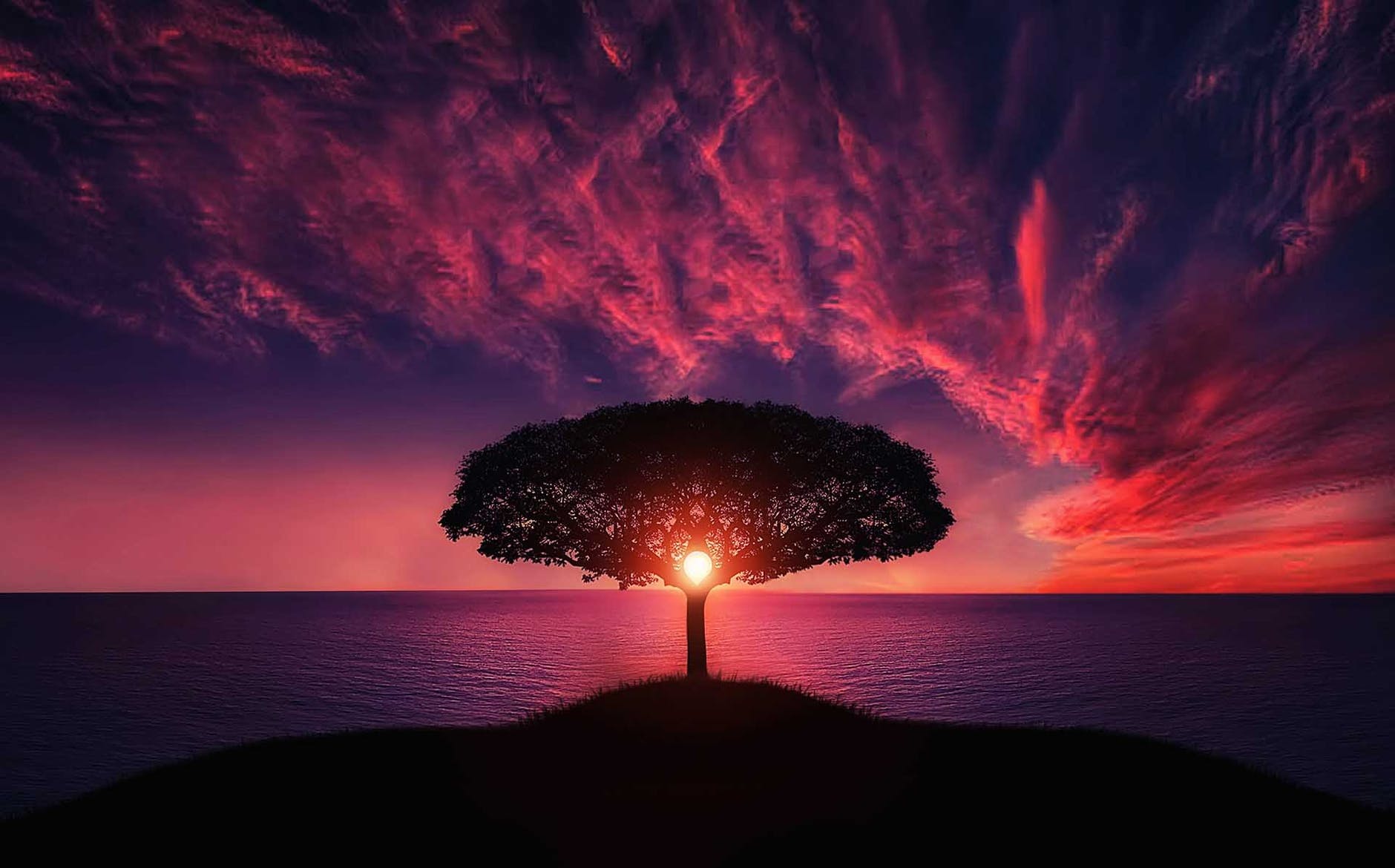
The Joker is a card of destiny. Of a rebirth. It is a portal, the number Zero. It is the Tarot’s equivalent of The Fool. It is Odin, god of war. The god who hung nine days upside down on the world tree, and gave an eye to learn the runes, and the knowledge of all things.
And where does that leave Mr Z if Kyiv is captured? We drew this card before.
He concedes or he is gone.
But with a pro-Russian president back in Ukraine, pro-Russian separatists active near and within Moldova, perhaps, if he can take Kyiv soon enough before he HAS to get Odessa, and has an experienced Ukrainian politician already in situ; an able and willing Russian proxy president …perhaps Putin could call the troops home, avoiding the need to take Odessa, no need to wreak destruction on this iconic port city. It is now politically re-secured for Russia.
Moldova has applied to join NATO But as we are seeing, a lot can happen in a day right now. Joining Nato could take years. And the West is making an elementary error of psychology, in stating so categorically what it will NOT do. Whatever the West’s actual intentions, to state up front what they will not do, to remove certain cards from the table so as not to frighten everyone, is a gift to Putin, but not enough of a reassurance sufficient for him to stand down.
As ever, only time will tell. I am just wondering about that Joker.
PS: 20:35 PM There is a feeling that something new is afoot. If Pres P were to present Mr Z with terms, and if he has grave enough concerns re Kyiv, who knows, perhaps he may, then he could withdraw and still claim victory, if Mr Z agrees that Ukraine shall let go the 2 seperatist states in the Donbass and Crimea. Since Mr P has been telling the Russian people all along that these were his objectives.
#cartomancy I don’t know; is something shifting- 6 Clubs, Ace Hearts rev, 6 Spades, grief, loss, progress, healing, King Diamonds, Mr Putin? 3 Clubs, a meeting. New talks – a breakthrough? 3 -6 days (3 /6 Clubs) longest 6 months but no, will be sooner if at all.
What is the Tarot’s general impression of the cosmic weather this month, spanning the zodiac signs of Sagittarius and Capricorn and therefore including Christmas?
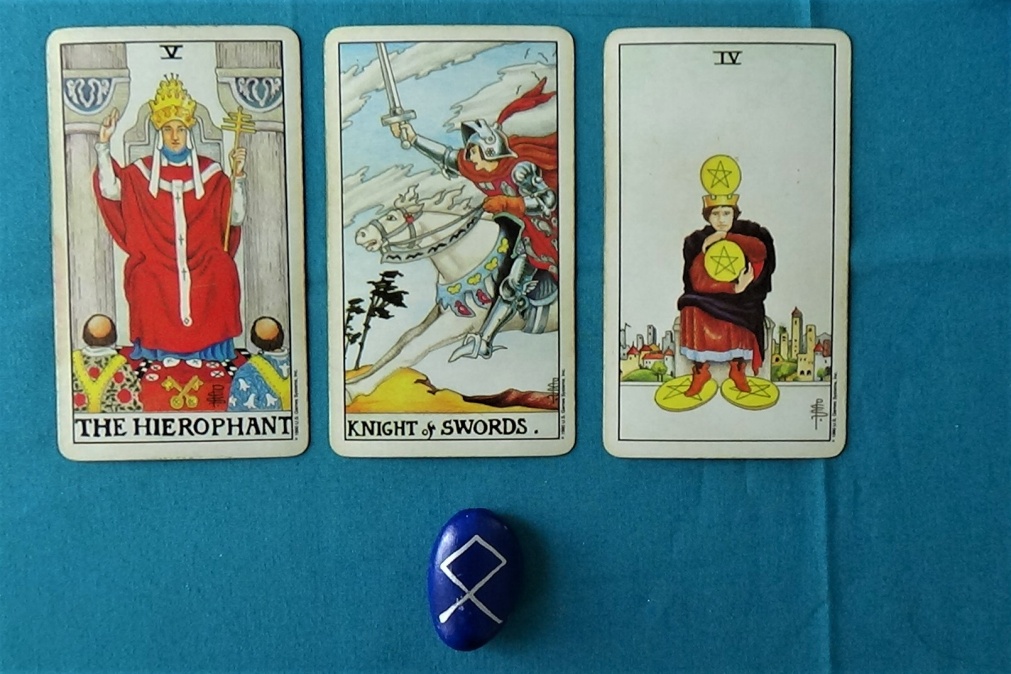
The Four of Pentacles is ruled by Mercury, the planet of travel, research, trade and commerce. Mercury also rules IT and data analysis, and it rules Virgo, which in astrology is the sixth house of harvest, health, routines and hygiene.
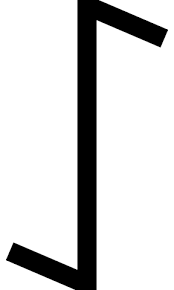
Rune: Othala
Meanings: wealth, ancestry, ancestral homelands, family, old age, our old folk, different generations, memories, identity, belonging, and all the things that we most treasure.
Where do we feel at home?
This rune also picks up on migration and surrounding questions and issues.
General Impressions
December looks pretty eventful on the world stage, not to say stressful, with sudden flurries of news, mostly not welcome. We might want to switch off the media for a bit, and have a break from all the shrieking.
These cards look reasonably reassuring all the same, not too much shock and awe. Here’s hoping we’ve already seen the worst of December.
The Knight of Swords; sudden attack, storm, wind, can be read in reference to recent terrible weather events, and the damage and tragic casualties in Kentucky.
The Earth itself is always restless, and currently more unsettled than usual. Perhaps it is little wonder that we are too. The world is never quiet, never at peace. Nor is the Earth. It is always relative. Each year, the Moon pulls away, and so does the Sun in this present cycle.
But really, short of an actual world war, the whole world is embattled one way and another, no quiet news months since December 2019, when we first learned of a newly emerging health crisis in Wuhan.
We now approach the second anniversary of the pandemic with its new variants, and unrolling economic, political and social effects. There is no government, that is, no government that permits even peaceful dissent, that is not grappling with this monstrously slippery eel, while experiencing furious criticism and dissent from one quarter or another, no matter what response they make, deciding how to tackle the problem. The Hierophant as a symbol of governments anywhere is either taking a pasting right now, or, depending on the country, dealing them out.
These are times of instability. This instability is not only man-made but natural, due to extreme weather events, and seismic, volcanic events, such as the ongoing eruption on La Palma, and recent periodic increases in solar flare activity.
The La Palma eruption has now become the longest running on the island, and the cards suggest it will still be erupting into January 2022 though it seems to be calming now. Article HERE
What is the Tarot connection? Well, we are in the zodiac time frame of Sagittarius, 22 November- 21 December, and the court card of Sagittarius is the Knight of Wands, as seen here in the Gilded Tarot Royale.
From The Gilded Tarot Royale, Artist, Ciro Marchetti
Sagittarius is the element of Mutable Fire. Changeable fire. Changeable states. Blow me down, if this depiction of Sir Sagittarius does not actually show a volcano erupting magma.
Then in Java, Mount Semeru erupted 4 December, spilling out a deadly pyroclastic flow.
“The slurry of debris that swept down Semeru proved catastrophic to villagers living around the mountain’s base in the Lumajang Regency, particularly Curah Kobokan. According to The Jakarta Post, at least 39 people have died. Large numbers of homes were destroyed or damaged, and many animals are among the eruption’s victims.”
Of course, this is not to say that the month of the zodiac sign of Sagittarius= volcano eruption month.
But there it is, or there it was. A card specifically correlating with the dates 22 November-21 December and we are looking at it. The synchronicity, at least for 2021 is undeniable.
What else might these cards mean in practical terms?
Obviously, this can only be a very general reading, and is therefore limited in its specificity, but The Hierophant represents stability, security and continuity, doing things ‘by the book.’ And it also represents the converse as previously discussed. This December we are not doing things by the book, while at the same time there is plenty of ‘throwing the book ‘ at XYZ.
The Hierophant is turning up a lot in readings at the moment, which is hardly surprising. Sometimes it is drawn the right way up, but just as often it is being drawn upside down, reflecting a situation in which old wisdoms, old ways of seeing things and doing things are being challenged.
Why is this not surprising? Well, it shouldn’t be. The Tarot detects, reflects and projects.
First it acts as a mirror on what is already happening. This is crucial in a reading because it confirms the baseline for the reader.
The Hierophant attacked by the Knight of Swords marks a time of acute unrest, such as we have been witnessing for some time now, every time we turn on the television or engage on social media.
Astrology associates this with the fact that the outer planet Uranus, ‘planet of rebellion and innovation’, is stationed in Taurus, the steady Bull sign associated with The Hierophant.
Uranus is retrograde for parts of December, signifying a mood of intense inward reflection on what needs to stay and what needs to go or change, both collectively, and privately and individually.
Uranus made this move into Taurus in 2019 and will stay there until April 2026, so we are in for a bumpy ride. The question is how we can best handle things on an individual level, re-evaluating our priorities, keeping our cool, learning new skills at every opportunity and helping our children to do the same.
The Four of Pentacles is about HANGING ON IN THERE. And there are times, when continuity offers the best scenario all in all.
Some astrologers think Boris Johnson is about to meet his political nemesis. Possibly, but to me it does not look that way, not this month, parties or no parties, knowledge of parties, or no knowledge of parties. Why not? Because of the appearance of the Four of Pentacles. If he goes, having inherited the poisoned chalice of this pandemic at the very beginning almost, of his premiership, it will be of his own volition because of sheer exhaustion.
This is a very broad picture, very general, yes. But of the 78 cards in a Tarot deck, 75 stayed in the deck and these were the three drawn for this coming month, December 2021.
Let’s look again. Save scrolling up.
UK
Her Majesty the Queen is a Taurus subject, a pillar of our society. Above politics, she has seen many leaders some and go. She is very much a figure who has always believed in putting wider duty before personal convenience.
She does things by the book, like the Hierophant.
Elizabeth 11 represents a part of the national psyche, the young monarch of our parent’s childhoods, those born during the war or soon after it. Lately, this first year of her widowhood, we have witnessed signs of a decline in her health. At the age of 95, this is only natural and to be expected, but since we have drawn the Taurean Hierophant for December, and it has been drawn next to the challenging Knight of Swords, it remains to be seen whether the Queen will make her annual Christmas address in quite the same way as usual this year.
Europe
Covid cases have been rising again, with new lockdowns and protests in the Netherlands, Austria and other countries. The signs are that this most recent rise in cases as at the time of writing (14 November) may continue into December and flu may add to the pressure on health services, but with luck, the Four of Pentacles is a stable card, suggesting that the situation may, not improve perhaps, but be maintaining a standoff by/towards the end of December.
Covid
Some Medical observers are sanguine about the Omicron variant, suggesting we may soon be approaching the endemic phase, when a brand new virus, in this case, SARS‑CoV‑2 gradually becomes part of the new ‘normal’ in human epidemiology, and it becomes a question of living with it.
Today however, 13 December, sadly marks the first UK death of someone with the Omicron variant.
EU, Poland, Belarus, Ukraine and Russia
The current border situation is tense. It may well escalate, suggests the Knight of Swords, but again, the steady Four of Pentacles hints that if it does, the crisis abates again at least temporarily somewhat by or until mid January. Why? In terms of timing the stable Four of Pentacles represents the third decan of Capricorn, dates 11-19 January.
The Knight of Swords can mean new laws, sharp messages, sabre-rattling and military aircraft, just as the weather associated with the Knight of Swords is northern and easterly; cool, cloudy, windy, but it can bring sudden frosts, sudden rain or storms.
The Knight of Swords traditionally also refers to airborne objects, including missiles, but also viruses and bacteria sharp objects, including surgical instruments such as injection needles and pens. Here is an escalation of covid vaccinations across Europe.
Trade and Travel
The Four of Pentacles is ruled by Mercury the planet of travel, trade and commerce, also IT and data analysis. In addition Mercury rules Virgo, sixth house of health and hygiene.
This, together with the Knight of Swords, reminds us that common sense says, vaccinations or no vaccinations, we need to stay alert and continue taking common sense precautions against covid and flu this Christmas.
But meantime, certain international restrictions may be reintroduced again on an emergency basis, while a further lock-down has not been entirely ruled out by the UK Government. The Four of Pentacles, sometimes nicknamed the Miser card, describes a pragmatist, who is ready to take the dour responsibility for making unpopular decisions should it detect that need.
Some suggest that covid is ‘just’ ‘flu. We know it isn’t. SARS‑CoV‑2 is a new coronavirus, not a ‘flu virus. But even ‘just’ ‘flu is no joke at all if we get a bad dose.
Personal
The Hierophant represents whatever is your own status quo. You may be somewhat restless and unsettled. I know I am. The Knight of Swords drawn next door to the domestic Hierophant suggests a need for ‘fresh air’ and extra space this month.
Not all of us fancy a party this year. Many of us are not in the mood. for doing whatever is our usual thing this year, suggests this combination. Maybe we never were, but this applies with bells on this year.
The Four of Pentacleshas a lot in common with the rune of ancestry, households and inheritance, Othala.
Look back at the things you have bought over the years. What did you buy in the past that you still treasure? What have you been given by older family members that you treasure to remember them by? Othala talks about the things we treasure. These do not have to be things. They include cherished memories. But every day, we are creating new memories.
A recovering economy needs our spending. And it’s great to treat loved ones – . But for a lot of people the festive season can be a dreadful money worry. Last month there was much excited media speculation about shipping and supplies this year, and worries about ‘must have’ toys from overseas arriving in time for Christmas.
What’s with this ‘must have’ business? Conspicuous consumerism ruling the roost in the home? Is this healthy or a helpful preparation for children, to suggest this is how it really works?
The Four of Pentacles advises that friends and loved ones will be understanding if finances are tighter this year than previous Christmases. And given the way things have been in 2021 and 2020 before that, they may welcome that same understanding in return.
The Tarot is not trying to be a Scrooge or a kill-joy in presenting this card. Spending less, or spending carefully, based on quality, durability or longer term thinking doesn’t equate with not having any kind of a good time.
It’s just that no- one has infinite resources, debt is no joke, and this year looks like a departure from the way many of us have done things before.
24 December: The Hierophant also represents Christmas time, as a traditional religious season of celebration. But long before Christianity we celebrated Yule in northern Europe, meaning ‘wheel,’ to mark the turning of the wheel of the year, the solstice and the passing of the darkest day.
The third and final square between Saturn and Uranus in Taurus, these big planets, these heavy hitters, bring a feeling of push and pull between Uranus (splurging, doing your own thing, party time) and Saturn (saving, doing family duties, staying home and relaxing) this Christmas Eve 2021.
Ways of doing things that worked OK for you in the past, don’t sit so well with you right now.
Uranus is retrograde for nearly half of the year every year. This is nothing new or unusual, just a seasonal opportunity to go back to the drawing board and re consider occupations and habits.
In Tarot this is represented by the Lovers card meaning: news, calls, social events, new ideas, chat, gossip, communication, curiosity…it is also about short travel, trade, commerce, shopping . Think Mercury, ruler of Gemini. Another name for Mercury, Hermes.
Astrologers consider this a favourable Full Moon, in harmonious aspect with Jupiter, lucky for new partnerships and ventures, and for legal and business matters, though with possible tensions attached in terms of close relationships.
The Lovers can present us with a need to make difficult choices. Again, these could be totally unromantic; hard-nosed, to do with our work, security and finance.
Venus planet of love, beauty,luxury – and finance goes retrograde in Capricorn 19 December shortly after the Full Moon until 29 January.
This is glamour but serious with it. You could say Cinderella grows up, Prince or no prince. Venus retrograde in Capricorn is no- frills power dressing, literally or metaphorically. Fashion or Beauty here goes hand in glove with perceived status material power, like a Queen who wears her jewels f in token of her reach of power for the world to see.
This is a planetary euphemism for an examination of our personal standards of conduct and deportment, at home and at work. What is our public persona? How about a bit of gravitas, says Venus in Capricorn, style, poise, dignity and rectitude?
Beauty is in a serious mood. Beast better behave.
21 December – Solstice
We leave freewheeling Sagittarius ruled by big bouncy Jupiter and move into Capricorn, ruled by serious hardworking master of self-discipline and dominion, Saturn.
But Saturn brings the solstice, returning us to the light, for all his serious face.
This is the spirit of the agile, tough and hardy ibex or mountain goat, Capricorn.
The ibex nimbly scales the heights, stands atop the farthest crags. In Europe, the alpine ibex does battle in December for territory and mates.
The ibex, inspiration of Capricorn, reckons to do battle to get what it needs in life, delicately sniffs the cold, clean air, every inch a master of all he surveys.
The sunshine is free, and the rain and the snow, and the moon and the stars. Our good health too, if we are lucky. But we all must do battle some day one day in our lives, sooner or later, up against some kind of authority or other, or make peace with the fact we didn’t when maybe we really needed to,for our own or someone else’s sake.
Who says we wait until New Year to make a new plan?
Any day will do for a new resolution But from a natural, seasonal, symbolic and magickal perspective, 21 December works even better.
Season’s Greetings with all Best Wishes for a brighter 2022.
Nothing new under the sun? Someone once asked me, did I believe in reincarnation? Well, of course, plenty of people do, around the world. Easter is the great Christian celebration of Resurrection, when Jesus Christ, Yeshua Ben Joseph, was said to have risen from the tomb on the third day following his barbaric crucifixion, signifying the hope of the soul’s eternity for all mankind.
Let’s consider The Yew, Taxus Baccata. The Yew tree is widely viewed as a symbol of resurrection. Why is that? Its branches grow down into the ground to form new stems, which then rise up around the old central growth as separate but linked trunks. After a time, they cannot be distinguished from the original tree.
It is susceptible to death by damage or disease but has been described as the the one living thing on Earth that could, at least in theory, however hypothetically, live indefinitely. It’s thought that there are English yews 4000 years old. Hence its popularity in graveyards, as a symbol of resurrection on Judgement Day.
The old Norse rune Eiwaz represents the yew, and its numinous capacity for regeneration. For this reason, it is considered a good omen for recovery if someone is ill.
Eiwaz
The Memory is supple as the Yew, the Mind as mysterious and it can play strange tricks.
Some years ago, stirring a pan, standing by the stove, I had an oddly vivid experience, a flashback, and I was standing in an entirely different kitchen, sparse, white painted, with a high ceiling and a door to my left. There was sunlight coming in at the open door from which I knew there was a flight of steep, narrow steps leading down to a courtyard, and I was wondering where ‘Pietro’ had got to, and why he was not home yet. I knew this unknown faceless personage Pietro was a husband. NB The name of the present Il Matrimonio is not Pietro or remotely Peter-ish.
Could this have been an ancestral memory? I am Anglo-Irish-Scottish. Not Italian. A vivid daydream then. A snapshot. A picture from a book maybe, or a film? Possibly. I had never had this particular vision or experience before, and have not had it again, but I ‘knew’ at the time, that I was in Siena.
I have to say, I don’t welcome the idea of coming back once I am done and out of here. I’m not keen on the idea of reincarnation, except as recycled material. Life on Earth is 4.5 billion years old, and we are just the current manifestations of it. If Earth is a closed system, in the sense that material may enter through the atmosphere but not leave it, then in that sense, it may seem unscientific NOT to believe in reincarnation, if only in the sense of particle recycling.
But what if particles could retain impressions, memories? Like those stories of people who have heart transplants, and later develop new tastes, and behaviours, subsequently discovered to have been part of the donor’s personality? You don’t have to look far to come across such stories and make up your own minds. Urban legends? A degree of skepticism is sensible and healthy, except when it is of the howling variety, and I heartily mistrust pronouncements on what may not be possible.
I don’t personally welcome the idea of repeating the human experience, and this is not meant as a complaint. I am pretty sure of this much though. Whatever happens, it won’t be my choice.
I first began to study the Tarot at least partly as an effort to make sense of some deeply strange experiences, downright freaky, a few of them, after which it seemed more plausible to me that our consciousness is not extinguished at the time of bodily death. Death is a process, not an event. The brain is not the mind. Our departure from our home in the body is a process that can take days. The tradition of the Wake was a wise one.
I know a lady near me who runs a care home, and when a resident dies she opens the windows, not only for obvious practical reasons, to keep the room cool and fresh, but to help the newly departed soul on its way to wherever it wants to go.
Some years ago I received a request for an email reading, a young lady who wanted to know, was her brother OK? I asked what exactly did she want me to investigate that she could not ask him herself, and she said he was dead. He had committed suicide. She did not tell me more, nor did I ask about the circumstances.
Her questions were:
Where was he now?
How was he now?
A lot of my work is directed at immediately practical matters, home, work, business, money, relationships, family. I do not work as a medium, not at all, but I had previously done other readings focused on deceased loved ones, on occasion with some very surprising feedback.
I sat down to think about this and among other cards, was particularly struck by an appearance of the Sun card from The Golden Tarot, Kat Black.
From The Golden Tarot, Kat Black
The Sun card is life itself, travel, children, health and happiness, success, moments in the sun.
This is a card of innocence and animals. Things in their natural state. You can see this for yourself, looking at this card from The Golden Tarot and in the Rider-Waite decks. In some other decks, those meanings are not necessarily so clear.
The Sun card is a card of birth.
The appearance of this card in particular suggested to me that wherever he was, whatever he was, he was like a child again, sometimes awake, sometimes asleep. He didn’t remember his death, not at all, or the events that drove him to it.
Bless his soul. He was a little boy again. In my mind’s eye, I saw him kicking about in a puddle, not idly kicking, bored, not fed up, but happily, quietly preoccupied. If he had any memories, if he had a consciousness surviving death, if that could be possible, then this was his afterlife.
News of a birth was coming soon, I told the young lady, based on this Sun card. This was a birth close by, probably within the family, and whether it was a boy or girl, the Tarot was suggesting the possibility, however bizarre, that it was her brother being reborn.
Three weeks later I received an email from this young lady, very happy and excited, to say her sister was expecting a baby. Wouldn’t it be weird, she joked, if she was going to be her brother’s auntie this time around?
The returning Star Child from the ending of 2001: A Space Odyssey
I would like to think the Tarot’s vision offered this young lady some kind of comfort, however peculiar, for a truly terrible grief, and hope for her brother’s peace. Because not all griefs are equal. Some deaths, as with untimely or violent deaths by suicide or murder, are harder to bear for those who mourn than others.
Reincarnation? I can see it in the genetic sense of the word. Or perhaps I mean epigenetics, and a kind of acquired cell memory. I went through a brief spell at one time of wanting a cup of hot chocolate at night. Not cocoa made with milk in the pan. This was made with water like making an instant coffee, drunk with two cream crackers and a bit of Lancashire cheese. I mentioned this to my mother and she said that was what her father Alfred, my maternal grandfather, always had for supper.
I never knew my grandfather, he died before I was born, of lung cancer, but we share the same birthday. He was a well-known museum curator, who like so many others, took a lengthy leave of absence to serve in the Navy during the war. I worked a short time in Museums after graduating.
Maybe he wanted to send my mother a message, and that was why I wanted his supper. I joked to her that maybe he wanted to say sorry, as he wasn’t always the nicest father he could have been, but she didn’t think that would have been in character.
But where did that very specific temporary new habit come from, I wonder.
Until next time 🙂
Video presentation is a discussion of children’s experiences suggestive of the possibilities of reincarnation with Dr Jim Tucker at the University of Virginia.
February was added to the older Julian calendar in the 700’s BCE when two new months were added to create the new Gregorian calendar, matching it up more closely with the actual length of the Earth’s journey round the sun.
But the Anglo Saxons called February Sōlmōnath, from sōl n Old English word for wet sand or mud, alluding to the weather this time of year and the effects of rain and snow melt. The romantic Solway Firth between North West England and South West Scotland is actually the massive tidal ‘Mud way’, rather than the ‘Sun way.’
The northern English scholar monk , saint Bede, wrote that February was celebrated as “the month of cakes,” when ritual offerings of savory cakes and loaves of bread were made to ensure a good year’s harvest.
But is the fire festival of Imbolc and Brigid is a more ancient celebration in Gaelic Britain, including Ireland, Scotland, swathes of Northern England and the Isle of Man.
Brigid’s fire festival began as a neolithic festival marking the 1/2 way point between the winter solstice (Yule) and the spring equinox (Beltane.)
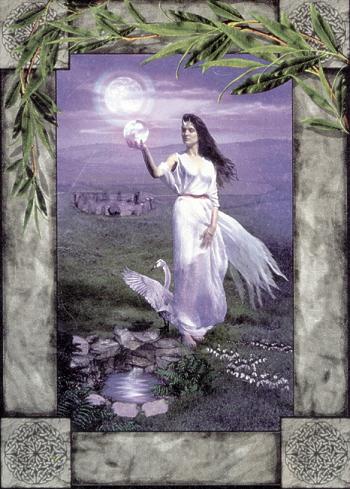
Imbolc spans 1-2 February, celebrating the arrival of Brigid, the Divine Feminine, and the harbinger of the coming of spring and the first lambs, so vital to survival of those early communities. Brigid’s name means ‘Exalted One’.
Brigid From The Sacred Circle Tarot
‘Imbolc’ is thought to mean ‘in the belly’ referring to the precious ewes in lamb Soon is the time of the first lambs although the start of the lambing season varies by up to two weeks in any given year.
Brigid was a powerful protector of women in childbirth, as well as the safe birthing of precious livestock. She was not only a goddess of the Tuatha Dé Danann, The Tribe of the Gods, but a triple goddess of healers, poets and smiths.
Via Wiki Riders of the Sidhe, the Tuatha de Dannan
“The Tuatha de Danaan, the people of the (mother) goddess Danu in Celtic mythology; a race inhabiting Ireland before the arrival of the Milesians (the ancestors of the modern Irish). They were said to have been skilled in magic, and the earliest reference to them relates that, after they were banished from heaven because of their knowledge, they descended on Ireland in a cloud of mist. They were thought to have disappeared into the hills when overcome by the Milesians. The Leabhar Gabhála (Book of Invasions), a fictitious history of Ireland from the earliest times, treats them as actual people, and they were so regarded by native historians up to the 17th century. In popular legend they have become associated with the numerous fairies still supposed to inhabit the Irish landscape”. From The Encylopedia Britannica
Brigid was said to visit one’s home at Imbolc. People would make a bed for her, and leave food and drink and items of clothing outside in the hope of receiving her blessings, petitioning her to protect homes and livestock.
This was a time for feasting and visits to sacred wells, and a time for ritual divination. A St Brigid’s cross is made from rushes and was placed in doorways to protect the home from harm, representing the wheel of the seasons.
Spring is fierce in its quickening of new shoots. Spring is initiation. Spring is fire, just as Aries the Ram of the zodiac, though bot starting until later, in late March, is a fire sign.
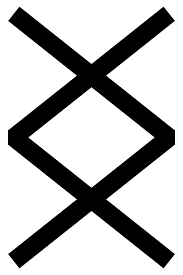
The old Norse rune ING or INGUZ is a fire sign rune, associated with male fertility, vitality and recovery from sickness. This powerful protective rune can also be noticed incorporated into pargeting, used in half-timbered buildings in Britain and northern Europe
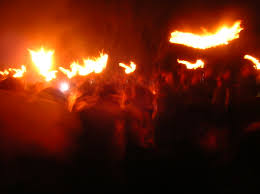
The people would light bonfires on the hilltops by night, and by day might run cattle through the smoke of lower lying bonfires, asking divine protection for the livestock.
Imbolc was a key moment in weather forecasting. This was the time when The Cailleach —the divine crone of Gaelic tradition—gathered firewood for the rest of the winter. If the Cailleach knew the winter was going to last a good while longer, she’d make sure of good weather during Imbolc and would use it to gather more firewood to top up her stores. Bad weather at Imbolc was good news. The Cailleach wasn’t worried about running out of firewood. She had turned over and gone back to sleep and the worst of winter was almost over.
Via Pinterest
‘Dark sacred night’…yes, but when the dark goes on too long, we shout back at the dark, fighting back with the Promethean gift of fire.
30 April is known as May Eve, marking May Day and the beginning of the ancient Celt festival of Beltane.
Beltane begins at dusk on 30 April and is matched by its European counterpart, Walpurgis Nacht, or St Walpurga’s Night in Germanic tradition.
St Walpurga or Walburge was born in Crediton in Devon, but travelled widely as a missionary in the service of her uncle St Boniface, and eventually became abbess of a monastery in Heidenheim in modern Bavaria where she died 25 February 777 or 779. She was canonized 1 May 870.
Walpurga is reputed to protect sailors in storms at sea, reputedly thanks to a miracle when she was sailing to Germany and a terrible storm broke out, and she knelt on deck and prayed and the storm cleared as if by magic…
And yet, interestingly, Walpurga is also a protector against witchcraft. Curious, isn’t it. That someone’s holy prayer is someone else’s satanic spell or witch’s invocation.
Origins
Two great festivals in northern Europe long pre-dating Christianity were Samhain (Halloween) marking the start of winter, and Beltane (April 30/May 1) marking the start of summer.
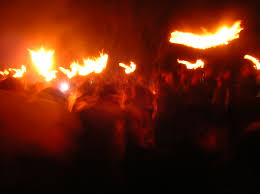
Beltane ‘the fires of Bel’ began as an ancient fire festival celebrated since at least the Dark Ages if not long before. The celebrations began at dusk on April 30th when great bonfires were lit to welcome the height of spring now associated with the zodiac sign of Taurus the Bull, representing the fertility of spring in full bloom.”
Traditionally,” writes Glennie Kindred (in Sacred Celebrations), “all fires in the community were put out and a special fire was kindled for Beltane. This was the ‘balefire’ or the Teineigen, the ‘need fire.’
Bel or Belenus (Celtic: possibly, Bright One) was a deity associated with pastures, meadows and animal husbandry and other agriculture. He was a fire god rather than a sun god as such, though the sun was used as a common motif in religious imagery.
The cattle were walked between two bonfires in a symbolical purification ritual, to be protected by the smoke from Bel’s fire before being put out to the open pastures for the summer. Bonfires were lit on sacred hills too, and the smoke was considered a magical blessing on the fields, animals, and community, and was also supposed to maintain a fragile balance, keeping up a smokescreen, literally, between the human and faery realms.
The month of May got its name from Maia, also called Flora, the Greek goddess of spring and new abundance. Maia was the oldest of the seven sisters known as the Pleiades, and she was the mother of Hermes (Mercury.) The last zodiac sign of Spring, Gemini, is ruled by airy Mercury, as the air fills with butterflies and pollen.
Flora, or Maia by Botticelli
The name ‘May’ has been used in English since about 1430. Before this time the name of this month was spelled Maius or Mai. The Anglo- Saxons called it Tri-Milchus because all that lush new grass meant cows could now be milked three times a day.
The celebration of May Day has its roots in astronomy, celebrating the halfway point between the spring equinox and the summer solstice. It has been celebrated in the British Isles and through much of Europe as a fertility festival since the Dark Ages, and probably before that, with many stories and superstitions attached.
Superstitions
Like Halloween, May Eve and May Day is a magical time of year, liminal, when the veil between different worlds and realities is thinner than at other times of year.
Beltane or Walpurgisnacht is the mirror image, the spring season’s equivalent of Halloween when witches are said to dance at the Devil’s Sabbath.
This is a time for ghosts, but this is also the time of year when folklore suggests you are most likely to meet a supernatural being from the realm of ‘faery.’
The Fae are an ancient race, and they do not like humans whom they view as destructive, and who is to say they do not have a fair point there. The Fae are afraid of iron. To keep them at bay-
Touch wood no good
Touch iron, this you can rely on…
In this sense the Fae could be said to represent the spirit of humanity before the Iron Age.
They are not the cute creatures of fairy tale. Encounters are dangerous and are best avoided – or you may never be seen again. Do not, whatever you do, go to sleep on a fairy hill at any time, but especially not on May Eve or May Day and especially beware of going to sleep under flowering hawthorn bushes ….
Sex and Scandal
The Christian church made attempts to ban May Day festivities outright because of their overtly pagan nature and “lewd” context as an open celebration of male and female sexuality and fertility – ‘a heathenish vanity generally abused to superstition and wickedness.’
May Day meant drinking and fighting, another reason for the church’s disapproval, but this in itself harks back to the ancient traditions of the sacrifice of ‘The Green Man’ – a mythical figure representing the eternal battle waged between summer and winter, feast and famine. Many pubs in England are still named The Green Man.
In Padstow, Minehead and some other places in the UK, mischievous hobby-horses (‘osses) roamed the streets in search of unsuspecting young ladies to ‘carry away’ for undisclosed purposes.
Morris dancers up to no good riding with hobbyhorses, Richmond embankment,1620
Men who had been disappointed in love would make straw men representing their rivals and stick them on bushes. These depictions were needless to say, often deeply unflattering, and fighting might well follow once they were discovered and identified and the maker was known.
May Day harks back to the ancient traditions of the sacrifice of ‘The Green Man’ – a mythical figure representing the eternal battle waged between summer and winter, feast and famine. Many pubs in England are still named The Green Man.
This splendid depiction is on a boss in Rochester Cathedral, thanks to Wikimedia Commons.
The Puritans banned May Day under Oliver Cromwell but Charles 11 brought it back into custom after the Restoration.
Maypole Dancing goes back at least to the 14th century, but it seems the custom was very old even then, though the dance as we know it today, so pretty and decorative(and tame) -children dancing in village squares, is probably a Victorian invention . The maypole is generally assumed to be a phallic symbol, but the Norse peoples connected it with tree worship, and this connects British and Germanic tradition going back to a shared proto-germanic culture which is part of the common root culture in British life even today.
The Maypole dancing which so upset the Church and the Puritans comes down to us from the rites of spring dedicated to Freya.
The maypole originally represented a living tree, in particular the giant ash tree Yggdrasil, the great “world tree” of Norse myth, linking the nine worlds of the Norse cosmology including Asgard, land of the gods, Midgard, or Earth and Hel, the underworld.
“Ygg” means terrible. It was on this tree that Odin chose to hang nine days and nights, thirsty and fasting in exchange for the knowledge of the runes. The Norns sit beneath it and when every new person is born, carves their names into its bark…and with it, their destiny, although this can change. The Norns will allow us to rewrite it, unlike the destinies woven by the three Fates of Greek mythology.
Walpurgis Night
Also In the Germanic tradition, Walpurgis Night, on April 30th is a moon festival sacred to the goddess Freya.
“Walpurga” is another one of Freya’s names. The re-dedication of the holiday to “St. Walpurga” was a later Christian addition.
Freya (Old Norse, Freyja meaning “Lady”) is one of the pre-eminent goddesses in Norse mythology. She was the goddess of love and beauty in Norse mythology, the goddess of marriage and family and a great prophetess – a seeress. She taught her husband Odin how to read the runes, and like Odin, she had a fiercer aspect as a patron deity of war and death in battle.
Freya wears a cloak of falcon feathers and has a magical gold necklace called Brísingamen. She rides in a chariot pulled by two cats and a sacred boar called Hildisvíni runs alongside, though he is not shown in this picture.
The cats, it has been speculated, were two male kittens found by Thor. They had been abandoned by their mother and he took them to Freya. What kind of cats? I’d have thought Norwegian Forest cats, but legend suggests the kittens were grey-blue and on that basis it’s speculated they were Russian Blues.
Bringing in the May
I washed my face in water
That had neither rained nor run
And then I dried it on a towel
That was never woven or spun
The rhyme suggests we go out barefoot very early on May morning and wash our faces in all that magical dew (or late snow) Your complexion will instantly improve. Let the wind and sunshine dry our faces and we’ll have good luck all year.
Bringing in ‘the may’ means gathering cuttings of flowering trees for magical protection of the home. Bring in branches of forsythia, magnolia, lilac, or other flowering branches. Decorate the doorway to keep away unfriendly fae and other spirits
Make garlands or decorate a basket or a ‘May bush’ with flowers and coloured ribbons. This would often be a hawthorn bush but it doesn’t have to be.
If you need to move a bee hive, May 1 is a traditional day for doing it, hopefully clement for the bees.
Turnips are traditionally planted on May 1. Plant now for lovely mashed turnip later. What are you waiting for?
Fishermen expect to get lucky with catch on May Day.
It’s a powerful day for spell-casting…any spells to do with bringing in health, wealth, and abundance. Light a red or pink candle for love or passion…but be careful what you wish for, and it is unlucky to try and take what is not rightfully available to you.
Traditionally it is unlucky to get married in May. ‘Marry in May, regret it for aye.’ But not to panic if you’ve got the date already booked. The writer of this article was born on May Eve and got married in May – 30 years ago this year- and like all of us, has had mixed luck in life. But so far at least is still married.
This Beltane, Venus has moved into her astrological home turf of Taurus. Good for money, the Stock Exchange. Good for all things green and growing. Good for glamour…an old term for magic. Venus will stay here for almost a month. And Mars moves into its home sign of Aries on 30 April. Pow. Action time. Vim and vigour.
This Walpurgis baby turns 61 on 30 April. Vim and vigour, not feeling it so much, but we shall see…..I may report back.
Did the Norse celebrate Halloween? Plus a message from the runes for you…
Public Domain
What we know of Norse Mythology comes largely from the Eddas, two collections of writings from assorted anonymous writers, dating around 1250 CE.
All Hallows Eve, Halloween or Samhain is a Gaelic custom, not Norse. The Norse peoples did mark this time of year, although in a different way, with Álfablót – the Elf Ritual.
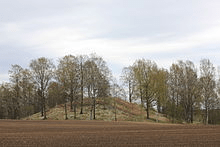
Elves were associated with burial mounds (also known as barrows) as it was believed that they lived in or around them, and more than this, elves were associated with the souls of the dead, rather than fairies in the other sense of the word, as a supernatural entity that was never human.
Rakni’s burial mound, Noway, Public Domain
It is the largest burial mound in Scandinavia, 77 metres in diameter and over 15 metres in height. There are a number of stories associated with it, one associated with a roving sea-King Raki or Ragnar. Skull fragments were found inside it, of a man aged between 20 and 25 but there were no grave goods. The mound has been dated to the sixth century to the time of the great migration after the collapse of the Roman Empire.
It is possible that this chieftain was an ancestor of Rollo, the Norse ancestor of William the Conqueror.
Like the modern Halloween, Álfablót originally marked the general end of autumn, although it may technically be celebrated on any day around this time. However in recent years, it has been predominantly practiced on or close to 31st October (Halloween/Samhain).
Traditionally, Álfablót almost certainly involved an animal sacrifice, (blood) Records suggest this may even have been a (highly valuable) bull. It was intended as a sacrifice to the elves, asking for protection from the ancestors. Connected with this, the elves were also associated with fertility.
A chief difference here is, unlike Halloween/Samhain, Álfablót was not a community celebration. It was a private ritual performed at the homesteads. Strangers were not permitted to take part or even watch.
Old Norse Runes
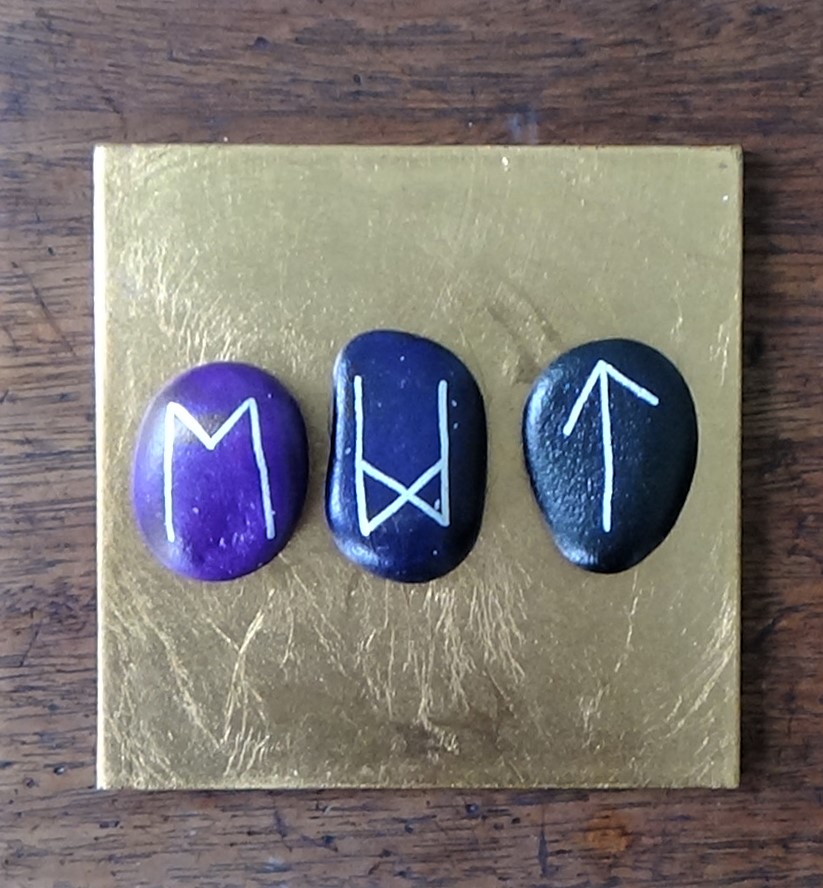
What runes do we drawn this Halloween Álfablót 2022?
Ehwaz The Horse transport, journey progress
Mannaz Merkstave Communication difficulties, trouble with fellow man
Tiwaz Justice, Law and War (spear)
The message is not a cheerful one, I am sorry to say, but it will easily be understood why not in the context of the war in Ukraine and a lot more besides.
One might reasonably say, but the dead do us no harm? It is the living we need to watch for. Well, that depends upon their legacy, and the memories they leave behind. Jewish graves read ‘may their memory be a blessing.’
The rune of mankind has been drawn merkstave. This advice is a downer. In these days of travelling far afield almost at the drop of a hat, don’t be too quick at this time to get on your ‘horse’ and ride off to the lands of ‘strangers’.
Don’t be too quick to share your opinions with your neighbour, or all and sundry.
You do not know what they may be struggling with when you enter their space. Beware of the horses coming to your door carrying strangers. Some will come as friends, and honour us with their arrival. But not every stranger comes as a friend. The history books warn, it is a friendly fool that can’t tell friend from foe.
Why do you travel? What do you bring to the places you visit, for the sustenance of the people who live there?
Who is this that is coming now? Why do they come? What do they seek? What do they offer? Is it a fair just and lawful exchange? Or is this a hunting trip? What is the prey? What is the prize?
This grim counsel goes against our powerful instinct of hospitality and kindness to strangers. But that bottom line was always there, and the runes are reminding us.
The Viking raid on Lindisfarne in 793 sent a shock wave through Europe. But this was just the start of something bigger. What was driving it? In part, changes to the laws of inheritance in Scandinavia, younger sons, now dispossessed of family farms, had to go in search of their own fortunes.
So they did.
The Viking Raid on Lindisfarne
Another way of looking at these runes in terms of comment or advice about the cosmic weather right now, which is, beware of joining the crowd.
Beware of crowds. This, following the tragedy in Seoul where 150 or more people have died in a crush at a Halloween celebration. And the death toll is still rising, following the collapse of a bridge in India killing over 141 people who were celebrating Diwali, the festival of lights.
This also refers to getting into arguments on social media, and avoid gossip at this time. Stay clear of group-think.
The runes here are reflecting the fact that fiery Mars, planet of war, has just moved into the zodiac domain of Gemini, the sign of communications and siblings, and it will stay there, appparently moving backwards or retrograde, until 12 January 2023. There will be spectacular events. One can see how this combination may represent aeroplanes, missiles or indeed any kind of projectile. The threat of a nuclear attack is real, though I haven’t been shown that it will happen.
Contagion travels by the same token, suggesting an inevitable rise of flu and covid cases starting now, at least in the northern hemisphere.
There are many kinds of ghosts. There are the whirling leaves that used to be buds. There are the echoes of the distant past. There are the ghosts of our hopes, not all of which can ever be realized, the grief, the fears and memories of the living.
But Jupiter is returning to Pisces and this brings a promise of good cheer. Even in desperate times we see a Ukrainian soldier rescuing a hamster in a cage, the hamster obliviously running in its wheel. The soldier places it in the back of the truck, returns for two rabbits.
In such moments rests the hope for humanity.
Death is the theme for the season- and this is an unusually tricky Halloween season, caught between the partial solar in Scorpio on 25 October, and the upcoming Lunar eclipse in Taurus on 8 November.
A friend came to stay recently and brought a present for my birthday. We thought it might be fun for me to try and guess what was inside the packaging using my pendulum and cards. It was roughly cylindrical, not too heavy, rolled in bubble wrap and brown paper.
I held my pendulum over it.
‘Are the contents of this package edible?’ The pendulum span anticlockwise. No.(sob)
‘Are the contents of this package paper?’ No. ‘Ceramic?’ No.’ Wood?’ Yes.
I drew the Three of Pentacles, a card signifying progress in business and pride in one’s work, and from The Gilded Tarot by kind permission of Ciro Marchetti.
‘Is it a craft item? I asked my friend.
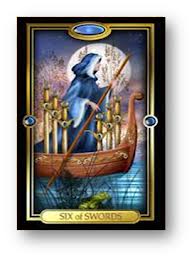
‘Yes.’ she said, smiling from ear to ear, as ducks suddenly quacked outside on the pond and Il Matrimonio ran to the balcony to see there if there was a fox. There sometimes is. Then I drew the Six of Swords, a card of personal progress, solemn journeys and quests for learning.
Was it something to do with a river or riverbank, I wondered. Was it a little wooden boat? Or a frog? I like frogs.
‘No’. My friend said, smiling, ‘But you are warm. Now open it!
And inside it was – this! A wooden Indian Runner Duck. What a little character.
🙂
Well, I never. No wonder she’d been laughing to herself every time we’d fed the ducks, knowing what she had in store to give me.
Now, that is what I call a friend. And psychically, here was that darn Jungian synchronicity thing at work again.
Good try, Tarot my friend. Not a bull’s eye this time, but a respectable attempt, and this often is how Tarot works in a reading, too, regardless of the classical card meanings, sparking ideas directly off the imagery.
This is how, while Tarot presents a great academic study, anyone can read it, who likes to use associative thinking.




















 True Tarot Tales