


20 February 2023 the sun re-enters the zodiac territory of Pisces the Fishes until 20 March 2023, the date of spring equinox when we will move into the mythical sky territory of Aries the Ram.
‘Pisces’ is from the Latin plural for fish, and the zodiac sign is named after one of the largest constellations in the zodiac. The two fish are said to represent Venus and Cupid in Greco-Roman mythology after they turned themselves into fish to escape a terrible monster, a Titan called Typhon who was later imprisoned by Zeus, tricked and trapped under Mt Etna where he still roars to this day, seeking to escape.
The twin fishes of Pisces are often depicted as koi carp.

Pisces symbolizes the concept of The Flood. This time of year marked the rainy season in Mesopotamia -where western astrology originated.
This is also the time of the winter flood melt, when mountain streams swell the rivers and will sometimes flood the valleys below. This is the time of year for the earliest spawning of fresh water fish.
The spring equinox now occurs during the zodiac month of Pisces when the sun passes across the ecliptic, crossing the imaginary line of the cord joining the two fishes. This year, 2022, the spring equinox will occur on Sunday 20 March.
Once upon a time the equinox occurred during the time allotted to the zodiac timing of Aries, the first sign of the western zodiac, but this has changed over time owing to the wobble of the Earth; an effect known as the precession of the equinoxes.

Pisces is the 14th largest constellation overall covering a large V-shaped region of the northern hemisphere. While it is large, its stars are faint — none brighter than fourth magnitude — making it hard to see with the naked eye.
Pisces is seen as two fish swimming at right angles to each other, one to the north and one to the west, attached to one another by a cord of stars, just as life and death, and winter and spring are conjoined and cannot be separated.
Pisces is the twelfth and final sign of the zodiac year, and rules the twelfth house in a personal horoscope, representing hopes, dreams and fears- what lies beneath. It stands for the mystery of the unknowable. It operates outwith the boundaries. This is its power, its magic and its danger, in the meaning of the spaces between reality and illusion.

Planetary aspects: Jupiter and Neptune
Pisces is the constellation associated with watery Neptune in Modern astrology but this planet was not discovered until 1846, and optimistic Jupiter is the original ruler of Pisces in traditional (Hellenistic) astrology. Astrologers vary in respect of which of these rulers they use in their own work.
The Pisces Archetype

The zodiac signs represent archetypes, meaning something that is considered to be a perfect or typical example of a particular kind of person or thing.
The zodiac signs paint a portrait of a person born at a particular time of year, in a particular season. A baby born in summer arrives into a different physical environment from a winter baby; with differences of temperature, hours of daylight, maternal diet during pregnancy and so on, with potentially different effects on the baby’s physical makeup and constitution.
The major arcana Tarot card for Pisces is The Moon, The Moon: ebb and flow, cyclical shifts, intuition, dreams, visionary capabilities, fertility, difficulties with travel, uncertainties, shadow boxing, wild creatures, instinct v civilisation, genius, delusion, visions, and ghosts.
The full moon is a hunter’s moon. The crab, sometimes shown as a crayfish, lives between the sea and the land.
Pisces rules the liminal spaces.

The court card of Pisces is the Knight of Cups, signifying an offer, an invitation, a proposal, a welcome message, a bringer of good news, an admirer, lover, chivalry, a Sir Galahad, good health, a healing cup, loving cup.

Pisces is a mutable sign, marking the end of a season. The other mutable signs are Gemini and Sagittarius. Pisces marks the end of winter leading up to the spring/vernal equinox. Of all the zodiac signs, the mutable signs are traditionally considered as the most flexible and adaptable, the ones most at ease with endings and transitions and change.
Pisces is not only the last sign of winter as we are moving into spring; it is the last sign of the zodiac year, the culmination of all the signs that came before it. Pisces rules the feet and symbolically Pisces has one foot- in the death of the old year, and one foot in the new life of springtime.
Saturn transits into Pisces 7 March 2023 where it will stay for two and a half years. This planetary transit, for many of us, will feel like the end of an era.
I am writing this by the telephone, keeping vigil for my mother, a true Capricorn native ruled by Saturn, as disciplined and dutiful as she is brave and beautiful, with a keen intellect, and a wit that can bite but that is equally playful at times, even childlike. She is very poorly indeed at this time of writing, and is being treated in hospital for pneumonia and a suspected heart attack.

Pisces is famous for its emotional depths and visionary capabilities; sensitive, intuitive, psychic, artistically gifted but also competent or capable of scientific or technical brilliance.
But of course there is no such thing in reality as THE Pisces personality. You are a unique individual. Your zodiac sign (sun sign) is a major keynote, but it is nothing like the full picture in real life – or in astrology. There are many other factors in play, your rising sign, your Moon sign; the planets in your houses, your decan and the degree of the actual day you were born.
If you don’t feel like a ‘typical’ Pisces, perhaps you are a second or third decan Pisces, rather than a ‘most typical’ first decan Pisces.
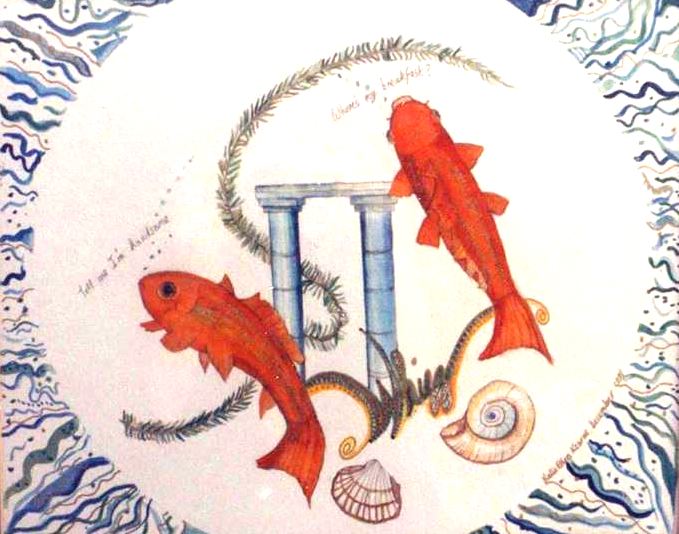
Many years ago I painted this portrait of my parent’s venerable goldfish, Whizz. One of my sisters won him at a fair and that’s how he came to live with us. Perhaps not the greatest start for him, but he lived to be seventeen! One fish, two portraits in one in pen and watercolour.
What are the decans?
The decans (or decanates) are a way of marking time, breaking down each of the zodiac signs into three shorter blocks of roughly ten days each.
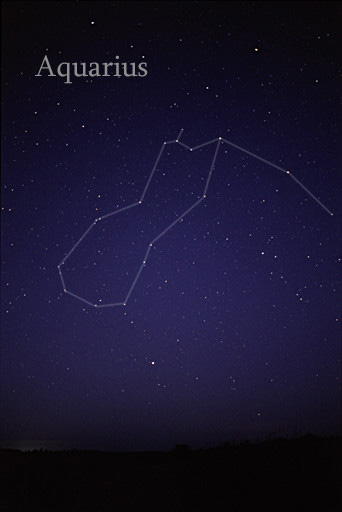
The Zodiac is a belt of sky we see from earth, tracking the path of the sun across the sky over the course of the year. We call this pathway of the sun ‘the ecliptic,’ The Greeks named the signs after twelve of the constellations appearing on, or crossing this zodiac belt: Aries, Taurus, Gemini Cancer, Leo, Virgo, Libra, Scorpio, Sagittarius, Capricorn, Aquarius, and lastly, Pisces.
Each of these designated zodiac signs represents a 30 degree section of the zodiac belt. Each sign is then further sub-divided into three blocks of ten degrees, each about ten days in length, with slight variations. This gives us the ‘decans,’ from the Latin meaning ‘ten,’ or they may also be called decanates.
The decans are known as the ‘thirty-six faces of astrology’, adding extra depth and nuance to the stories of the signs of the zodiac, distinguishing between someone born at the start of their zodiac month from someone who is born during the middle or at the end of the zodiac month.
First Decan
Pisces- Pisces
Dates: 19 Feb-29 Feb
Planetary rulers: Traditional: Jupiter/ Modern: Neptune
Tarot card: Eight of Cups
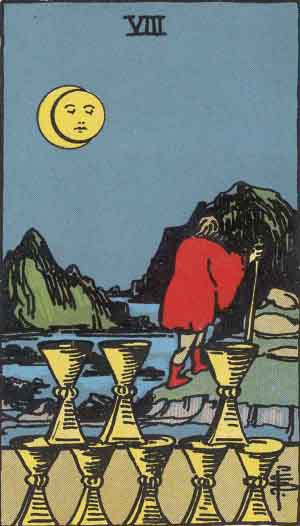
Card meanings: Moving on, cutting ones losses, leaving something behind, disillusionment, regret.
The first decan of any sign is considered the most typical. Pisces makes for versatility and adaptability, while Neptune presents a soft or gentle manner or appearance. This Pisces is only rarely aggressive or confrontational.
But there is a sense of a push and pull going on here. Jupiter means they think big and step forward. Neptune means they swim round in circles or hide in the weeds. Neptune, planet of illusion, is their sub-ruler, which emphasize creativity and imagination. This Pisces native connects with other people on an unconscious level, almost hearing what they are thinking. Maybe they haven’t noticed this about themselves yet, or take telepathy for granted, but watch out for the signs.
This Pisces 1st decan double style has a tendency to go on a lot of detours before arriving at their final destination. While quiet, this Pisces has deep passions and their love life can be tempestuous. Their ideal partner is lively and communicative with a can-do approach.
They often look younger than their age, but they need to be especially beware unhealthy habits in order to protect their health; mood, and the chest, lungs and feet in particular. Pisces is extra-sensitive to the effects of overindulgence of alcohol or mind altering drugs.
A desire to do good for mankind is characteristic of the kindly first decan Pisces.
Second Decan
Pisces-Cancer
Dates: 1 -10 March (approx.)
Planetary rulers: Jupiter
Tarot card: Nine of Cups

Card Meanings: dreams come true, wishes granted, food and drink, the hospitality industry, overdoing things
The sub-influences for this decan are Cancer, ruled by The Moon. Cancer is the natural ruler of the fourth house of home, family and security. These Pisces subjects typically stay very close to birth family members. Pisces may struggle to loosen break parental ties and become independent, but must do so if they want to progress and develop and become the adult in the room, to provide for and parent their own children, building their own family unit.
These are the most elusive most watery of the fishes. Now you see them, now you don’t. Their zone of the sky from March 1 –10 houses the stars of the water of Aquarius, and Eridanus the river and the west fish of Pisces.
These Pisceans are masters of disguise and can blend into any environment effortlessly. Pisces decan 2 absorbs. It is sensitive and psychic, but for the same reason these people need to choose their company with care, and form healthy habits early on in life. These subjects are supremely susceptible to the influence of others in their environment, and this can work positively or negatively.
Third Decan
Pisces- Scorpio
Dates: 11 March-20 March
Planetary ruler: Mars
Tarot card– Ten of Cups
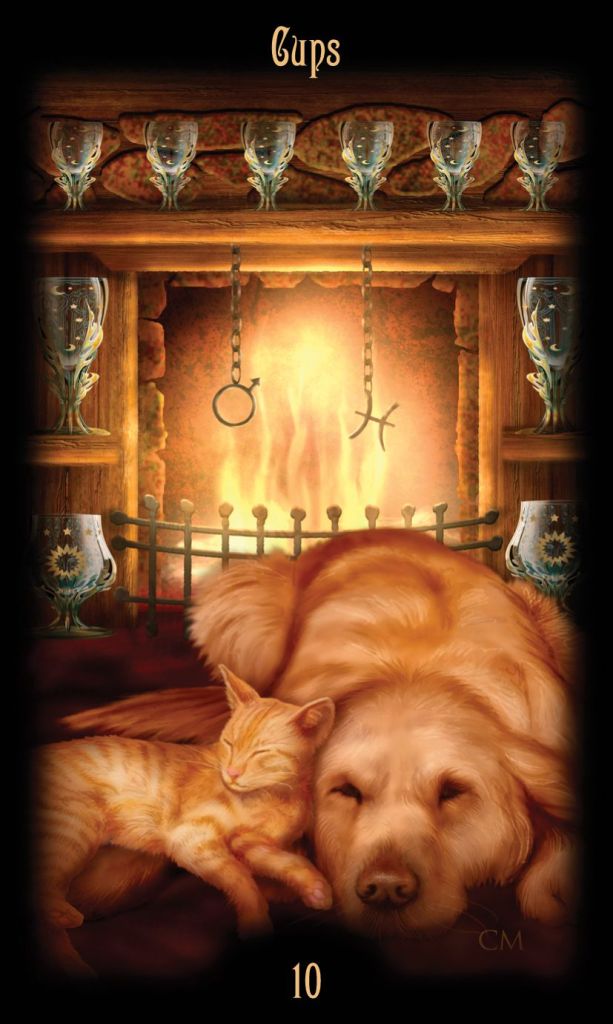
Card Meanings: contentment, completion, arrival, family life, a happy home
The sub-influences for this decan are Scorpio and its rulers, traditional Mars or modern Pluto.
Energetic Mars and Scorpio – natural ruler of the eighth house of desire, willpower, drive and determination – brings to this Pisces extra charisma, and the drive and determination to push forward where Pisces otherwise can tend to hold back, lacking that forcefulness. This Pisces has the artistic creativity of Pisces/Neptune; but has that extra sticking power to turn dreams into realities.
Pluto brings depth and Mars brings speed and energy of attack. This Pisces needs to stay busy, and needs plenty of energy outlets.
Pisces marks the completion of the zodiac wheel and this final decan marks, the point at which we move into Aries and a whole new circle starts over again. Aries too, is also ruled by energetic Mars.
These Pisces natives, just like the other decans, are enormously receptive to their environment, but they tend to stay more aloof and watchful and are less likely to blend in or fall under the influence of what is going on around them. They are highly observant, natural detectives, well suited to police or other kinds of investigative work. Pisces-Scorpio is an excellent listener, tuning in the wants and needs of others, listening between the lines to what is not being said.
The Cusps of Pisces
Aquarius-Pisces: February 15-21
Aquarius-Pisces: This is a Pisces native with Aquarius tendencies; a person of high principles, often rather quiet, refined, and with strong likes and dislikes. This Pisces is likely to travel a fair bit and has executive ability and can make money, but can become bored quite easily and needs to be extra careful not to get trapped, becoming committed too soon in a relationship that really doesn’t suit them
Pisces-Aries: March 17-23
Born on the Pisces-Aries cusp, this native is especially instinctive and brave. This mix of energy combines physical and moral courage with compassion for others which can make this Pisces individual a successful leader. This person is loyal to friends and colleagues and they are also generous, and eager to see others do well.
Famous Pisces
Michelangelo, Copernicus, George 111, Albert Einstein, Neville Chamberlain, Sidney Poitier, Elizabeth Taylor, Yuri Gagarin, Michael Gorbachev, Osama Bin Laden, Steve Irwin, Steve Jobs…For more see HERE
Back soon 🙂






















 True Tarot Tales