February, the Fae and the Fires of Imbolc

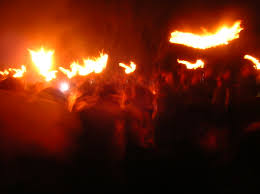
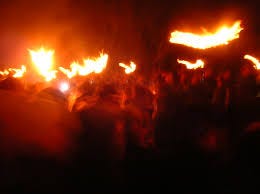
The first of February marks the mid-point between the winter solstice and the spring equinox. It’s also known as Candlemas, the Christian festival of presenting Jesus at the temple. But long before Christianity, this time of year marked a more ancient celebration in Gaelic Britain: the rites of spring, and the fire festival of Imbolc.

Let’s get with the programme, Imbolc style, and parade down the street, and go pray for the health of the fields! It’s all about the soil. Modern soil scientists will agree.

February

The name February comes from the Latin ‘Februarius,’ referring to Februa; a Roman festival of ritual purification. Below, the Roman spa at Bath, UK.
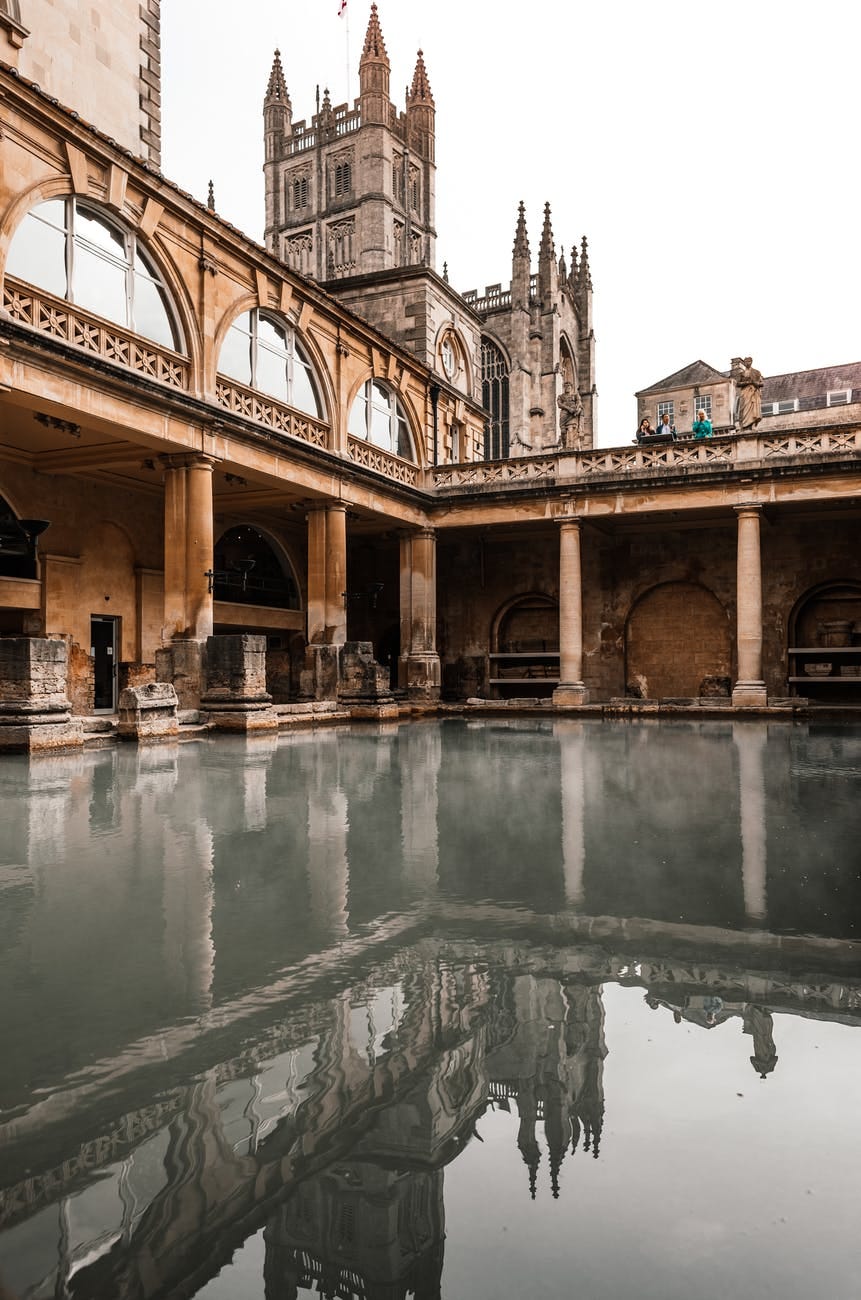
Photo by Rachel Claire on Pexels.com

Two new months of January and February were added to the older Julian calendar in the 700’s BCE to create the new Gregorian calendar, matching it up more closely with the actual length of the Earth’s journey round the sun.

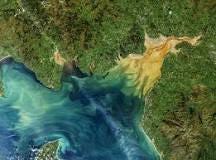
But the Anglo Saxons called February Sōlmōnath, from sōl , the Old English word for wet sand or mud, alluding to the weather this time of year, and the effects of rain and snow-melt. The romantic Solway Firth between North West England and South West Scotland is actually the massive tidal ‘Mud Way’ rather than the romantic ‘Sun Way.’
The northern English scholar monk , saint Bede, wrote that February was celebrated as “the month of cakes,” when ritual offerings of savory cakes and loaves of bread were made to ensure a good year’s harvest.

Imbolc

The fire festival of Imbolc and Brigid began as a neolithic festival marking the 1/2 way point between the winter solstice (Yule) and the spring equinox (Beltane.)

Imbolc marks the start of spring, celebrating the arrival of the goddess deity Brigid, “The Exalted One,” the harbinger of the first lambs, so vital to the survival of those early communities. The deity Brigid later became conflated with the Christian figure of Saint Brigid of Kildare.
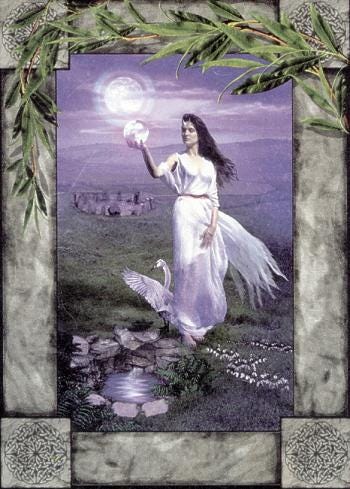
Brigid From The Sacred Circle Tarot

‘Imbolc’ is thought to mean ‘in the belly,’ referring to the precious ewes in lamb. Soon it would -it will be- be the time of the first lambs, though the start of the lambing season can vary by up to two weeks in any given year.
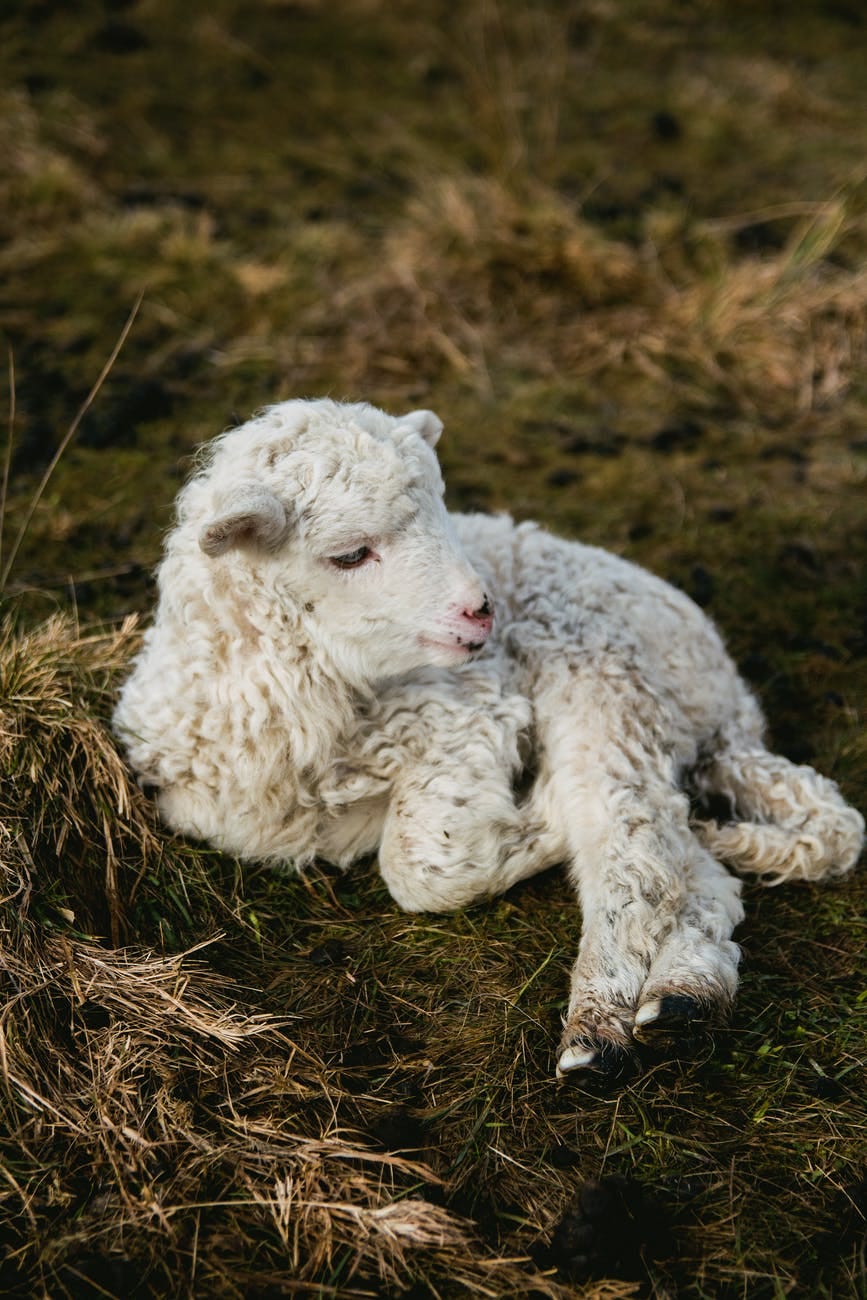
Photo by Paul Seling on Pexels.com

Brigid was a protector of women in childbirth, as well as the safe birthing of precious livestock. She was not only a goddess of the Tuatha Dé Danann, The Tribe of the Gods, but a triple goddess of healers, poets and smiths.
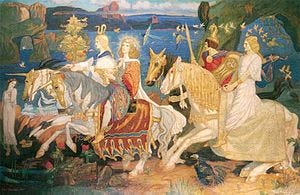
Via Wiki Riders of the Sidhe, the Tuatha de Dannan

The Tuatha de Danaan, the people of the (mother) goddess Danu in Celtic mythology; a race inhabiting Ireland before the arrival of the Milesians (the ancestors of the modern Irish). They were said to have been skilled in magic, and the earliest reference to them relates that, after they were banished from heaven because of their knowledge, they descended on Ireland in a cloud of mist. They were thought to have disappeared into the hills when overcome by the Milesians. The Leabhar Gabhála (Book of Invasions), a fictitious history of Ireland from the earliest times, treats them as actual people, and they were so regarded by native historians up to the 17th century. In popular legend they have become associated with the numerous fairies still supposed to inhabit the Irish landscape.”

From The Encylopedia Britannica

Brigid might visit one’s home at Imbolc. People would make a bed for her, and leave food and drink and items of clothing outside in the hope of receiving her blessings, petitioning her to protect their homes and livestock.

This was a time for feasting and visits to sacred wells, and a time for ritual divination. A St Brigid’s cross is made from rushes and was placed in doorways to protect the home from harm, representing the wheel of the seasons.
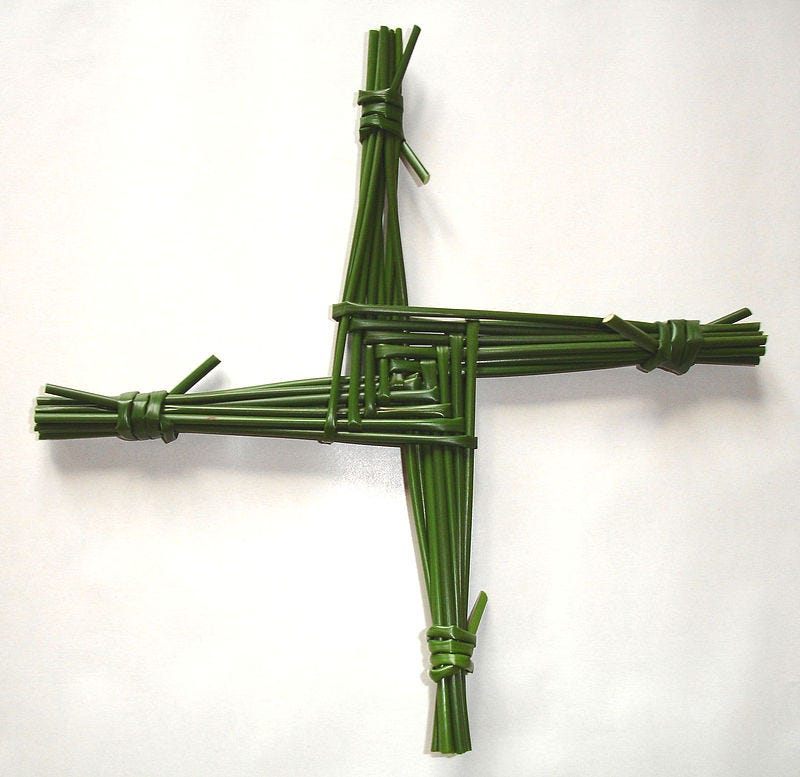
By Culnacreann – Own work, CC BY 3.0, https://commons.wikimedia.org/w/index.php?curid=3500722

The Fire of Imbolc and the Fire Rune INGWAZ

Fire and Spring is not gentle. New life is not gentle. It rises up fast and fierce. It has to, or it would never break through. Spring is fierce in its quickening of new shoots. It is initiation. Spring is fire, just as Aries the Ram of the zodiac is a cardinal fire sign, though we do not enter Aries until late March.

Where Brigid represented an essentially feminine energy, the old Norse rune ING/INWAZ or INGUZ is a fire sign rune, associated with male fertility, vitality and recovery from sickness. You can read more about runes here in a previous blog post on my website, True Tarot Tales.

This ancient masculine fire rune represents the power and potential of “The Seed” matched with action. Literally, the name of this rune means “the seed of the god Ing.” When we say we are do-ing, writ-ing …anything at all with -ing at the end of it, we are describing an action, and indirectly, invoking the magical energy of Ingwaz.

The people would light bonfires on the hilltops by night, and by day, they might run cattle through the smoke of lower lying bonfires, asking divine protection for the livestock.

The Cailleach

Imbolc was a key moment in weather forecasting. This was the time when The Cailleach —the divine  crone of Gaelic tradition—gathered firewood for the rest of the winter. If the Cailleach knew the winter was going to last a good while longer, she’d make sure of good weather during Imbolc and would use it to gather more firewood to top up her stores.

Bad weather at Imbolc was regarded as great news. It meant the Cailleach wasn’t worried about running out of firewood. She had turned over and gone back to sleep, and the worst of winter was almost over. We shall see. It has been cold and clear and glorious today where I live on the NW coast of England.
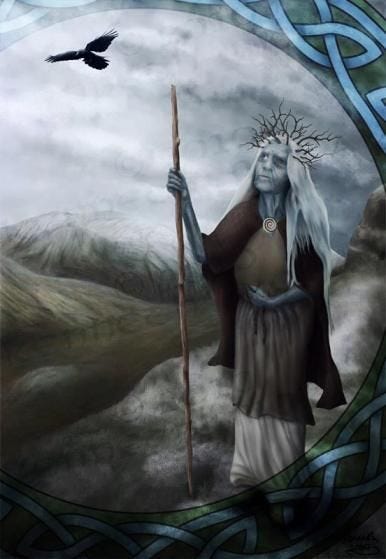
Via Pinterest

I am somewhat mixing up cultures, systems and traditions here, but Nature is the common ground and I make no apology for it. Imbolc falls in the second decan of the fixed Air sign of Aquarius. The fixed signs denote the height of a season. The second decan of Aquarius marks the height of winter, at least symbolically speaking, in the northern hemisphere and now the snowdrops are here.

white flowers on brown dried leaves

The Six of Swords in the Tarot deck is a card of recovery and onward progress. This can be read in terms of the natural seasons as the thawing, the passing of winter’s peak point, and now we are steering into spring.
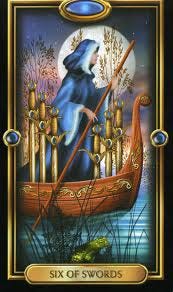
The Gilded Tarot

See the toad in the rushes? The frogs and fishes are, right now, undergoing a alchemy of profound physiological changes, getting ready to spawn.

The light is coming back again, galloping faster it seems, by the day. Dark sacred night’…yes, and the night is dark. It is sacred. It brings rest and healing. But when the dark goes on too long, we start fighting back with the Promethean gift of fire and action.

We are HERE. And we overcame such odds just to be here, to get born as US and not someone else. Science suggests the statistical odds against you and me getting born as us and not someone else were 1 in 400 trillion. Yet here we are. Somehow WE burst through.

We must have had the need. We must have had our reasons. Mighty powerful ones.

Back soon.

Thank you for reading.

Bringing in Beltane…Magical May Eve

Photo by Polina Kovaleva on Pexels.com

30 April is known as May Eve, marking May Day and the beginning of the ancient Celt festival of Beltane.

Beltane begins at dusk on 30 April and is matched by its European counterpart, Walpurgis Nacht, or St Walpurga’s Night in Germanic tradition.

St Walpurga or Walburge was born in Crediton in Devon, but travelled widely as a missionary in the service of her uncle St Boniface, and eventually became abbess of a monastery in Heidenheim in modern Bavaria where she died 25 February 777 or 779. She was canonized 1 May 870.

Walpurga is reputed to protect sailors in storms at sea, reputedly thanks to a miracle when she was sailing to Germany and a terrible storm broke out, and she knelt on deck and prayed and the storm cleared as if by magic…

And yet, interestingly, Walpurga is also a protector against witchcraft. Curious, isn’t it. That someone’s holy prayer is someone else’s satanic spell or witch’s invocation.

Origins

Two great festivals in northern Europe long pre-dating Christianity were Samhain (Halloween) marking the start of winter, and Beltane (April 30/May 1) marking the start of summer.

Beltane ‘the fires of Bel’ began as an ancient fire festival celebrated since at least the Dark Ages if not long before. The celebrations began at dusk on April 30th when great bonfires were lit to welcome the height of spring now associated with the zodiac sign of Taurus the Bull, representing the fertility of spring in full bloom.”

Traditionally,” writes Glennie Kindred (in Sacred Celebrations), “all fires in the community were put out and a special fire was kindled for Beltane. This was the ‘balefire’ or the Teineigen, the ‘need fire.’

Bel or Belenus (Celtic: possibly, Bright One) was a deity associated with pastures, meadows and animal husbandry and other agriculture. He was a fire god rather than a sun god as such, though the sun was used as a common motif in religious imagery.

The cattle were walked between two bonfires in a symbolical purification ritual, to be protected by the smoke from Bel’s fire before being put out to the open pastures for the summer.  Bonfires were lit on sacred hills too, and the smoke was considered a magical blessing on the fields, animals, and community, and was also supposed to maintain a fragile balance, keeping up a smokescreen, literally, between the human and faery realms.

The month of May got its name from Maia, also called Flora, the Greek goddess of spring and new abundance. Maia was the oldest of the seven sisters known as the Pleiades, and she was the mother of Hermes (Mercury.) The last zodiac sign of Spring, Gemini, is ruled by airy Mercury, as the air fills with butterflies and pollen.

Flora, or Maia by Botticelli

The name ‘May’ has been used in English since about 1430. Before this time the name of this month was spelled Maius or Mai. The Anglo- Saxons called it Tri-Milchus because all that lush new grass meant cows could now be milked three times a day.

The celebration of May Day has its roots in astronomy, celebrating the halfway point between the spring equinox and the summer solstice. It has been celebrated in the British Isles and through much of Europe as a fertility festival since the Dark Ages, and probably before that, with many stories and superstitions attached.

Superstitions

Like Halloween, May Eve and May Day is a magical time of year, liminal, when the veil between different worlds and realities is thinner than at other times of year.

Beltane or Walpurgisnacht is the mirror image, the spring season’s equivalent of Halloween when witches are said to dance at the Devil’s Sabbath.

This is a time for ghosts, but this is also the time of year when folklore suggests you are most likely to meet a supernatural being from the realm of ‘faery.’

Photo by Ellie Burgin on Pexels.com

The Fae are an ancient race, and they do not like humans whom they view as destructive, and who is to say they do not have a fair point there. The Fae are afraid of iron. To keep them at bay-

Touch wood no good

Touch iron, this you can rely on…

In this sense the Fae could be said to represent the spirit of humanity before the Iron Age.

They are not the cute creatures of fairy tale. Encounters are dangerous and are best avoided – or you may never be seen again. Do not, whatever you do, go to sleep on a fairy hill at any time, but especially not on May Eve or May Day and especially beware of going to sleep under flowering hawthorn bushes ….

Sex and Scandal

The Christian church made attempts to ban May Day festivities outright because of their overtly pagan nature and “lewd” context as an open celebration of male and female sexuality and fertility – ‘a heathenish vanity generally abused to superstition and wickedness.’ 

May Day meant drinking and fighting, another reason for the church’s disapproval, but this in itself harks back to the ancient traditions of the sacrifice of ‘The Green Man’ – a mythical figure representing the eternal battle waged between summer and winter, feast and famine. Many pubs in England are still named The Green Man.

In Padstow, Minehead and some other places in the UK, mischievous hobby-horses (‘osses) roamed the streets in search of unsuspecting young ladies to ‘carry away’ for undisclosed purposes.

Morris dancers up to no good riding with hobbyhorses, Richmond embankment,1620

Men who had been disappointed in love would make straw men representing their rivals and stick them on bushes. These depictions were needless to say, often deeply unflattering, and fighting might well follow once they were discovered and identified and the maker was known.

May Day harks back to the ancient traditions of the sacrifice of ‘The Green Man’ – a mythical figure representing the eternal battle waged between summer and winter, feast and famine. Many pubs in England are still named The Green Man.

This splendid depiction is on a boss in Rochester Cathedral, thanks to Wikimedia Commons.

The Puritans banned May Day under Oliver Cromwell but Charles 11 brought it back into custom after the Restoration.

Maypole Dancing goes back at least to the 14th century, but it seems the custom was very old even then, though the dance as we know it today, so pretty and decorative(and tame) -children dancing in village squares, is probably a Victorian invention . The maypole is generally assumed to be a phallic symbol, but the Norse peoples connected it with tree worship, and this connects British and Germanic tradition going back to a shared proto-germanic culture which is part of the common root culture in British life even today.

The Maypole dancing which so upset the Church and the Puritans comes down to us from the rites of spring dedicated to Freya.

The maypole originally represented a living tree, in particular the giant ash tree Yggdrasil, the great “world tree” of Norse myth, linking the nine worlds of the Norse cosmology including Asgard, land of the gods, Midgard, or Earth and Hel, the underworld.

“Ygg” means terrible. It was on this tree that Odin chose to hang nine days and nights, thirsty and fasting in exchange for the knowledge of the runes. The Norns sit beneath it and when every new person is born, carves their names into its bark…and with it, their destiny, although this can change. The Norns will allow us to rewrite it, unlike the destinies woven by the three Fates of Greek mythology.

Walpurgis Night

Also In the Germanic tradition, Walpurgis Night, on April 30th is a moon festival sacred to the goddess Freya.

“Walpurga” is another one of Freya’s names. The re-dedication of the holiday to “St. Walpurga” was a later Christian addition.

Freya (Old Norse, Freyja meaning “Lady”) is one of the pre-eminent goddesses in Norse mythology. She was the goddess of love and beauty in Norse mythology, the goddess of marriage and family and a great prophetess – a seeress. She taught her husband Odin how to read the runes, and like Odin, she had a fiercer aspect as a patron deity of war and death in battle.

Freya wears a cloak of falcon feathers and has a magical gold necklace called Brísingamen. She rides in a chariot pulled by two cats and a sacred boar called Hildisvíni runs alongside, though he is not shown in this picture.

The cats, it has been speculated, were two male kittens found by Thor. They had been abandoned by their mother and he took them to Freya. What kind of cats? I’d have thought Norwegian Forest cats, but legend suggests the kittens were grey-blue and on that basis it’s speculated they were Russian Blues.

Bringing in the May

I washed my face in water

That had neither rained nor run

And then I dried it on a towel

That was never woven or spun

  • The rhyme suggests we go out barefoot very early on May morning and wash our faces in all that magical dew (or late snow) Your complexion will instantly improve.  Let the wind and sunshine dry our faces and we’ll have good luck all year.
  • Bringing in ‘the may’ means gathering cuttings of flowering trees for magical protection of the home. Bring in branches of forsythia, magnolia, lilac, or other flowering branches. Decorate the doorway to keep away unfriendly fae and other spirits
  • Make garlands or decorate a basket or a ‘May bush’ with flowers and coloured ribbons. This would often be a hawthorn bush but it doesn’t have to be.
  • If you need to move a bee hive, May 1 is a traditional day for doing it, hopefully clement for the bees.
  • Turnips are traditionally planted on May 1. Plant now for lovely mashed turnip later. What are you waiting for?
  • Fishermen expect to get lucky with catch on May Day.
  • It’s a powerful day for spell-casting…any spells to do with bringing in health, wealth, and abundance. Light a red or pink candle for love or passion…but be careful what you wish for, and it is unlucky to try and take what is not rightfully available to you.
  • Traditionally it is unlucky to get married in May. ‘Marry in May, regret it for aye.’ But not to panic if you’ve got the date already booked. The writer of this article was born on May Eve and got married in May – 30 years ago this year- and like all of us, has had mixed luck in life. But so far at least is still married.

This Beltane, Venus has moved into her astrological home turf of Taurus. Good for money, the Stock Exchange. Good for all things green and growing. Good for glamour…an old term for magic. Venus will stay here for almost a month. And Mars moves into its home sign of Aries on 30 April. Pow. Action time. Vim and vigour.

This Walpurgis baby turns 61 on 30 April. Vim and vigour, not feeling it so much, but we shall see…..I may report back.

Wishing you the best of Beltane 2024

Until next time 🙂

Rex Factor

Reviewing all the Kings and Queens of England & Scotland

The World's Passenger Ships

Ship History site, a compendium of passenger ships 1858- today's new builds

Capricorn Astrology Research

Research into Astrology

WAR STORIES

WWII & its Aftermath - Jennie Mack Gray

Quintus Curtius

Fortress Of The Mind

Jessica Davidson

Astrologer ~ Mystic ~ Writer

Mythology Matters

Matters of Myth, and Why Myth Matters

The Sanctuary of Vindos

Brythonic Polytheism and Shamanism